
College Life and Learning Executive Summary - Spring 2023
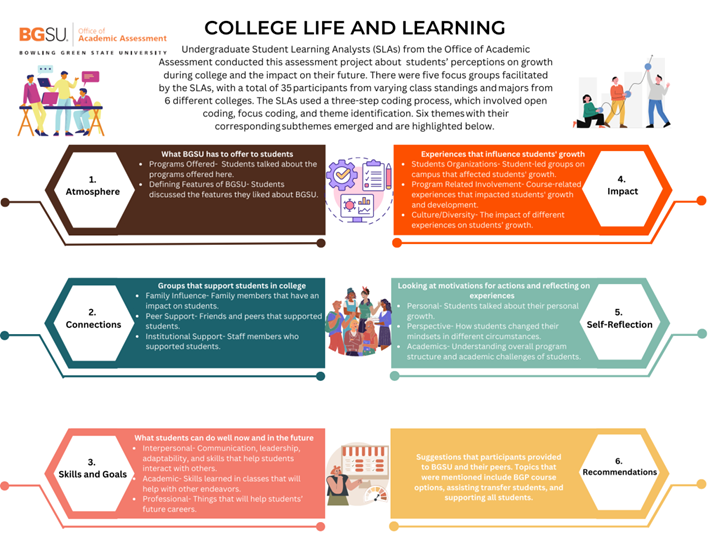
Bowling Green State University (BGSU) undergraduate Student Learning Analysts (SLAs) from the Office of Academic Assessment conducted this assessment project. The SLAs designed a focus group protocol to gain knowledge about students’ perceptions of growth during college and the potential impact of college on their future. The SLAs facilitated five virtual focus groups with 35 participants from varying class standings and majors from six colleges. Out of the 35 participants, 71.43% identified as female (n=25), 22.86% identified as male (n=8), 2.86% identified as non-binary (n=1), and 2.86% preferred not to state their identity (n=1). From the race/ethnicity information participants provided, 71.43% self-reported their race/ethnicity as White (n=25), 14.29% as Black/African American (n=5), 5.71% as Asian (n=2), 2.86% as White-Iranian American (n=1), 2.86% as White-Asian (n=1) and 2.86% as Not-specified (n=1). Zoom was used as the online meeting platform, and the focus groups were recorded. These recordings were then transcribed and analyzed. The SLAs used a three-step coding process, which involved open coding, focus coding, and theme identification. Six themes with their corresponding subthemes emerged throughout these discussions and are highlighted below.
- Atmosphere –Students discussed what BGSU has and offers that initially made them choose it over other institutions.
- Programs Offered – Students talked about the quality of majors and the convenience of Firelands.
- Defining Features of BGSU – Participants mentioned features of BGSU, which included scholarships, campus size, location, and the town.
A participant mentioned how they came to BGSU because they felt comfortable in Bowling Green:
I came to BGSU because my hometown is a really small town, and BG made me feel comfortable. This campus isn't that big, and it just felt like home. (T3, L19-20)
- Connections – Students talked about groups who supported or motivated their college journeys.
- Family Influence – Family can affect the motivation, decision-making, and finances of students.
- Peer Support – Students talked about how their friends and classmates helped with motivation and emotional support.
- Institutional Support – Students discussed advisors, professors, and other staff members who supported them.
This individual commented on how they grew their overall connections:
Since coming to BG, I joined a lot of clubs in my major. And I joined a sorority when I first came in, so I feel like I just built connections with my professors in my department and other people on campus. (T3, L47-49)
- Skills and Goals – Students discussed what they can do well now and in the future.
- Interpersonal – Students talked about skills in communication, leadership, and adaptability.
- Academic – Participants considered skills learned in classes that will help with other endeavors.
- Professional – Students discussed things that will help with their future careers.
A student touched on the overall goal associated with going to college:
I think regardless of what career you're going into, a lot of professionals and people in the job force will be looking for people who have degrees. People who've spent time improving their skills in the craft before going into them. Of course, that depends on the job. But for most things, you would go to college… (T1, L273-276)
- Impact – Participants talked about the experiences that influence their growth.
- Student Organizations – These are student-led groups on campus that affected participants’ growth.
- Program-Related Involvement – These are courses and course-related experiences, such as internships and study abroad experiences, that impacted students’ growth and development.
- Culture/Diversity – Students discussed the way different experiences impacted their growth.
A student shared how the experiences gained from college impacted them compared to high school:
BGSU has really helped me learn how to stand on my own two feet as an adult. Even though I had some skills when I graduated high school, there were still a lot of things I had no idea about. But now I know how to, like, make professional resumes, how to apply for loans, [and] jobs... So, it helped me actually grow into an adult. (T4, L40-43)
- Self-Reflection – Participants looked at motivations for things and reflected on experiences.
- Personal – Students looked back at personal growth, such as mental health, confidence, independence, etc.
- Perspective - This is how participants changed or perceived their mindsets over time or in different circumstances.
- Academics – Students reflected on the overall program structure and academic challenges.
This participant talked about how college was able to change their general perspective:
I think my perception of myself has changed since starting college. I have a really bad habit of never giving myself credit. I always push myself to be the best I can be academically, professionally, [and] personally. I can achieve all these things, and, like, still it's never enough for me, and I never like to recognize my strengths... I think college has allowed me to be kinder to myself and recognize my capabilities, and, like, my strengths and my intelligence. I've really enjoyed that transition, and journey of self-love. (T4, L234-241)
- Recommendations – These are suggestions that participants provided to BGSU and their peers. Topics that were mentioned include BGP course options, assisting transfer students, and supporting all students.
A student suggested transfer schedule assistance:
Since I transferred, having a clearer and concise transfer schedule, like what classes would transfer over for me, would have been more beneficial. (T1, L358-359)
For more information about this assessment project, please contact Dr. Jessica M. Turos, Associate Director of the BGSU Office of Academic Assessment, at jmturos@bgsu.edu.
Infographic
Updated: 03/19/2026 05:59PM