
Academics During COVID-19 Executive Summary - Fall 2020
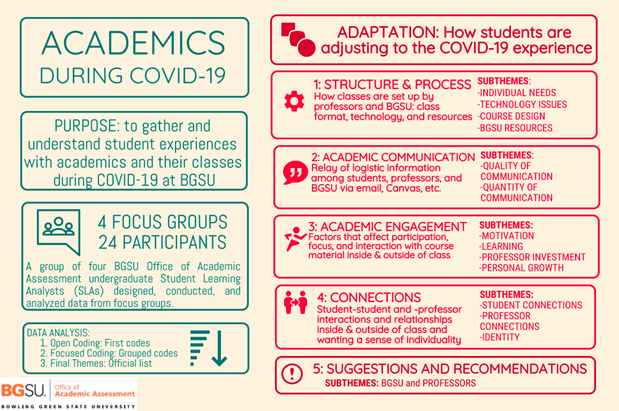
Four undergraduate Student Learning Analysts (SLAs) from the Bowling Green State University (BGSU) Office of Academic Assessment from a variety of majors conducted focus groups to gather information about and understand students’ experiences at BGSU in academics and their classes during COVID-19. The SLAs collaborated and developed questions and protocol, recruited participants, and facilitated four virtual focus groups via WebEx with a total of 24 participants. These focus groups were recorded in order to preserve data accuracy. Participant demographic data are as follows: 71% (n=17) self-identified as female, 29% (n=7) self-identified as male; 92% (n=22) identified as White, 4% (n=1) identified as Hispanic, and 4% (n=1) identified as multi-racial. Participants represented various colleges and majors. After the focus groups, the SLAs transcribed and coded recordings. The steps in the analysis process included: 1) open coding, 2) focused coding, and 3) identifying themes and subthemes. Students across the focus groups identified how they reacted to the broad impact of COVID-19 on their lives while talking about their academic experiences. Throughout the focus groups, students talked about an overarching theme of adaptation or the process of change to react to their learning environment at BGSU during the pandemic.
One student shared their struggle with adapting: … Last semester [spring 2020] was really awful. So, I was just like at least I'm going into this knowing it's online. But it's still been really hard just to, I guess, adapt, even though I have the experience from last semester. (T4, L47-49)
The overarching initial and continual adaptation to the academic environment shaped by COVID-19 is further reflected in the five themes with corresponding subthemes detailed below:
- Structure and Process: Students discussed how classes were set up in terms of class format, technology, and resources.
- Individual Needs: Participants noted student-specific factors, including format, GPA and grading requirements, COVID-19 restrictions, and learning challenges that affected their class experience.
- Technology Issues and Benefits: Students described how the impact of technology platforms, access, and support from faculty and services affected their class experience.
- Course Design: Participants talked about the way each class was set up and ran, including format, curriculum, schedule, timeframe, and workload.
- BGSU Resources: Students discussed what BGSU offered for support and student success; they talked about their awareness and/or understanding of resources.
A student shared how they thought the semester would be: I expected there to be a little bit more of, uh, uniformity between like, how professors set up classes. Um, like, whether it would be Zooms that I've seen, like, Top Hat, which is completely new to me. Just, I figured there'd be a more uniformity compared to last year and I still haven't seen that. (T4, L157-160)
- Academic Communication: Students discussed methods for the relay of logistic information between students and professors and between BGSU and students, including email and Canvas.
- Quality of Communication: Students noted the comprehensive and clear correspondence, or lack thereof, among professors, students, and BGSU.
- Quantity of Communication: Students talked about the amount and frequency of correspondence among professors, students, and BGSU.
Talking about communication with a professor, a student shared: Yeah, one good thing that some of my teachers have been doing to communicate is they’ll send out a weekly email like at the beginning of the week like on what you can expect so it’s just been one good thing that helps keep me kind of organized. (T1, L507-509)
- Academic Engagement: Students talked about factors that affected participation, focus, and interaction with course material inside and outside of class.
- Motivation: Students noted their desire and discipline, or lack thereof, to complete coursework.
- Learning: Students discussed factors such as detachment, organization, study spaces, and self-teaching that affected absorbing and retaining content.
- Professor Investment: Participants noted professor decisions that supported or hindered student success, including preparation, level of accessibility, technological literacy, strategies, and resources.
- Personal Growth: Participants talked about improvement in skills from previous semesters and personal development.
One participant noted a struggle with motivation: Yeah there is like no motivation when it comes to the online courses until there is something in the class that’s due...I just can't bring myself to do it...I think the online format is a little bit difficult to just get myself motivated to actually do the work. (T1, L233-238)
- Connections: Students talked about student-to-student and student-to-professor interactions, relationships inside and outside of class, and wanting a sense of individuality.
- Student Connections: Participants discussed how lack of opportunities for peer-to-peer interactions impacted the college experience and/or a sense of belonging.
- Professor Connections: Students discussed the degree of connecting with professors and how it affected their success. Students noted how the ability to gain a deeper bond with professors influenced their academic performance and the acquisition of professional knowledge and skills.
- Identity: Students talked about the ability to have their work stand out from the class, being seen as something other than an icon on a screen, and students’ level of identity and how it impacted their overall connection to their professors.
A student discussed the difficulties of making connections in class: Yeah, for my in-person labs like the face masks, the social distancing, it's all good. Like, we don't mind that. Um, the only thing is that, like, since we're so separated, we don't talk to each other much at all. Um, I don't think I've ever talked to anyone in my class other than the professor, and it just bums me out because, like, I feel like I make most of my friends in my labs. (T2, L617-621)
- Suggestions and Recommendations: Students provided suggestions and recommendations for BGSU and professors.
- BGSU: Students gave recommendations for advising, class format and deadlines, information and resources, communication, and technology training for faculty.
- Professors: Participants gave recommendations for faculty regarding communication tactics and assignment requirements in response to COVID-19.
When thinking about what could improve academics, a student suggested: Maybe, I don’t know, have a continued contingency plan in case something like this happens again. I mean, I know they couldn't prepare initially, but we are, we're learning and just be prepared for the future. (T3, L324-325)
For more information on this assessment project, please contact Dr. Jessica M. Turos at the BGSU Office of Academic Assessment at jmturos@bgsu.edu.
Infographic
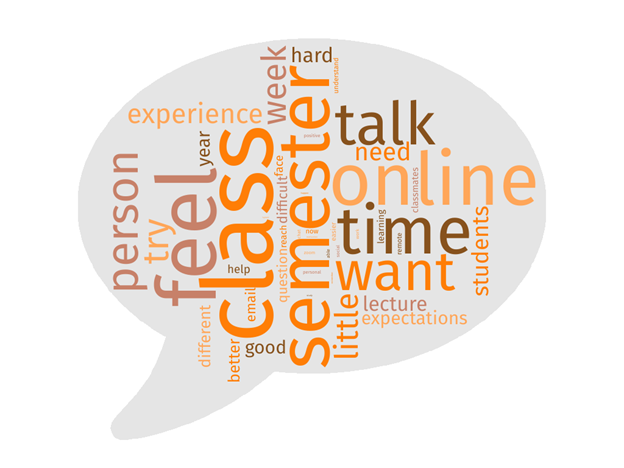
This word cloud was compiled from the transcript data from each focus group. The top 50 words mentioned by number of occurrences (excluding such words as like, the, etc.) are displayed. Size was determined by number of times each word was mentioned by the participants.
Updated: 03/19/2026 05:59PM