
Unmarried Adulthood: More than a Century of Change, 1900-2024
Family Profile No. 8, 2026
Author: Hannah N. Smith
The U.S. refined marriage rate declined steadily from the late 1960’s through the mid-2000’s and has remained relatively stable since 2008 (Loo, 2024a). In contrast, the refined divorce rate rose through the 1970’s, peaked around 1980, and has since returned to pre-1970s levels (Loo, 2024b). Taken together, shifting marriage and divorce patterns highlight the importance of tracking trends in unmarried adulthood.[1] Using data from the Decennial Censuses (1900-1990) and the American Community Survey 1-year estimates (2000-2024), this family profile showcases more than a century of change in the share of unmarried adults aged 18 and older in the U.S. It also examines differences across sociodemographic characteristics, namely age, race and ethnicity, and educational attainment. This profile is an update of FP-23-04 (Marino, 2023).
[1] We use the term “unmarried adulthood” as opposed to “singlehood” because some unmarried adults are cohabiting and for them “singlehood” would be a misnomer. The Decennial Census only began including questions to identify cohabitors in 1990, and thus we are unable distinguish between those who are single (without a partner) and those who are unmarried cohabitors in the years prior to 1990.
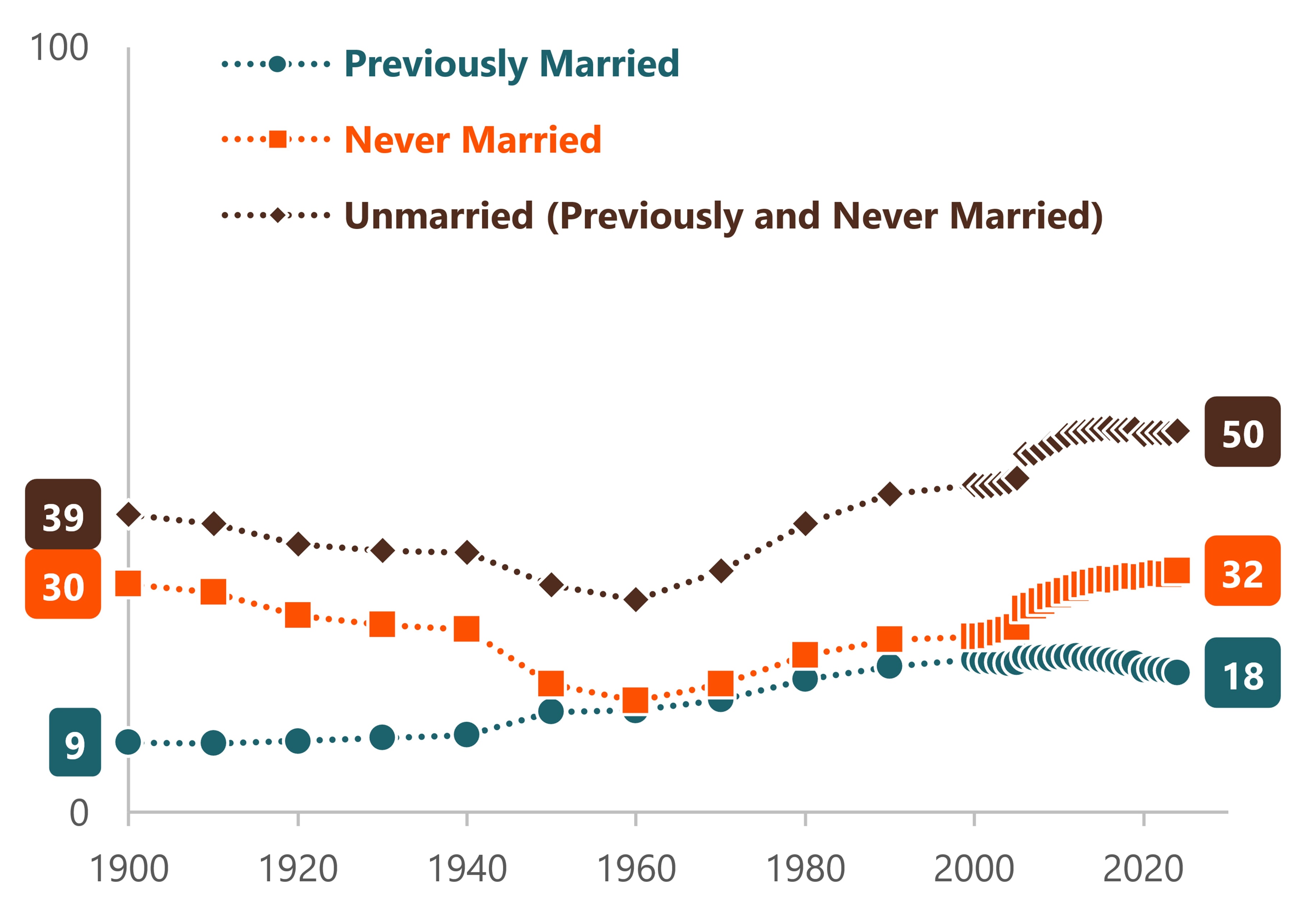
Change in the Share of Unmarried Adults in the U.S., 1900-2024
- Overall, the share of unmarried adults, both never married and previously married, decreased from 1900 (39%) to 1960 (28%). There was an overall increase in the share of unmarried adults after 1960, with half of adults (50%) reporting they were not currently married in 2024.
- Regarding never married adults, the share decreased from 30% in 1900 to 15% in 1960 but increased after 1960 reaching 32% in 2024.
- The share of previously married adults more than doubled from 9% in 1900 to about 20% between 2000 to 2016. It then declined slightly and has been around 18% since 2022.
- Since 1960 the upward trend in the share of unmarried adults has been driven mostly by the increasing share of those who were never married.
Figure 1. Share of Unmarried Adults in the U.S., 1900-2024
Change in the Share of Unmarried Adults in the U.S. by Age Group, 1900-2024
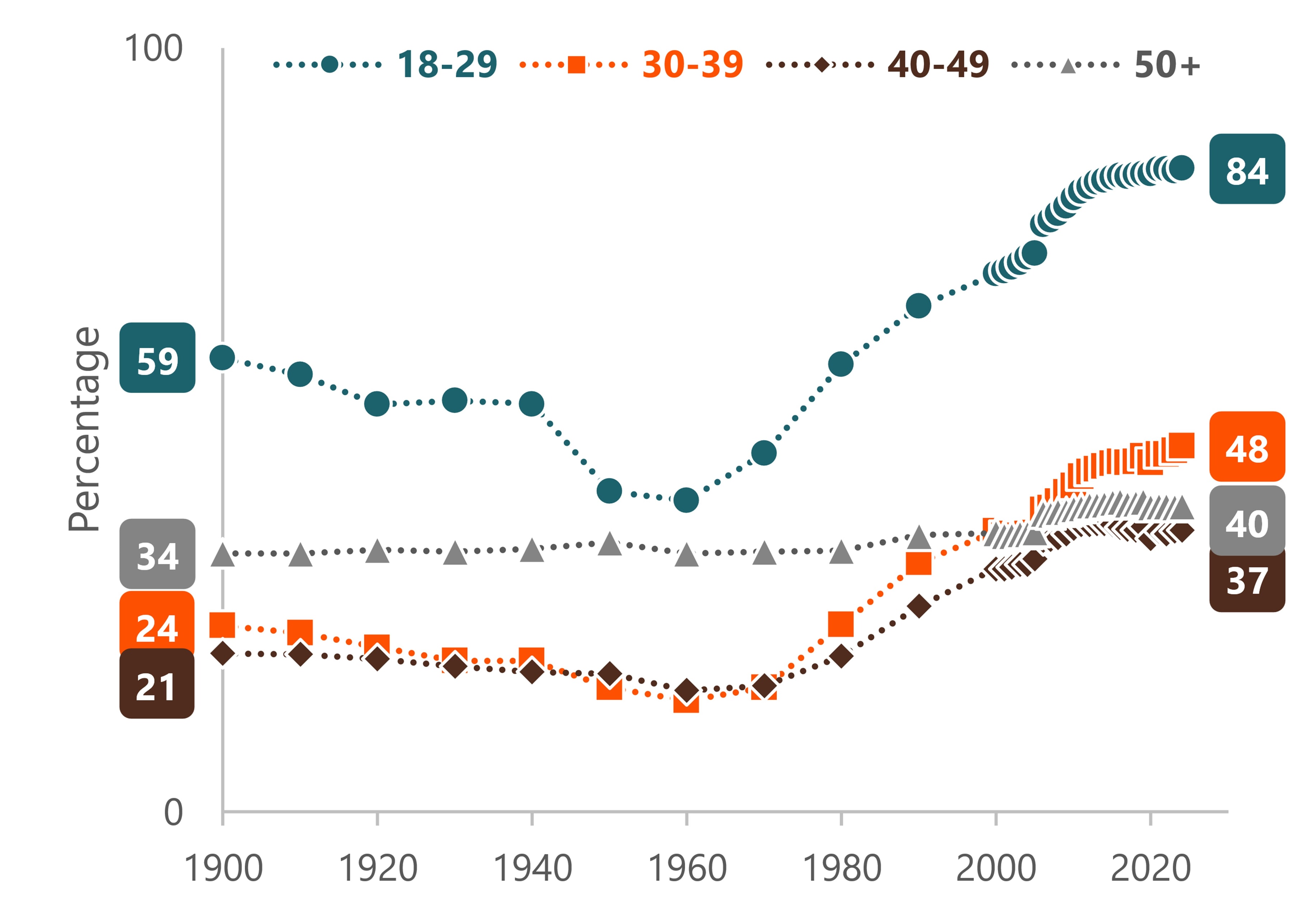
- Young adults aged 18 to 29 experienced a substantial decline in the share of unmarried over the first half of the 20th century, falling from 59% in 1900 to 41% in 1960. Since then the share has more than doubled, reaching 84% in 2024.
- Among adults aged 30 to 39, the share of unmarried followed a pattern similar to those aged 18 to 29, albeit with a more gradual decline from 1900 to 1960 (24% to 15%). Subsequently, the share of unmarried adults more than tripled from 15% in 1960 to 48% in 2024.
- As with their younger counterparts, the share of unmarried among adults aged 40 to 49 declined slightly from 21% in 1900 to 16% in 1960 but then increased twofold to 37% by 2024.
- In contrast, the share of unmarried adults aged 50 and older has changed little over time, increasing modestly from 34% in 1900 to 40% in 2024.
Change in Unmarried Adulthood by Race & Ethnicity, 1900-2024
- Since 1900, the share of unmarried adults has increased across all racial and ethnic groups, though the groups have diverged over time. In 1900, nearly identical shares of non-Hispanic White (39%), non-Hispanic Black (40%), and Hispanic (40%) adults were unmarried. The greatest share was among non-Hispanic Other/2+ adults (46%).
- By 1960, the share of unmarried adults had fallen among all groups except non-Hispanic Black adults, whose share was again around 40%. More than one-third (35%) of non-Hispanic Other/2+ adults were unmarried. Among Hispanic adults, the share of unmarried declined to 28%, and among non-Hispanic White adults, it fell to 26%.
- In 2024, the share of unmarried adults reached 68% among non-Hispanic Black adults, 55% among Hispanic adults, 47% among non-Hispanic Other/2+ adults, and 45% among non-Hispanic White adults, showing widening differences across groups.
Figure 3. Share of Unmarried Adults in the U.S. by Race & Ethnicity, 1900-2024
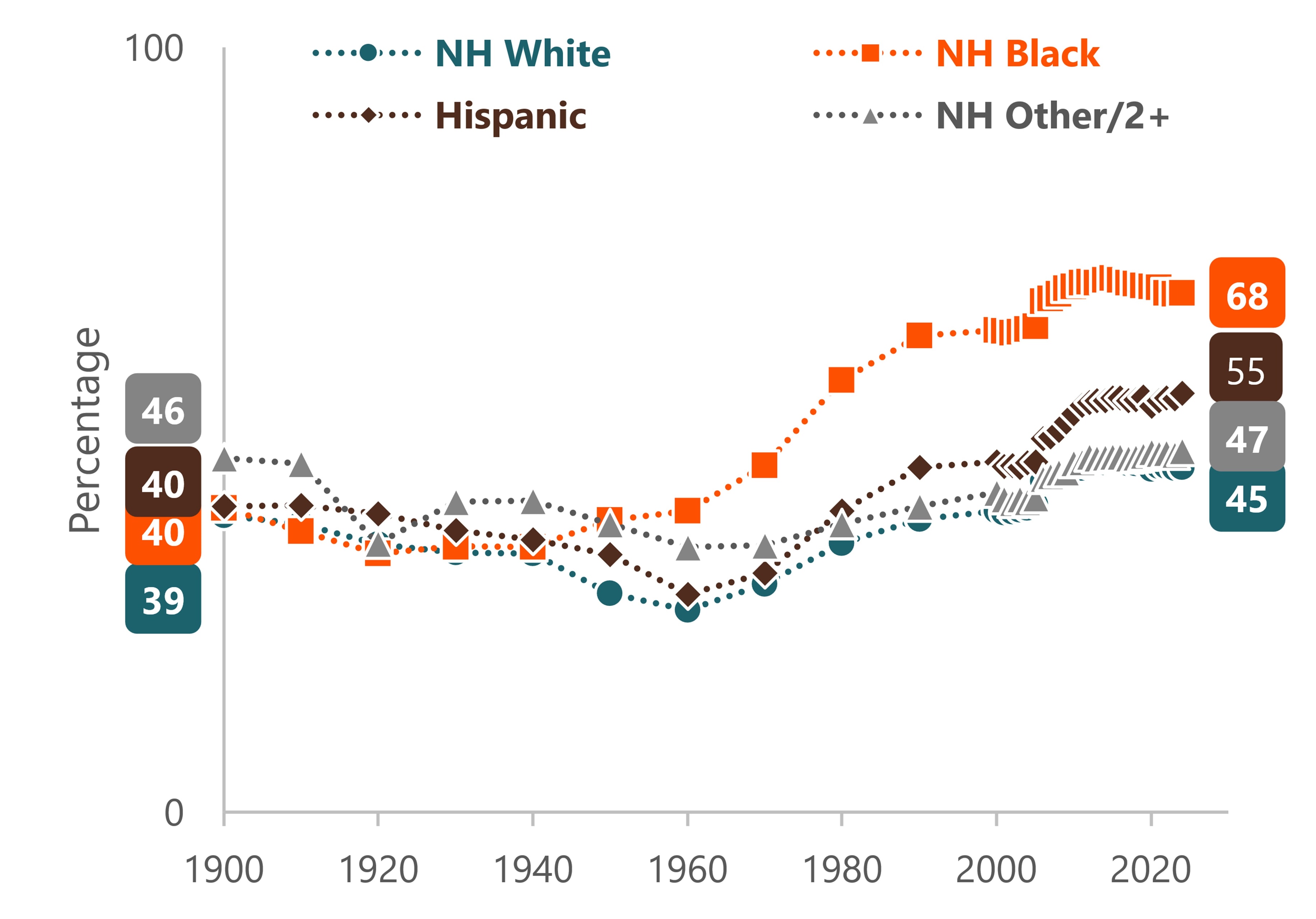
Note. NH = non-Hispanic. “Other/2+ Races” includes non-Hispanic individuals identifying as Asian (including Native Hawaiian and Other Pacific Islander), American Indian or Alaska Native alone, some other race alone, or two or more races.
Change in Unmarried Adulthood by Educational Attainment
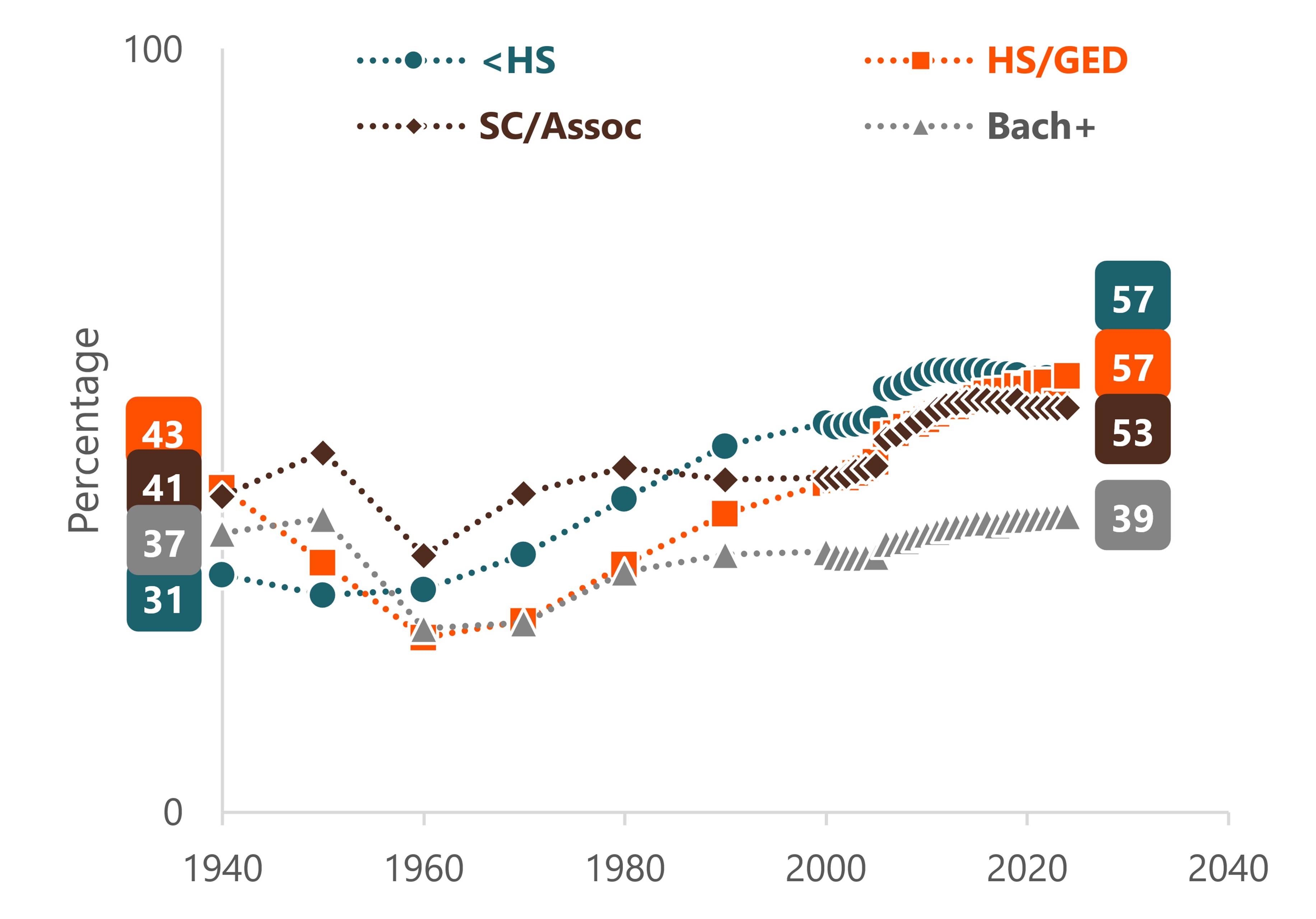
Note. The Decennial Census did not include questions regarding educational attainment prior to 1940.
Note. HS = high school; GED = general education diploma; SC = some college; Assoc = associate degree; Bach+ = bachelor’s degree or higher.
- From 1940 to 2024, the share of unmarried adults aged 18 and older fluctuated by educational attainment. Levels for most groups were lowest around 1960 and highest in the 2010s and early 2020s.
- Among those with less than a high school diploma, the percentage of unmarried adults increased from just under one-third (31%) in 1940 to over half (53%) in 2024, with the highest levels observed in the early 2010s (about 58%).
- Among adults with a high school diploma, the share of unmarried declined from 43% in 1940 to 23% in 1960, then increased steadily to 57% in 2024—the highest level observed over the period.
- The share among those with some college increased slightly from 1940 to 1950, declined to a low in 1960, and then rose to a peak in the mid-2010s (about 54%), remaining relatively stable at 53% in 2024.
- Among individuals with a bachelor’s degree or higher, the share of unmarried declined through 1960 (24%) and then gradually increased to 39% in 2024—the highest level observed over the period and similar to the level observed in 1940 (37%).
This Family Profile is an update of: FP-23-04

Data Source:
Ruggles, S., Flood, S., Sobek, M., Backman, D., Cooper, G., Rivera Drew, J. A., Richards, S., Rodgers, R., Schroeder, J., & Williams, K. C. W. (2024). IPUMS USA: Version 16.0 [Dataset]. Minneapolis, MN: IPUMS.https://doi.org/10.18128/D010.V16.0
References:
Loo, J. (2024a). Marriage: More than a century of change, 1900 & 2022. Family Profiles, FP-24-10. Bowling Green, OH: National Center for Family & Marriage Research. https://doi.org/10.25035/ncfmr/fp-24-10
Loo, J. (2024b). Divorce: More than a century of change, 1900 & 2022. Family Profiles, FP-24-11. Bowling Green, OH: National Center for Family & Marriage Research. https://doi.org/10.25035/ncfmr/fp-24-11
Marino, F. A. (2023). Unmarried adulthood: More than a century of change, 1900-2020. Family Profiles, FP-23-04. Bowling Green, OH: National Center for Family & Marriage Research. https://doi.org/10.25035/ncfmr/fp-23-04
Suggested Citation:
Smith, H. N. (2026). Unmarried adulthood: More than a century of change, 1900-2024. Family Profiles, FP-26-08. Bowling Green, OH: National Center for Family & Marriage Research. https://doi.org/10.25035/ncfmr/fp-26-08
Updated: 07/08/2026 07:39PM