
Variations in Religiosity by Partnership Status Among Older Adults
Family Profile No. 5, 2026
Authors: Olivia Jagodnik and Natalie Bankey
Religion and marriage have long been strongly intertwined institutions (Clarke-Stewart et al., 2006). Even as divorce has become commonplace, religiosity remains positively associated with marital stability and negatively associated with the likelihood of divorce (Brown et al., 2008). In the U.S., religiosity is highest among older adults, but varies by marital status (Smith et al., 2025). This variation is occurring alongside substantial shifts in the composition of partnership statuses among older Americans. Increasingly, older adults are less likely to be in a first marriage and more likely to be remarried, cohabiting, or unpartnered (Carr & Utz, 2020). These shifts underscore the importance of examining the relationship between partnership status and religious beliefs. Using data from the 2016 and 2018 waves of the Health and Retirement Study (HRS) [1], this family profile examines the relationship between partnership status and religious beliefs among men and women aged 50 and older. Sex is measured as male or female in the HRS; we use “women” and “men” to refer to these groups in this text. Partnership status differentiates among first married, remarried, cohabiting, and unpartnered adults. Religious beliefs is a measure tapping agreement that one tries hard to carry their religious beliefs over into other domains of their lives. This Family Profile is a companion piece to a previous Profile on marital status variation in religious attendance and beliefs among older adults (Marino & Mellencamp, 2022).
[1] The HRS (Health and Retirement Study) is sponsored by the National Institute on Aging (grant number NIA U01AG009740) and is conducted by the University of Michigan.
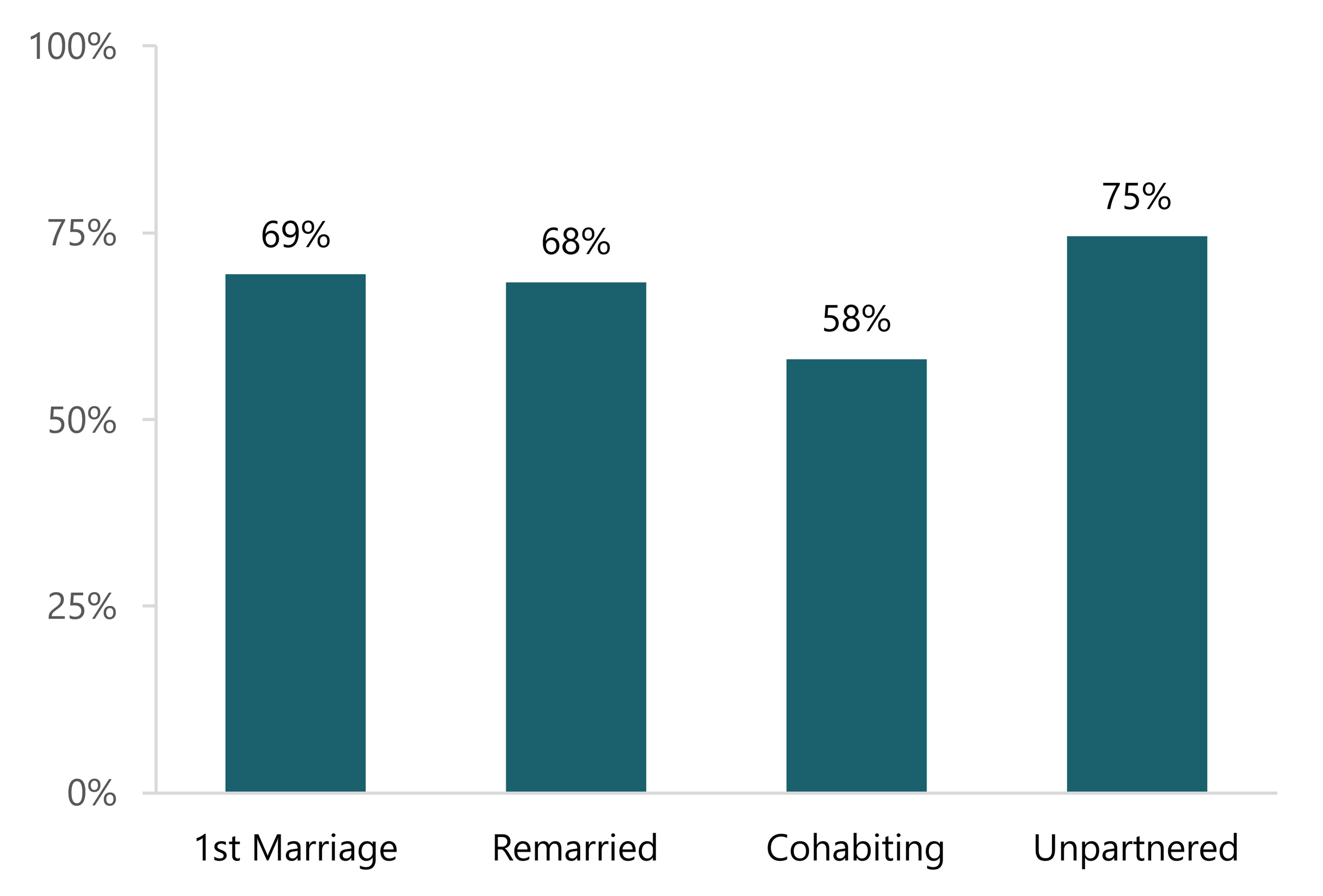
Religious Beliefs Among Women by Partnership Status
- Agreement that they live out their religious beliefs in other areas of life was most common among unpartnered women (75%).
- Cohabiting women exhibited the lowest levels of agreement (58%).
- Women in first marriages (69%) and remarried women (68%) reported similar levels of agreement.
Figure 1. Percentage of Women Aged 50 or Older Who Somewhat Agree or Strongly Agree that They Carry their Religious Beliefs with Them, by Partnership Status
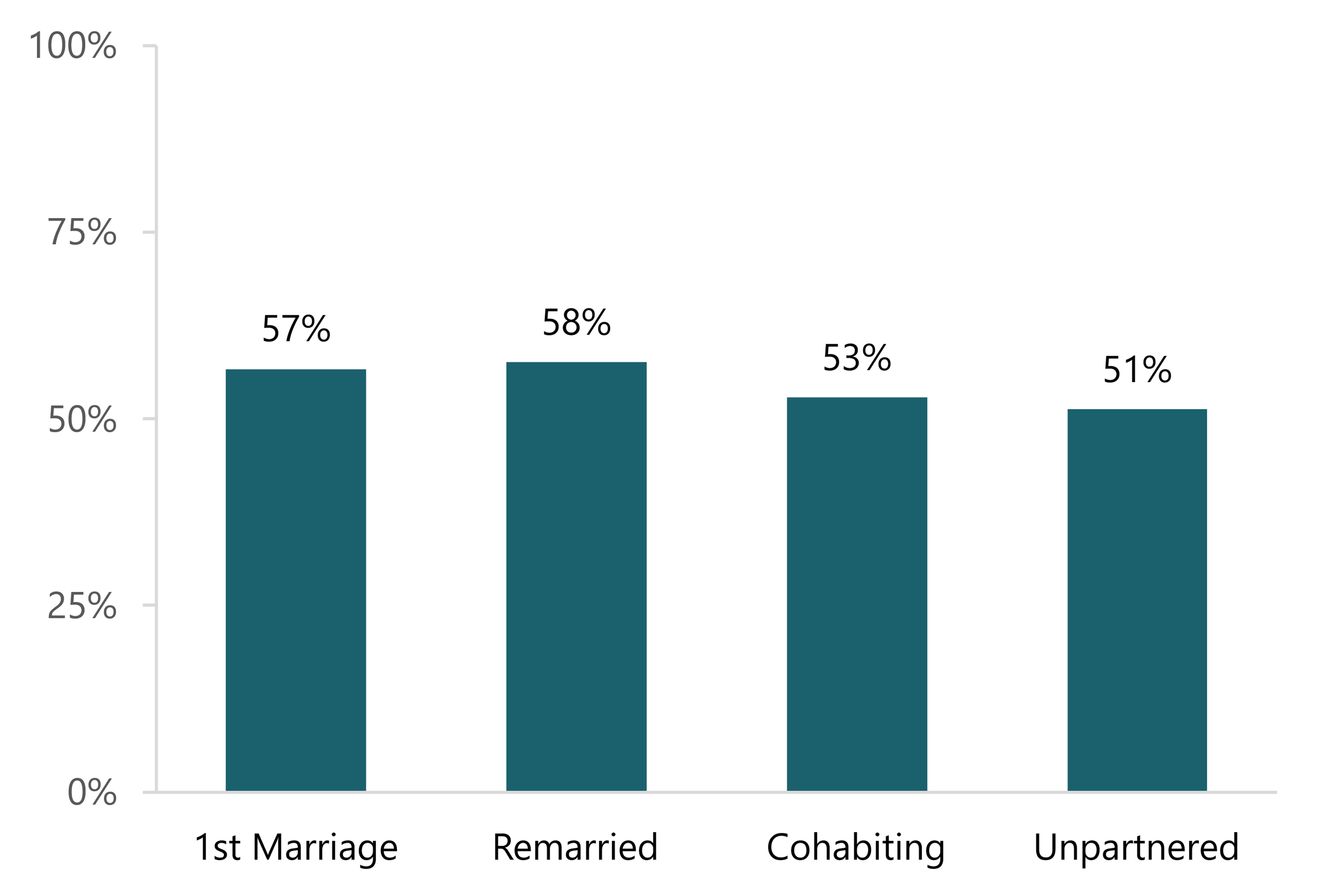
Religious Beliefs Among Men by Partnership Status
- Agreement that they live out their religious beliefs in other areas of life was lower among men than women across all partnership statuses.
- Among men, agreement was most common among those who were married, at 57% for those in a first marriage and 58% for remarried men.
- Cohabiting men reported lower levels of agreement than married men (53%).
- Unpartnered men exhibited the lowest levels of agreement (51%).
Figure 2. Percentage of Men Aged 50 or Older Who Somewhat Agree or Strongly Agree that they Carry their Religious Beliefs with Them, by Partnership Status

Data Sources:
Clarke. S. C. (1995). Advanced report of final marriage statistics, 1989 and 1990. Monthly Vital Statistics Report, 42(12). National Center for Health Statistics. https://www.cdc.gov/nchs/data/mvsr/mv43_12.pdf
Health and Retirement Study (2019). 2016 HRS Core (Final V2.0) public survey data. Produced and distributed by the University of Michigan with funding from the National Institute on Aging (grant number NIA U01AG009740). https://doi.org/10.7826/BNXV5753
Health and Retirement Study (2022). 2018 HRS Core (Final V2.0) public survey data. Produced and distributed by the University of Michigan with funding from the National Institute on Aging (grant number NIA U01AG009740). https://doi.org/10.7826/DHBR7907
Health and Retirement Study (2025). Cross-Wave Tracker File (Final 2022 V1.0) public survey data. Produced and distributed by the University of Michigan with funding from the National Institute on Aging (grant number NIA U01AG009740).https://doi.org/10.7826/OZGE2932
Health and Retirement Study, (RAND HRS Longitudinal File 2018 (V2)) public use dataset. Produced and distributed by the University of Michigan with funding from the National Institute on Aging (grant numbers NIA U01AG009740 and NIA R01AG073289). Ann Arbor, MI, (May 2022).)
RAND HRS Longitudinal File 2018. Produced by the RAND Center for the Study of Aging, with funding from the National Institute on Aging (grant numbers NIA U01AG009740 and NIA R01AG073289) and the Social Security Administration. Santa Monica, CA (May 2022).
References:
Brown, E., Orbuch, T. L., & Bauermeister, J. A. (2008). Religiosity and marital stability among black American and white American couples. Family Relations, 57, 187–97. https://doi.org/10.1111/j.1741-3729.2008.00493.x
Carr, D., & Utz, R. L. (2020). Families in later life: A decade in review. Journal of Marriage and Family, 82(1), 346–363. https://doi.org/10.1111/jomf.12609
Clarke-Stewart, A., & Brentano, C. (2006). Divorce: Causes and consequences. Yale University Press. https://doi.org/10.1111/J.1744-1617.2007.00148.X
Marino, F. A. & Mellencamp, K. A. (2022). Marital status variation in religiosity among older women and men. Family Profiles, FP-22-18. Bowling Green, OH: National Center for Family & Marriage Research. https://doi.org/10.25035/ncfmr/fp-22-18
Smith, G. A., Cooperman, A., Alper, B. A., Mohamed, B., Rotolo, C., Tevington, P., Nortey, J., Kallo, A., Diamant, J., & Fahmy, D. (2025, February 26). US Christian decline may be stabilizing: 2023-24 religious landscape study (RLS). Pew Research Center. https://doi.org/10.58094/4kqq-3112
Suggested Citation:
Jagodnik, O., & Bankey, N. (2026). Variations in religiosity by partnership status among older adults. Family Profiles, FP-26-05. Bowling Green, OH: National Center for Family & Marriage Research. https://doi.org/10.25035/ncfmr/fp-26-05
Updated: 07/08/2026 07:39PM