
Children’s Family Structure, 2025
Family Profile No. 6, 2026
Author: Jaycob Applegate
Minor children’s family structure has remained relatively stable in recent decades, a pattern documented in prior Family Profiles and related research (Eickmeyer, 2017; Manning et al., 2014; Payne, 2013, 2019; Westrick-Payne & Wiborg, 2021). Despite this relative stability, monitoring children’s family structure over time remains important. Using data from the 2025 Current Population Survey, ASEC (IPUMS CPS), this profile updates FP-21-26 (Westrick-Payne & Wiborg, 2021). We visualize variation in the family structure of minor children (under age 18) in the U.S. in 2019 (pre-pandemic) and 2025, as well as by race/ethnicity. We also present state-level variation in the share of children living with two married biological parents.
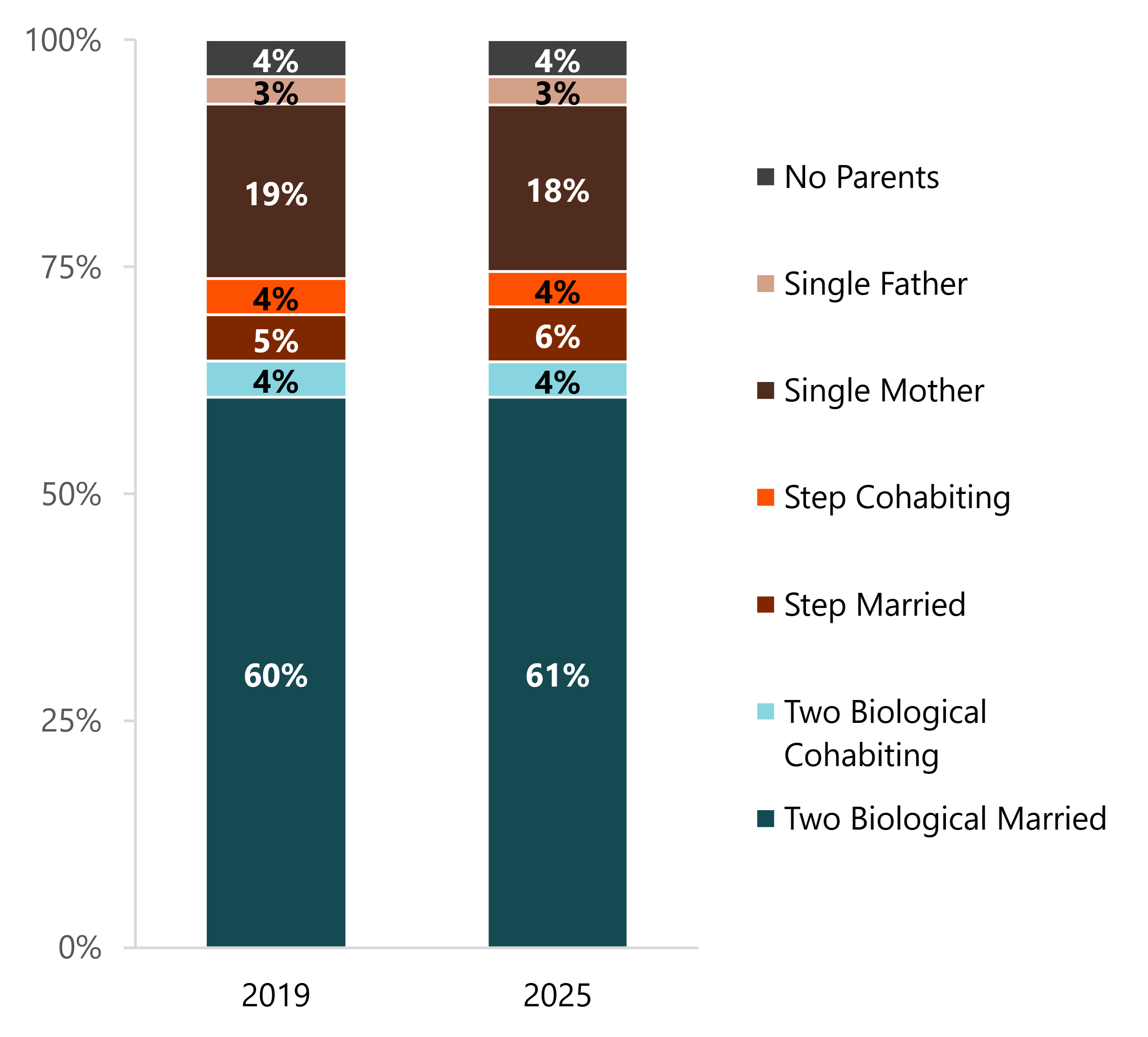
Children’s Family Structure, 2019 & 2025
- In 2025 the majority of children were living with two biological parents (65%). This share is nearly the same as in 2019 (64%).
- Among children living with two biological parents, most lived with married parents rather than cohabiting parents (94% vs. 6%), a pattern that remained unchanged from 2019.
- The second most common family type was single parent families (21%). In 2025, this percentage was slightly lower than what was observed in 2019 (22%).
- A majority of children living with single parents lived with a single mother (86%) rather than a single father (14%), a pattern that was the same in 2019.
- One in ten children lived in stepfamilies (10%), up slightly from 9% in 2019.
- Among children in stepfamilies, a majority lived with married parents (60%), an increase from 56% in 2019, while 40% lived with step-cohabiting parents.
Figure 1. Family Structure of Minor Children, 2019 & 2025
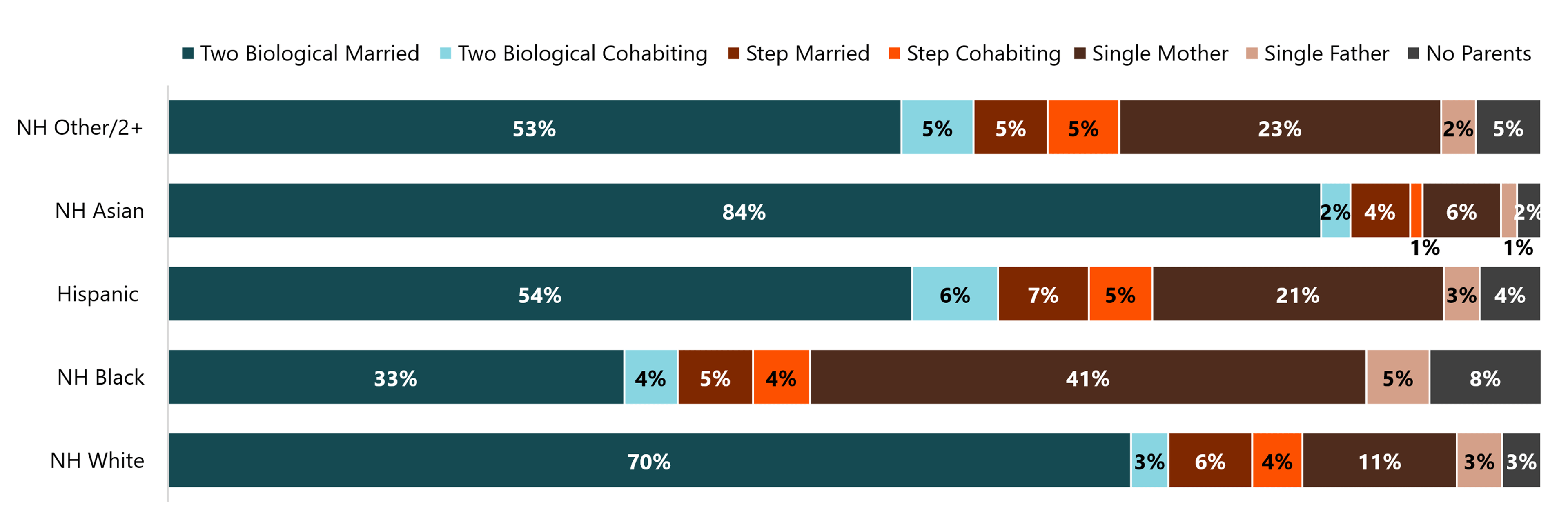
Children’s Family Structure by Race/Ethnicity, 2025
- Two biological parent families were most common among Asian (86%) and White children (73%), while Black children had the smallest share (37%).
- Cohabiting parent families were most prevalent among Hispanic (11%) and those in the Other/2+ races category (10%).
- Stepparent families were most common among Hispanic children (12%), followed by White and children Other/2+ races children (10% each).
- Single-mother families were most prevalent among Black children (41%). Similar shares of children in the Other/2+ races category (23%) and Hispanic children (21%) lived in single-mother families.
Figure 2. Family Structure of Minor Children by Race/Ethnicity, 2025
Geographic Variation in the Percentage of Children Living with Two Married Biological Parents
Figure 3. Geographic Variation in the Percentage of Children living with Two Biological Married Parents, 2025
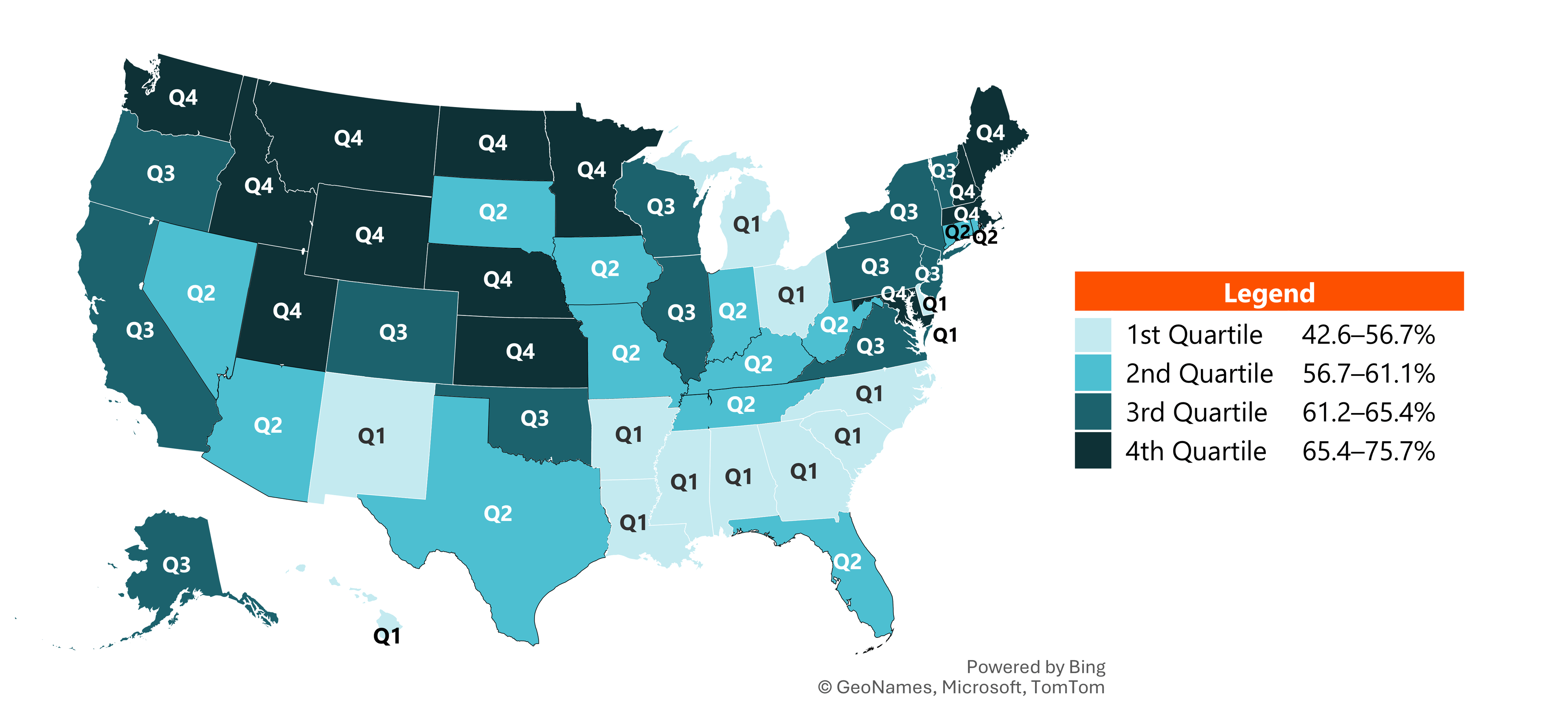
- Large variation existed in the share of children living with two biological married parents across states. Twenty-nine states had at least 60% of children with two biological married parents.
- Similar to 2019, several states with the highest shares of children living with two married biological parents were located in the Western Region of the U.S. (Utah, Idaho, and Washington).
- Utah took the number one spot in each year this profile has been updated, including 2013, 2019, 2021, and 2025.
- In 2025, many states with the smallest share of children living with two married biological parents (bottom 25%) were located in the Southern Region of the U.S. (South Carolina, Delaware, D.C., Alabama, North Carolina, Georgia, Arkansas, Mississippi, and Louisiana).
- In both 2019 and 2025, Mississippi and Louisiana had among the lowest shares of children living with two married biological parents at 45% and 43%, respectively.
This Family Profile is an update of: FP-13-19; FP-19-25; FP-21-26

Data Source:
Flood, S., King, M., Rodgers, R., Ruggles, S., Warren, J.R., & Westberry, M. (2025). Integrated Public Use Microdata Series, Current Population Survey: Version 13.0 [dataset]. Minneapolis, MN: IPUMS. https://doi.org/10.1828/D030.V13.0
References:
Eickmeyer, K. J. (2017). American children’s family structure: Two biological parent families. Family Profiles, FP-17-15. Bowling Green, OH: National Center for Family & Marriage Research. https://www.bgsu.edu/ncfmr/resources/data/family-profiles/eickmeyer-two-biological-parent-families-fp-17-15.html
Manning, W. D., Brown, S. L., & Stykes, J. B. (2014). Family complexity among children in the United States. The ANNALS of the American Academy of Political and Social Science, 654(1), 48-65. https://doi.org/10.1177%2F0002716214524515
Payne, K. K. (2013). Children’s family structure, 2013. Family Profiles, FP-13-19. Bowling Green, OH: National Center for Family & Marriage Research. https://www.bgsu.edu/content/dam/BGSU/college-of-arts-and-sciences/NCFMR/documents/FP/FP-13-19.pdf
Payne, K. K. (2019). Children’s family structure, 2019. Family Profiles, FP-19-25. Bowling Green, OH: National Center for Family & Marriage Research. https://doi.org/10.25035/ncfmr/fp-19-25
Westrick-Payne, K. K., & Wiborg, C. E. (2021). Children’s family structure, 2021. Family Profiles, FP-21-26. Bowling Green, OH: National Center for Family & Marriage Research. https://doi.org/10.25035/ncfmr/fp-21-26
Suggested Citation:
Applegate, J. S. (2026). Children’s family structure, 2025. Family Profiles, FP-26-06. Bowling Green, OH: National Center for Family & Marriage Research. https://doi.org/10.25035/ncfmr/fp-26-06
Updated: 07/08/2026 07:39PM