
Age Variation in Singlehood from Young Adulthood to Midlife, 2025
Family Profile No. 7, 2026
Author: Leni Doehrmann
In 2022, 40% of adults were single, meaning they were not currently in a cohabiting or marital union (Juteau, 2022). This share remained relatively stable, reaching 42% in 2025 (author’s calculation). Singlehood is partly dependent on the timing of entry into unions, but also the dissolution of these unions across the life course. Hence, some singles are never married, and others are previously married. Using new data from the 2025 Current Population Survey (CPS) ASEC, we update our Family Profile (Juteau, 2023) assessing singlehood from young to middle adulthood, differentiating four age groups: 18-29, 30-39, 40-49, and 50-59. We present the age variation in singlehood according to sex, race and ethnicity, nativity, and educational attainment. In this profile singlehood is defined as not currently in a marriage or cohabitating union.
Sex and Singlehood Across Age Groups
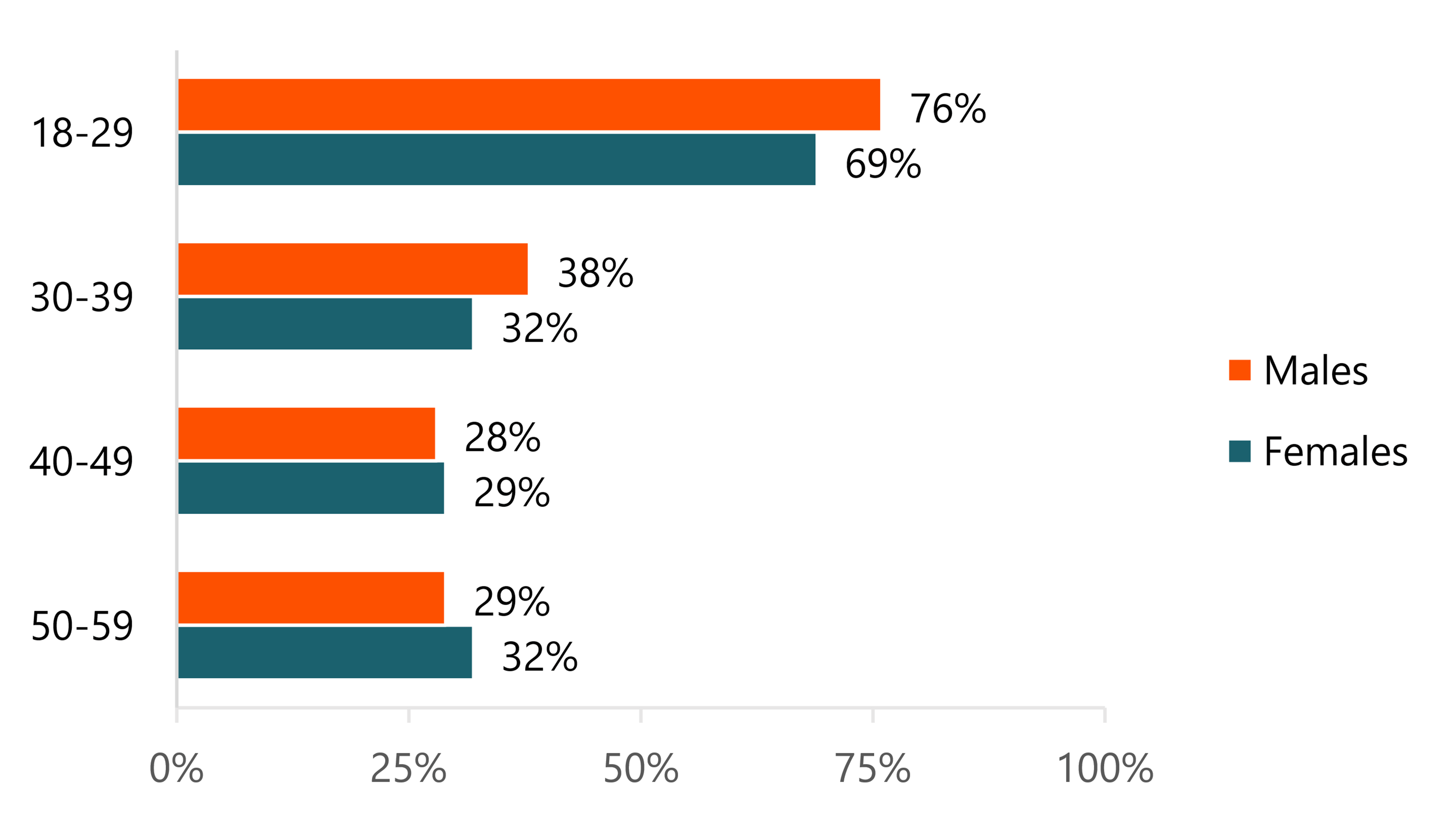
- The largest sex differences in the share single by age[KKP1] group were within the youngest two age groups (18-29 and 30-39). Among those aged 18-29, a larger share of males than females were single (76% vs. 69%). A similar pattern was observed among those in their thirties (38% vs. 32%).
- Among those aged 40-49 and those aged 50-59, the pattern by sex in singlehood reversed, as more females than males were single; however, sex differences were modest (29% vs. 28% and 32% vs. 29%, respectively).
Figure 1. Share of Single Individuals, by Age Group and Sex, 2025
Race/ Ethnicity and Singlehood Across Age Groups
- Among individuals in the youngest age group (18-29), Black adults had the highest level of singlehood at 85%, followed by Asian, Other/2+, and Hispanic individuals (78%, 77%, and 74%, respectively). White young adults had the lowest prevalence of singlehood in this age group (67%).
- Among individuals aged 30 to 39 years, three-fifths (60%) of Black individuals and 45% of Other/2+ individuals were single. Asian adults had the lowest proportion single (24%), followed by White adults (29%).
- About half of Black individuals in their forties and fifties were single in 2025 (51% and 50%, respectively). Other/2+ midlife individuals had the second-largest share of single individuals (37% among those aged 40-49, and 46% among those aged 50-59). Among Hispanic midlife individuals, 32% were single. Asian midlife adults had the lowest share (16% among those aged 40-49, and 17% among those aged 50-59), followed by White midlife adults (24% among those aged 40-49, and 28% among those aged 50-59).
Figure 2. Percentage of Single Individuals, by Race/Ethnicity and Age Group, 2025
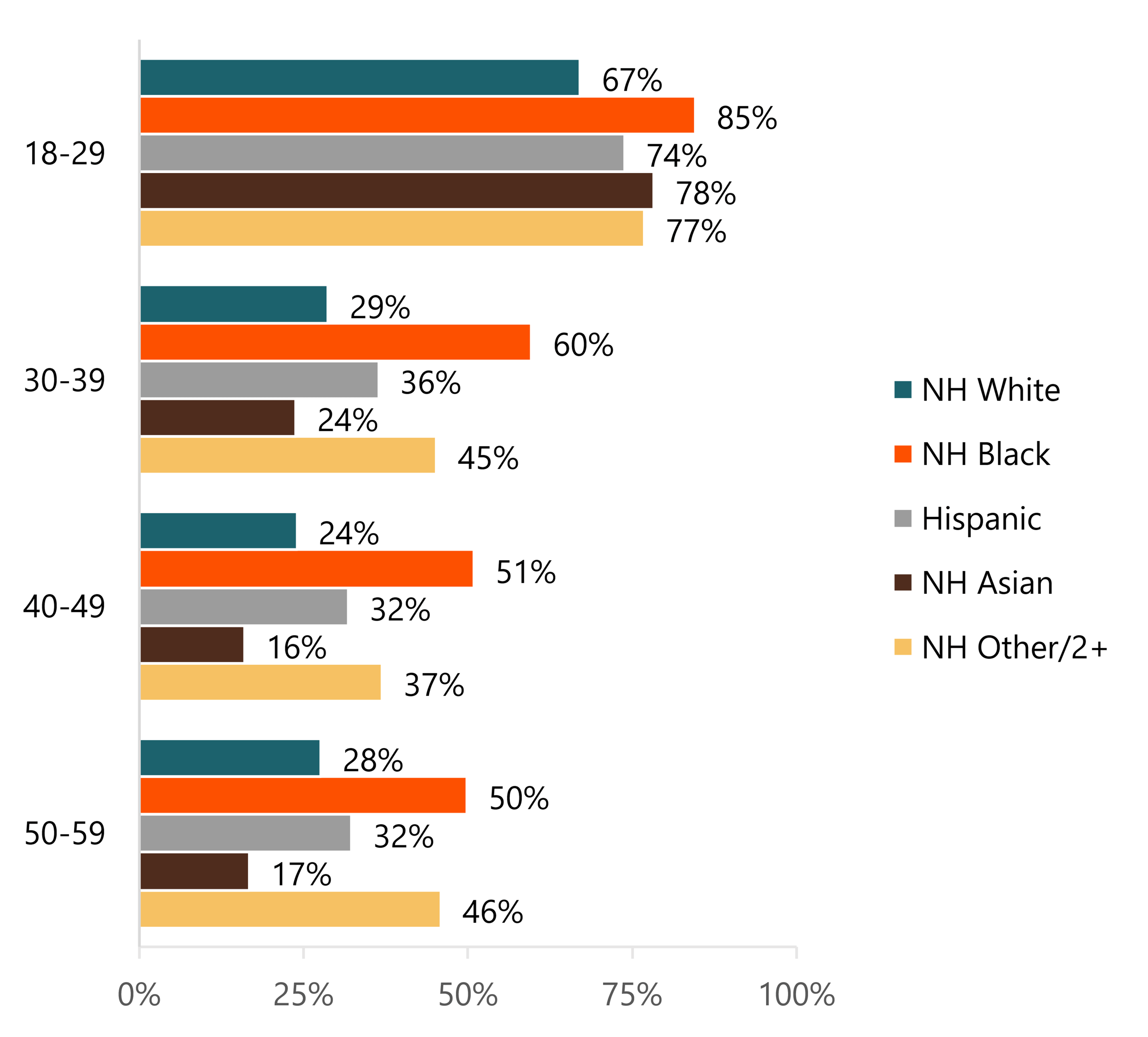
Note. NH = Non-Hispanic. “NH Asian” includes non-Hispanic individuals identifying as Asian or Native Hawaiian and Other Pacific Islander. “Other/2+ Races” includes non-Hispanic individuals identifying as American Indian or Alaska Native alone, some other race alone, or two or more races.
Nativity Status and Singlehood Across Age Groups
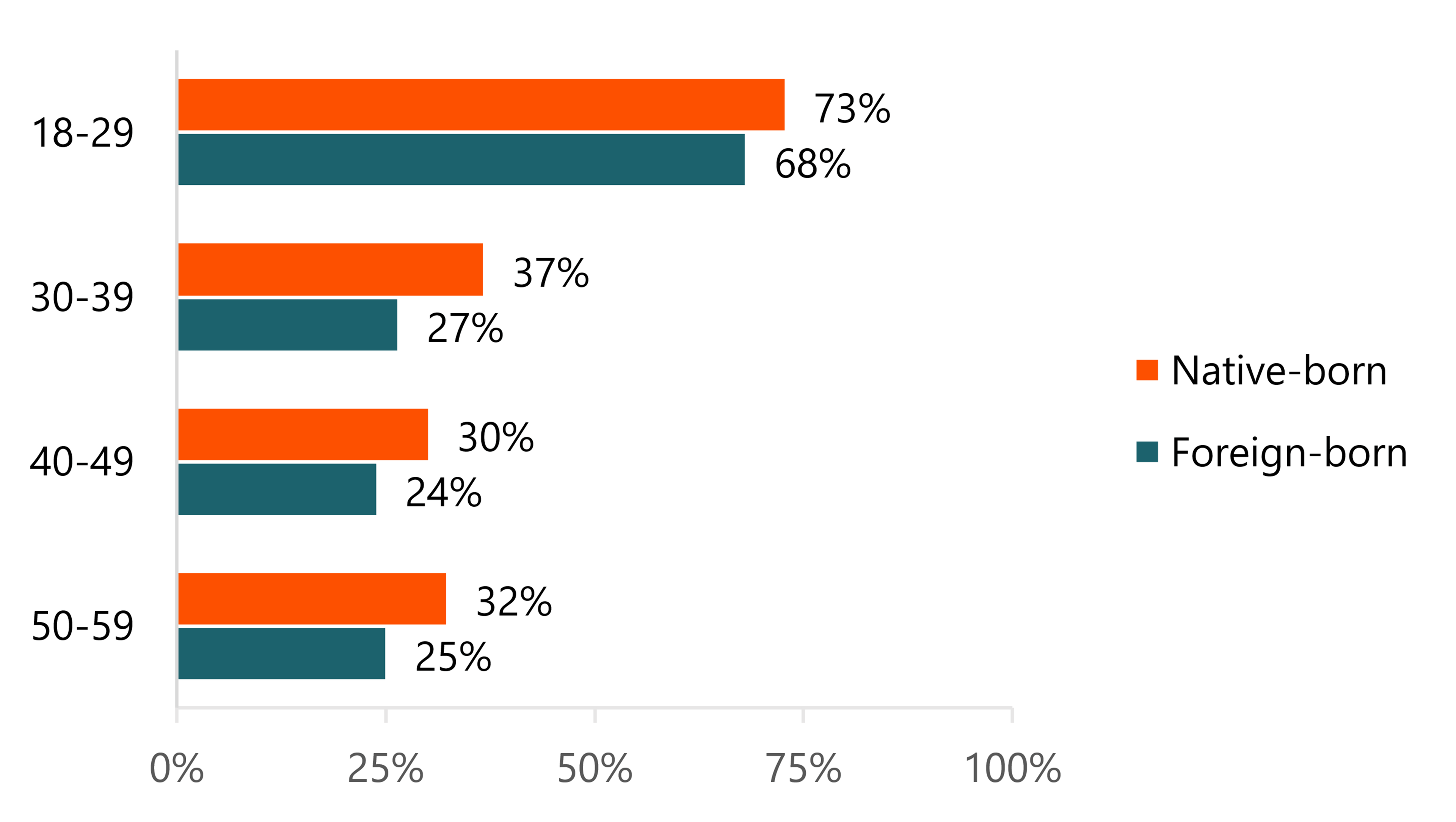
- Compared to foreign-born individuals, a larger share of native-born individuals were single across all age groups.
- Among those aged 18-29, nearly three-quarters (73%) of native-born individuals were single, compared to 68% of those who were foreign-born.
- The greatest difference by age was among those in their thirties, with 37% of native-born adults being single compared to 27% of foreign-born adults.
- Though slightly reduced, differences in singlehood between native-born and foreign-born individuals persisted across midlife. There was a 6 percentage-point difference among those in their forties (30% and 24%, respectively) and a 7 percentage-point difference among those in their fifties (32% and 25%, respectively).
Figure 3. Percentage of Single Individuals, by Nativity Status and Age Group, 2025
Educational Attainment and Singlehood Across Age Groups
- The share of 18–24-year-old adults who were single ranged from 90% among those with less than a high school diploma to 81% among those with at least a bachelor’s degree; however, the relationship was not linear. Those with less than a high school-level of education had a similar share single as those with some college education or an associate degree (90% and 89%, respectively), whereas those with a high school diploma/GED were similar to those who had received a bachelor’s degree (82% and 81%, respectively).
- Among young adults aged 25 to 29 years old, there was no educational gradient in singlehood. At every educational attainment level, slightly more than half of adults were not in a co-residential relationship.
- The educational differentials in singlehood were
greatest for those over age 30.
- Among those aged 30-39, those with a high school diploma/GED had the greatest share single (44%), followed by those with less than a high school-level of education (41%) and those with some college education or an associate degree (37%). Those with a bachelor’s degree had the lowest level of singlehood (27%).
- There were nearly identical educational gradients in singlehood among those aged 40-49 and 50-59. In both age groups, those with less than a high school-level of education had the greatest share of single individuals (37%), followed by those with a high school diploma/GED (35%) and those with some college or an associate degree (33%). Those who obtained at least a bachelor’s degree had the lowest proportion of singlehood for both age groups—about one-fifth (21%) among those aged 40-49 and about one-quarter (24%) among those aged 50-59.
Figure 4. Percentage of Single Individuals, by Educational Attainment and Age Group, 2025
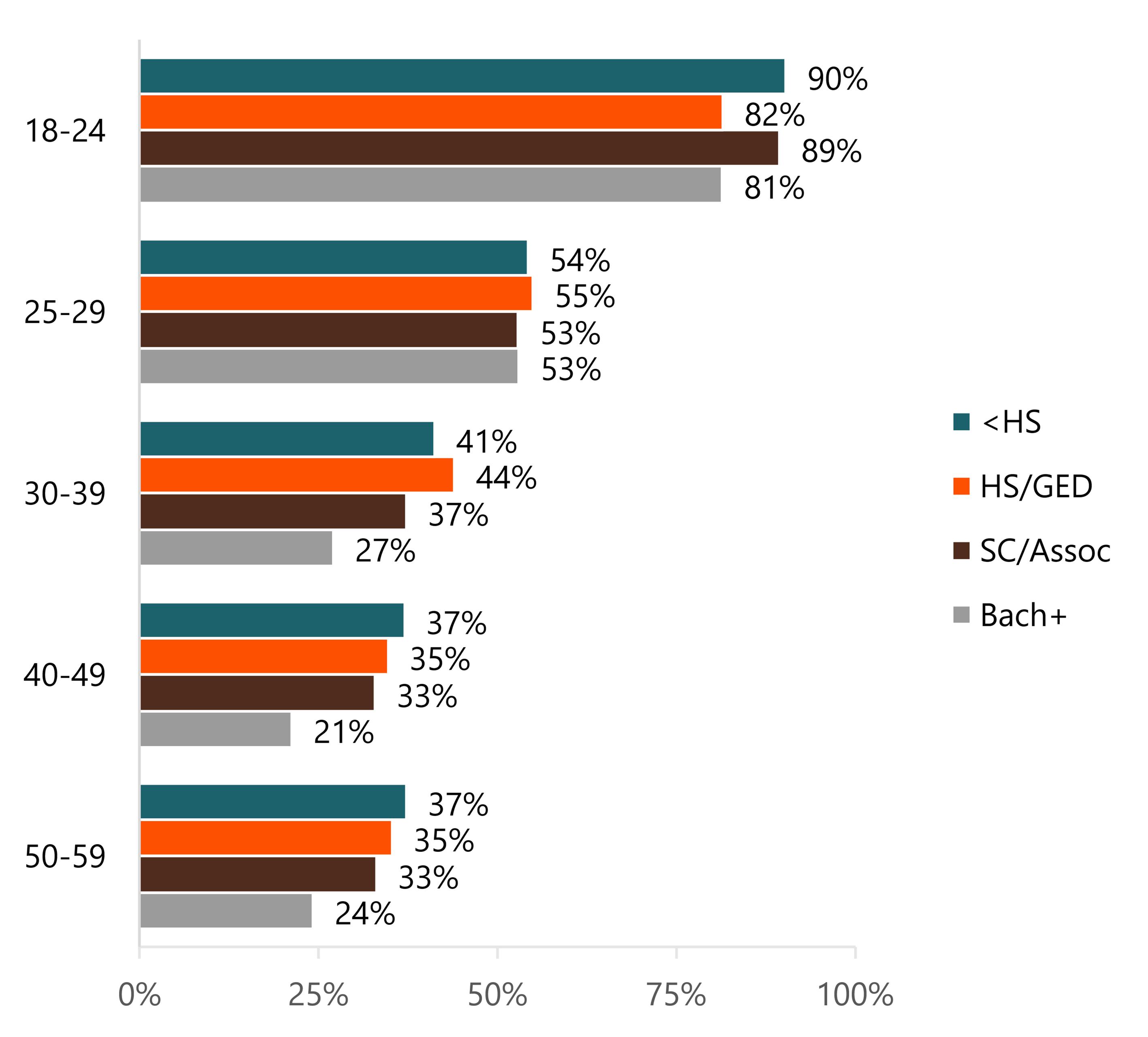
Note. SC = some college; Assoc = associate degree; Bach = bachelor’s degree; Mast = master’s degree; Prof = professional degree.
This Family Profile is an update of: FP-23-11

Data Source:
Flood, S., King, M., Rodgers, R., Ruggles, S., Warren, J. R., Backman, D., Breton, E., Cooper, G., Rivera Drew, J. A., Richards, S., Riper, D. V., & Williams, K. C. W. (2025). Integrated Public Use Microdata Series: Current Population Survey: Version 13.0 [dataset]. Minneapolis, MN: IPUMS. https://doi.org/10.18128/D030.V9.0
References:
Juteau, G. (2022). Characteristics of single adults in the U.S., 2022. Family Profile, FP-22-30. Bowling Green, OH: National Center for Family & Marriage Research. https://doi.org/10.25035/ncfmr/fp-22-30
Juteau, G. (2023). Age variation in singlehood from young to midlife adulthood, 2022. Family Profile, FP-23-11. Bowling Green, OH: National Center for Family & Marriage Research. https://doi.org/10.25035/ncfmr/fp-23-11
Suggested Citation:
Doehrmann, L. (2026). Age variation in singlehood from young adulthood to midlife. Family Profiles, FP-26-07. Bowling Green, OH: National Center for Family & Marriage Research. https://doi.org/10.25035/ncfmr/fp-26-07
Updated: 07/08/2026 07:39PM