
Reflective And Integrative Learning Executive Summary - Spring 2017
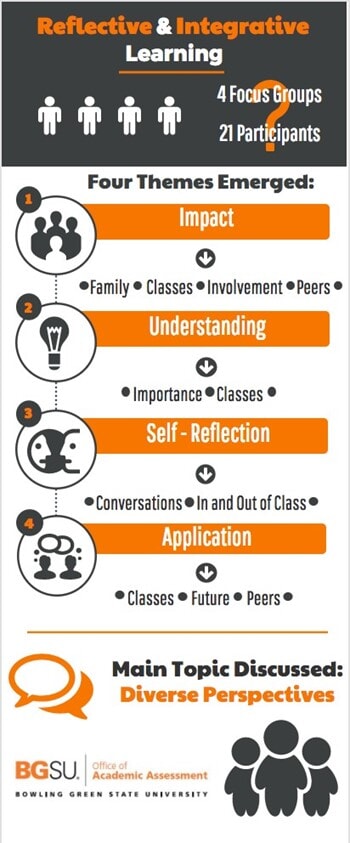
This project was a student-led assessment of students at Bowling Green State University. It was conducted by a team of four students identified as Student Learning Analysts (SLAs) as part of the Office of Academic Assessment. The SLAs designed a focus group protocol exploring students' integrative and reflective learning. The topic of Reflective and Integrative Learning was taken from the National Survey of Student Engagement (NSSE) and explored based on BGSU's NSSE results. There were four focus groups facilitated by the SLAs with a total of 21 participants from varying class standing and majors. Audio recorders were used to ensure that all information was properly documented, which were then transcribed and coded into themes by the SLAs. All codes were analyzed and narrowed to four main themes with subthemes, which are listed below.
- Impact: A variety of influences surfaced to shape student perspectives.
- Family
- Classes
- Involvement
- Peers
“...taking these BGP (general education) classes which you are presented with discussion-based questions from people in all different majors and backgrounds and it really gives you a look about how life will be.” (T3, L256- 258).
- Understanding: Many participants indicated that it was important to consider the perspectives from others.
- Importance
- Classes
“I think diverse perspectives are as needed as oxygen because they provide avenues for innovation because I think like without them we would have everyone doing everything the same thing, never like questioning it and we wouldn’t be where we are today. So I think like diverse perspectives are like extremely important.” (T4, L328-332).
- Self-Reflection: Other participants enhanced their own perspective based on the consideration of others.
- Conversations - Inside and outside of the classroom
“I would say for me it's less taking action and more having conversations, which isn't necessarily as powerful but just going home and having conversations about diversity and different identities I notice comes up a lot…” (T3, L184-187).
- Application: When understanding was gained from diverse perspectives some participants demonstrated that they not only understood other people's perspectives, but that they had begun to apply that knowledge.
- Classes
- Future
- Peers
“...I have a friend that goes by they/them so correcting others as well... kind of influences your behavior instead of just doing that yourself just [saying] 'hey sorry, you know, they go by these pronouns.'”(T3, L218-220).
With BGSU students’ input about reflective and integrative learning, four main themes arose: Impact, Understanding, Self- Reflection, and Application. Each theme contained subthemes and are all included because of the impact they were said to have on students' learning at BGSU.
For a full copy of this report, please contact Dr. Jessica Turos, Associate Director, Office of Academic Assessment at jmturos@bgsu.edu.
Infographic
Updated: 03/19/2026 06:00PM