
September 2026 Newsletter
News and Events
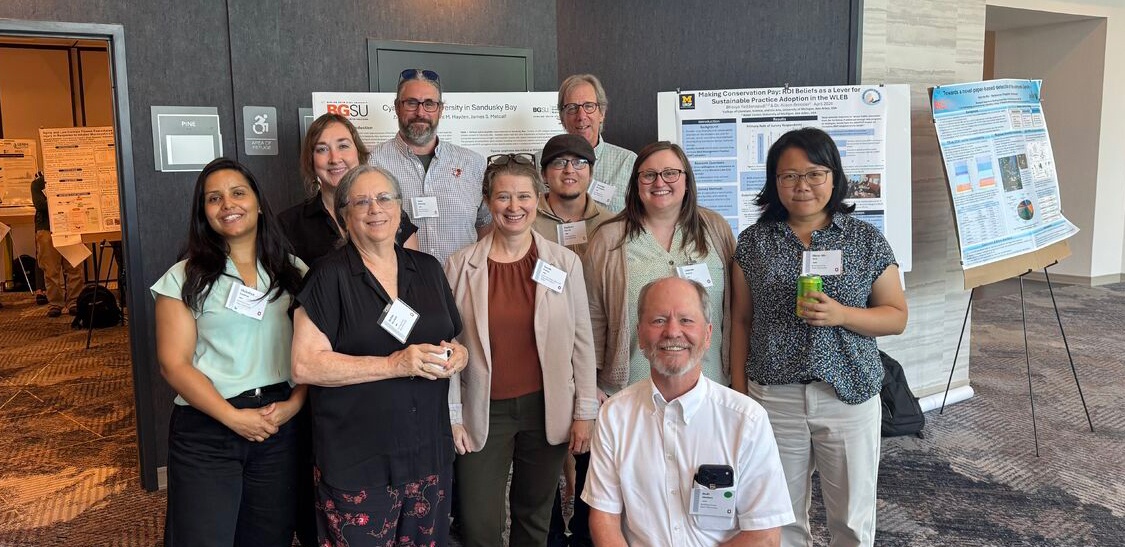
- BGSU CGLWS was well represented at the Annual Understanding Harmful Algal Blooms State of the Science Conference and Ohio Domestic Action Plan Workshop Sept 2-3 in Toledo. This conference highlights current scientific knowledge related to algal blooms, and actions being taken by the state to address this important issue. CGLWS faculty and students, including Kevin McCluney, Lauren Brown, Zach Morris, Shikshya Gautam, and Hsin-Ho Wei were able to share their research through invited talks and poster presentations. It was a great place for BGSU faculty and students to interact with other Great Lakes researchers, government agencies, and the agricultural community.
- Arijit Khan was very active at the Very Large Data Bases (VLDB) conference in Boston with a research paper, demonstration, and workshop.
- Ohio Sea Grant has a nice article highlighting the work by Kevin Neves, Jeff Miner, and John Farver on fish otolith development in aquaculture systems and hatcheries: Studying Fish ‘Ear Stones’ to Protect Aquaculture and Fisheries | Ohio Sea Grant. Kevin also shared about this work during the Sept. 24 Freshwater Science webinar: The Sound of Survival: How Fish Hearing Shapes Aquaculture and Fisheries Success | Ohio Sea Grant.
Amílcar Challú and Jenn Stucker attended the Wyandotte Nation Annual Gathering in Oklahoma Sept. 11-13. There, Amílcar was able to share a poster highlighting the work of CGLWS REU student Jaksyn Trimbach, who used Ohio General Land Office surveys to describe vegetation of the Big Spring Reservation in the early 1800’s.
The H2Ohio Wetland Monitoring Program just published their 2025 Annual Report, which includes significant contributions from BGSU faculty, students, and staff including Lauren Brown, Ganming Liu, Nathan Manning, Kevin McCluney, Helen Michaels, Bob Midden, Genna Hunt, Ewan Isherwood, Corbin Kohart, and Sang Suk Lee: H2Ohio Wetland Monitoring Program Publishes 2025 Annual Report - The Lake Erie and Aquatic Research Network
- Thanks to Mark Sprang for leading a tour of the Historical Collections of the Great Lakes Archives on Sept. 9 for CGLWS members. Sarah, Mason, and Enrique were able to join. We saw a lot of potential for research using some Lake Erie fisheries records spanning decades. Let us know if you are interested in exploring possibilities!
- George Bullerjahn has received the 2026 National Harmful Algal Bloom Committee Lifetime Research and Service Award in recognition of his research achievements, leadership, and extensive service to the HAB community. Congratulations George!
Recent Publications
Mehdizavareh, H., G. Santangelo, G. Nicora, S. Cichoszi, A. Dagliati, A. Khan, and R. Bellazzi. 2027. Informative Missingness to Generate Irregular Clinical Time Series. In: Andreev, P., Van Woensel, W., Holmes, J., Sauré, A. (eds) Artificial Intelligence in Medicine. AIME 2026. Lecture Notes in Computer Science, vol 16749. Springer, Cham.
https://doi.org/10.1007/978-3-032-30813-9_37
Member Spotlights
Graduate Member
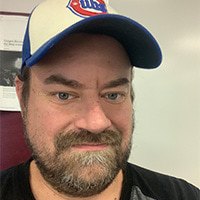
Kyle Hallowell
PhD Candidate & Adjunct Professor (Owens Community College)
Center for Photochemical Sciences - Furgal Materials Workshop
Medical and Environmental Polymer Chemistry
Graduate Assistant/Graphic Designer for CGLWS
I was born in Michigan but grew up in Texas. Both my undergraduate degrees (Digital Art and Marine Biology) are from BGSU, and I currently work with Dr. Joseph Furgal in the Center for Photochemical Sciences.
Dr. Furgal saw my work and capabilities in Organic Chemistry and reached out to offer a place in his materials workshop. BGSU offers a PhD program with an attached masters degree in Photochemistry which both covers my tuition and grants me a decent stipend to research and work within it.
I handle medical and environmental projects that come through the Furgal Materials Workshop. I work under an NIH grant to develop a long-lasting, nitric oxide releasing polymeric system for medical applications. This polymer could grant anti-microbial, anti-thrombotic, healing properties to IV tubing, implants, or wound seal equipment. As a second project, I develop polymer coatings to prevent invasive mussel species from attaching to different substrates. This could stem the spread of invasive species and reduce population numbers along the lake shores. I also work with the removal and study of microplastics from environmental and wastewater media.
I plan on using my varied background and experience to become an application chemist and product manager within industrial research and development. I hope to be able to communicate difficult scientific ideas and projects to non-scientific individuals and prevent misunderstandings from leading to media outcry.
I have enjoyed going to Put-in Bay every summer to collect live mussel specimens in collaboration with Stone Labs and ODNR. Outside of my research, I was born in St. Joseph, MI so I have a nostalgic connection to the beaches of St. Joe and its lighthouse.
Faculty Member
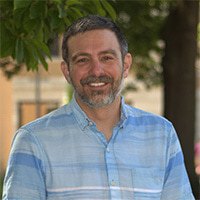
Kevin McCluney
Associate Professor & Graduate Coordinator
Department of Biological Sciences
Wetland and Stream Ecology
Communications Chair - CGLWS
I grew up on the edge of the Indian River Lagoon in Cocoa, FL. I've been at BGSU since 2014.
The work in my lab is diverse, but we typically focus on the watersheds rather than the lake itself. Recent projects have included 1) investigations of soil health in agricultural fields and sources of phosphorus in streams during storms using stable isotopes, 2) quantifying the role of plants and animals in nutrient cycling in wetlands and ditches both through our role in H2Ohio wetland monitoring and associated work, and 3) examining the spatial and temporal variability and impact of pharmaceuticals and other emerging contaminants on stream food webs. These projects focus on threats to water quality and ways to improve water quality, supporting the "public good."
In our lab, we have collaborated with geochemists and environmental chemists (Angelica Vazquez-Ortega, Bob Midden), forensic chemists (Travis Worst), hydrologists (Ganming Liu), and have been working towards collaborations with social scientists inside and outside BGSU.
The core classes I've taught include Concepts in Biology I (BIOL 2040), Principles of Biometry (BIOL 4620/5620), and Invertebrate Diversity (4270/5270). I really like teaching all of them, for different reasons. In the introductory course, many of the student's love biology, get excited about what we are learning, and ask great questions. It is rewarding to see their interest and enthusiasm. In the upper level classes, I get to help students learn about very important topics, like experimental design and the power of statistics, or the amazing diversity of invertebrates and their adaptations and importance to ecosystems (including aquatic ones) and to humans.
I'm not sure I have a single favorite. I had never visited the Great Lakes prior to starting as faculty here and on my first visit to Lake Erie, I was struck by how much it reminded me of the ocean where I grew up in FL. When I visited some of the dunes on Lake Michigan, I felt that way even more. The beaches there are some of the best I've visited. Spring migration at Magee Marsh is also quite special and our whole family goes every year for The Biggest Week in American Birding.
Upcoming Events
- Great Lakes Coastal Symposium, Oct. 26-28, Huron OH
- AI Data Centers and Sustainability Panel, featuring Andy Kear, Enrique Gomezdelcampo, Timothy Pape, and Kefa Otiso will be on Oct. 13 from 1:15-2:15pm in 207 BTSU
- Betco round-table meeting about potential collaborations in Life Sciences 202, 1pm on Oct. 14 - CGLWS Faculty
Ottawa National Wildlife Refuge fieldtrip, 1-4pm on Oct. 16 - CGLWS Faculty
- The BGSU Sustainability Office wants to collaborate on research using new microplastics filters on campus washing machines. Talk to Kyle Hallowell or Joe Furgal if you are interested in potential grants, CURS students, etc.
- The new Consul General of Canada-Detroit, Andrea Clements, will be visiting BGSU on Oct. 23. She is a BGSU alumna and we hope to organize a CGLWS roundtable meeting with her at some point during her visit. Stay tuned for updates. - CGLWS Faculty
- The Great Lakes Biochar Initiative has donated some biochar for experimental use. Please contact Sarah if you are interested in using some or being part of future proposals using biochar to improve Great Lakes water quality.
Updated: 09/30/2026 02:00PM