
Coresidential Partnering Across Young and Middle Adulthood, 2008-2024
Family Profile No. 14, 2026
Author: Krista K. Westrick-Payne
The increasing age at first marriage in the U.S. is well documented (U.S. Census Bureau, 2026). Less is known about whether young and middle-aged adults are living with a romantic partner, regardless of marital status. In this Profile, we examine trends in coresidential partnering across young and middle adulthood using the 2008-2024 American Community Survey (ACS) 1-year estimates from IPUMS USA. Using household roster information, adults were classified as coresidentially partnered if they were living with a spouse or unmarried partner. Because both members of a couple were identified, estimates represent the share of adults—not households—who were coresidentially partnered. This measure does not capture dating relationships in which partners live in separate households. The NCFMR also has many other Family Profiles on marriage as well as cohabitation, which you can explore at the links below.
Living with a Spouse or Unmarried Partner
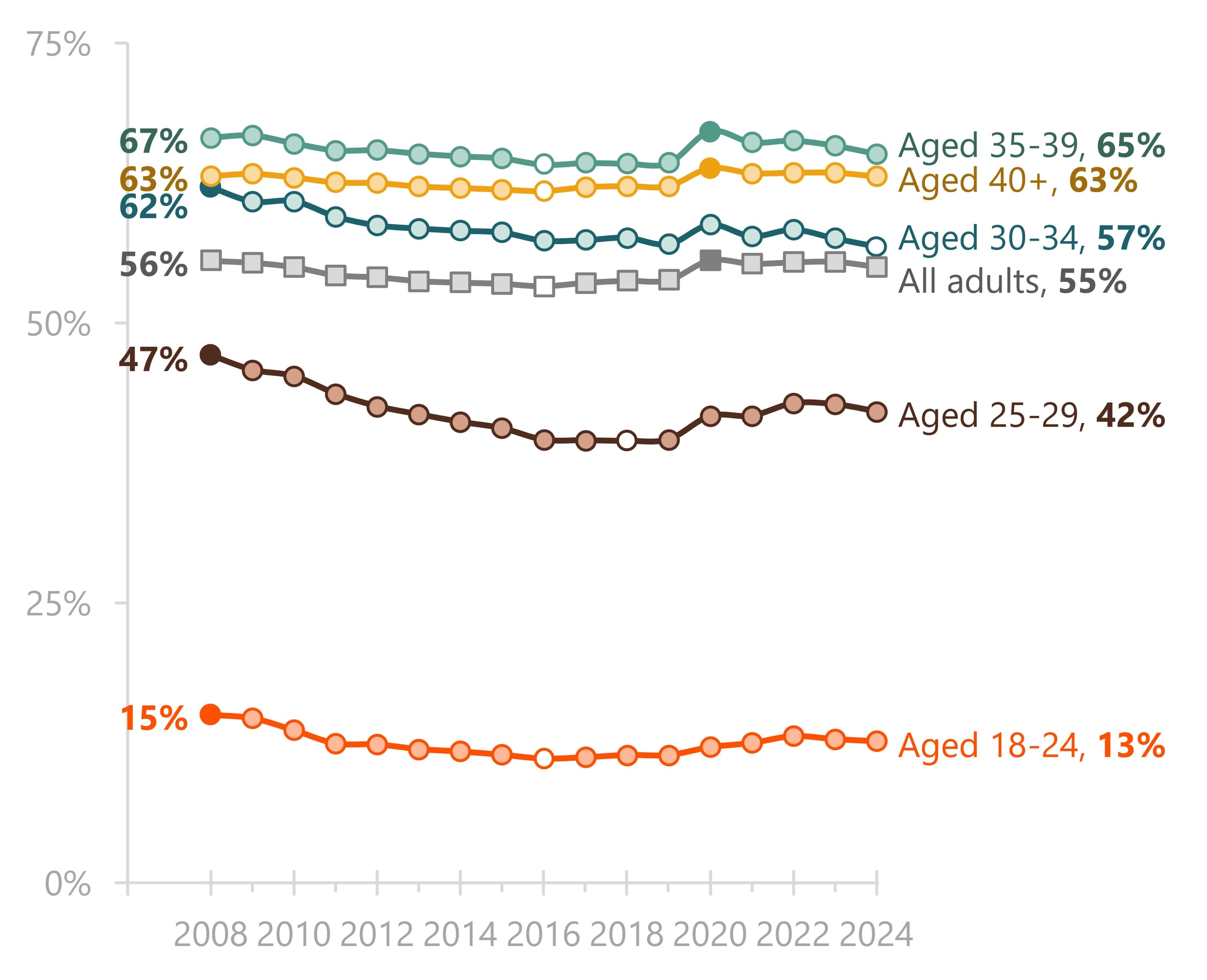
Figure 1. Living with a Spouse or Unmarried Partner by Age Group, 2008-2024
Source: NCFMR analysis of American Community Survey, 1-Year Estimates, 2008-2024 (IPUMS USA)
The share of all adults living with a spouse or unmarried partner declined from 56% in 2008 to a low of 53% in 2016 before increasing again in the early 2020s. In 2024 the share was similar to what it was in 2008 at 55%.
- Among adults aged 18-24, the share living with a spouse or unmarried partner declined from 15% in 2008 to 11% during 2016-2019 before increasing to 13% in 2024.
- Adults aged 35-39 consistently had the highest share living with a spouse or unmarried partner, hovering around two-thirds throughout the period.
- Adults aged 40 and older experienced little change over the period, with shares at between 62% and 64%.
Marriage and Cohabitation Trends
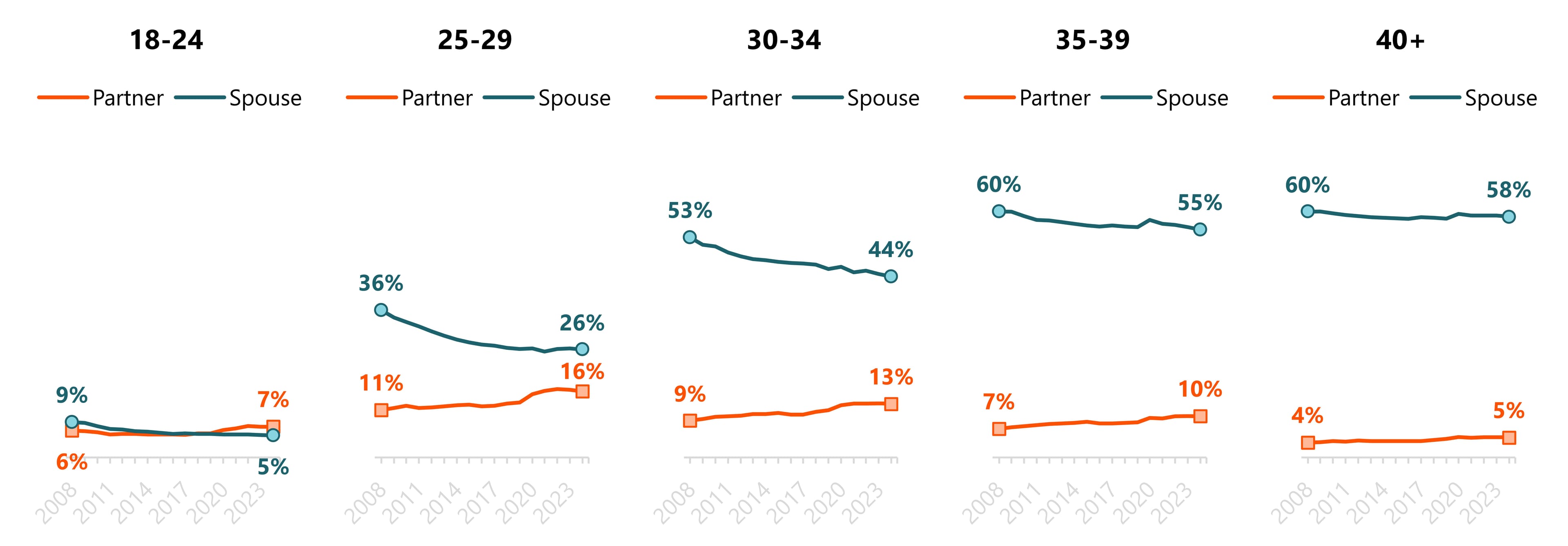
Figure 2. Share of Adults Living with a Spouse and Share Living with an Unmarried Partner by Age Group, 2008-2024
Source: NCFMR analysis of American Community Survey, 1-Year Estimates, 2008-2024 (IPUMS USA)
- Across all age groups, the share living with a spouse generally declined from 2008 and 2024. Among adults aged 35-39 and 40+, shares increased slightly in 2020 before resuming their gradual decline.
- During the same period, the share living with an unmarried partner generally increased, although several age groups experienced a slight decline around 2016 before continuing to increase. The increase in the share living with an unmarried partner partially offset declines in the share living with a spouse.
- Among adults aged 18-24, the share living with an unmarried partner exceeded the share living with a spouse beginning in 2018 and remained higher through 2024.

Data Source:
Ruggles, S., Flood, S., Sobek, M., Backman, D., Cooper, G., Rivera Drew, J. A., Richards, S., Rodgers, R., Schroeder, J., & Williams, K. C. W. (2025). IPUMS USA: Version 16.0 [Dataset]. Minneapolis, MN: IPUMS. https://doi.org/10.18128/D010.V16.0
References:
Westrick-Payne, K. K. (2026). The timing of first marriage: Age trends and characteristics. Family Profiles, FP-26-13. Bowling Green, OH: National Center for Family & Marriage Research. https://doi.org/10.25035/ncfmr/fp-26-13
Suggested Citation:
Westrick-Payne, K. K. (2026). Coresidential partnering across young and middle adulthood, 2008-2024. Family Profiles, FP-26-14. Bowling Green, OH: National Center for Family & Marriage Research. https://doi.org/10.25035/ncfmr/fp-26-14
Updated: 09/10/2026 05:00PM