
Young Adults in the Parental Home, 2007-2025
Family Profile No. 19, 2026
Author: Morgan Poole
Declining housing affordability and higher unemployment have contributed to increases in young adults’ co-residence with parents in the United States (Acolin, Lin, & Wachter, 2024). Young adult co-residence varies by young adult age, sex, and school enrollment (Acolin, Lin, & Wachter, 2026). Using the Current Population Survey (CPS), we track young adults’ parental co-residence by age, sex, and school enrollment from 2007 through 2025 to understand how residential patterns of young adults have evolved over the past eighteen years. We define parental co-residence as living with one’s own parent(s) or a partner/spouse’s parent(s). This family profile updates previous profiles on parental co-residence using recent data (FP-24-02, FP-21-23, FP-19-04, FP-16-16, FP-13-07, and FP-12-22).
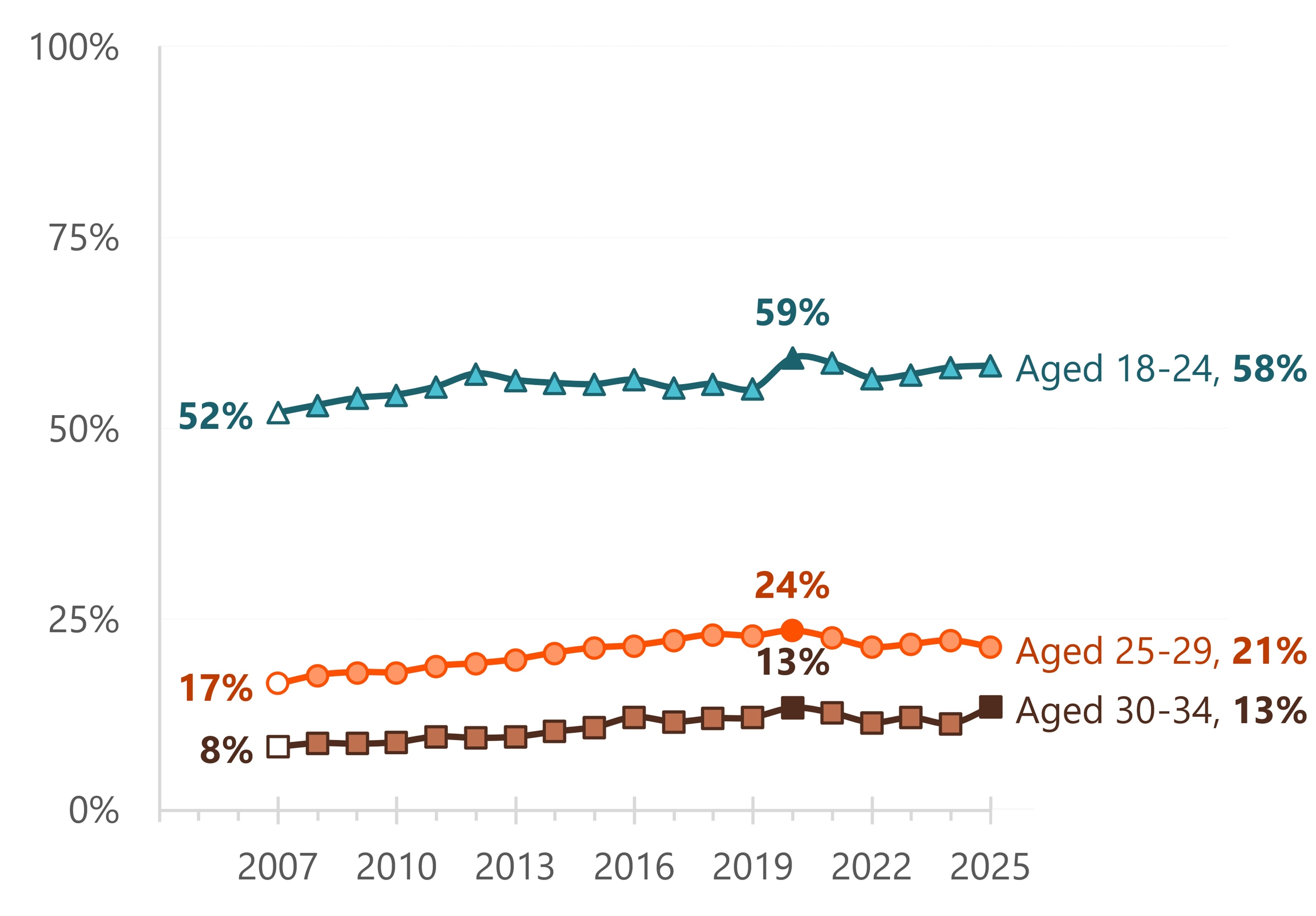
Between 2007 and 2025, the share of young adults co-residing with parents increased across all age groups and peaked in 2020 for 18–24-year-olds and 25–29-year-olds. For 30–34-year-olds, their peak occurred in 2025.
- Throughout the past 18 years, over half of young adults aged 18-24 lived with their parents. This age group had the largest share living in a parent’s home.
- The share of 18–24-year-olds living with parents peaked at 59% in 2020. Though slight decreases occurred in 2021 and 2022, it increased from 2023 onward, bringing the rate back up to 58% in 2025.
- In 2025, more than one in five (21%) young adults aged 25-29 were living in the parental home, up from 17% in 2007.
- The share of young adults co-residing with parents in the oldest age group (30-34) gradually rose from 8% in 2007 to a peak of 13% in 2025.
Source: NCFMR analyses of IPUMS-CPS, Current Population Survey, ASEC, 2007-2025
Share of Young Adults Living in the Parental Home by Sex and Age Group
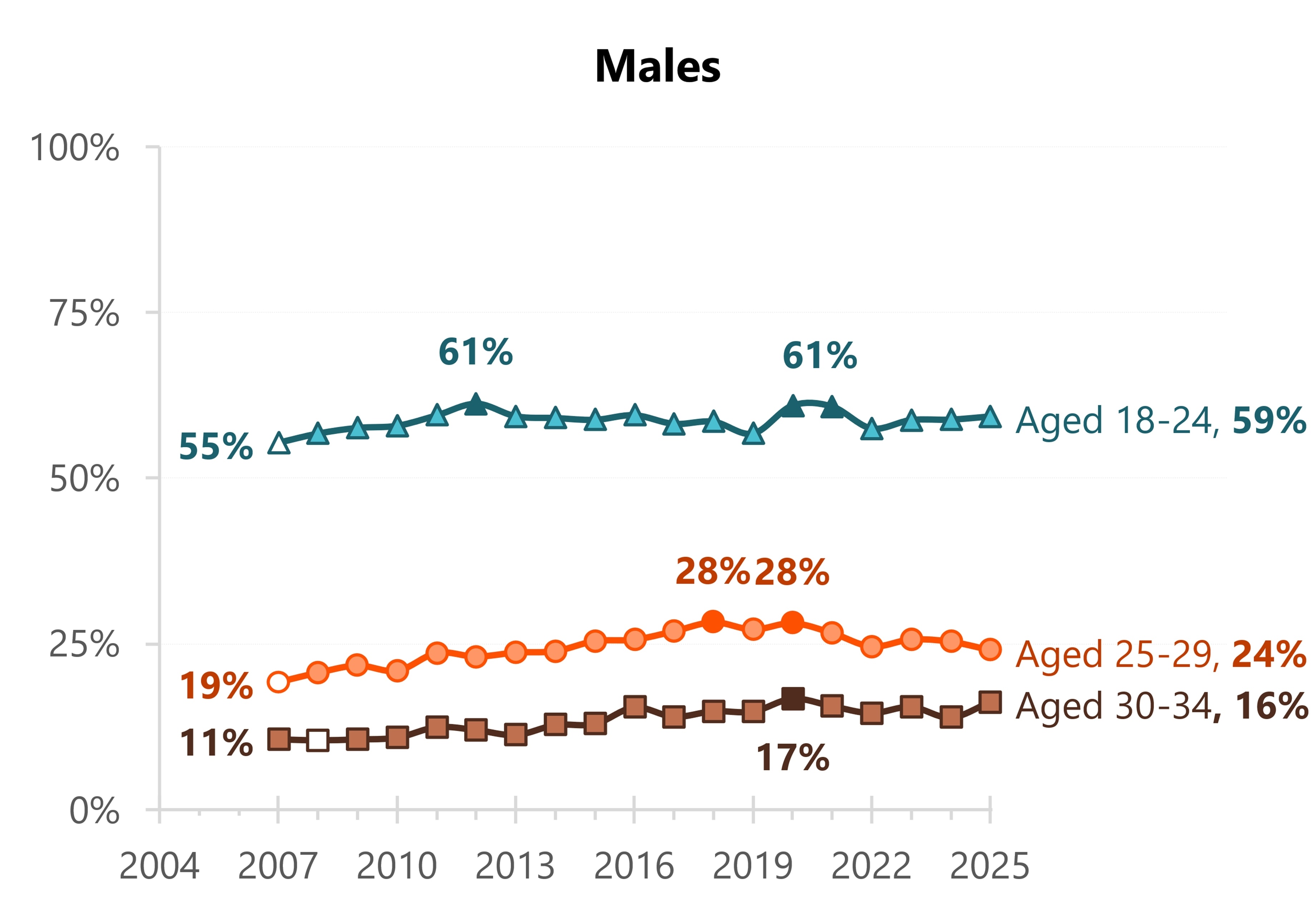
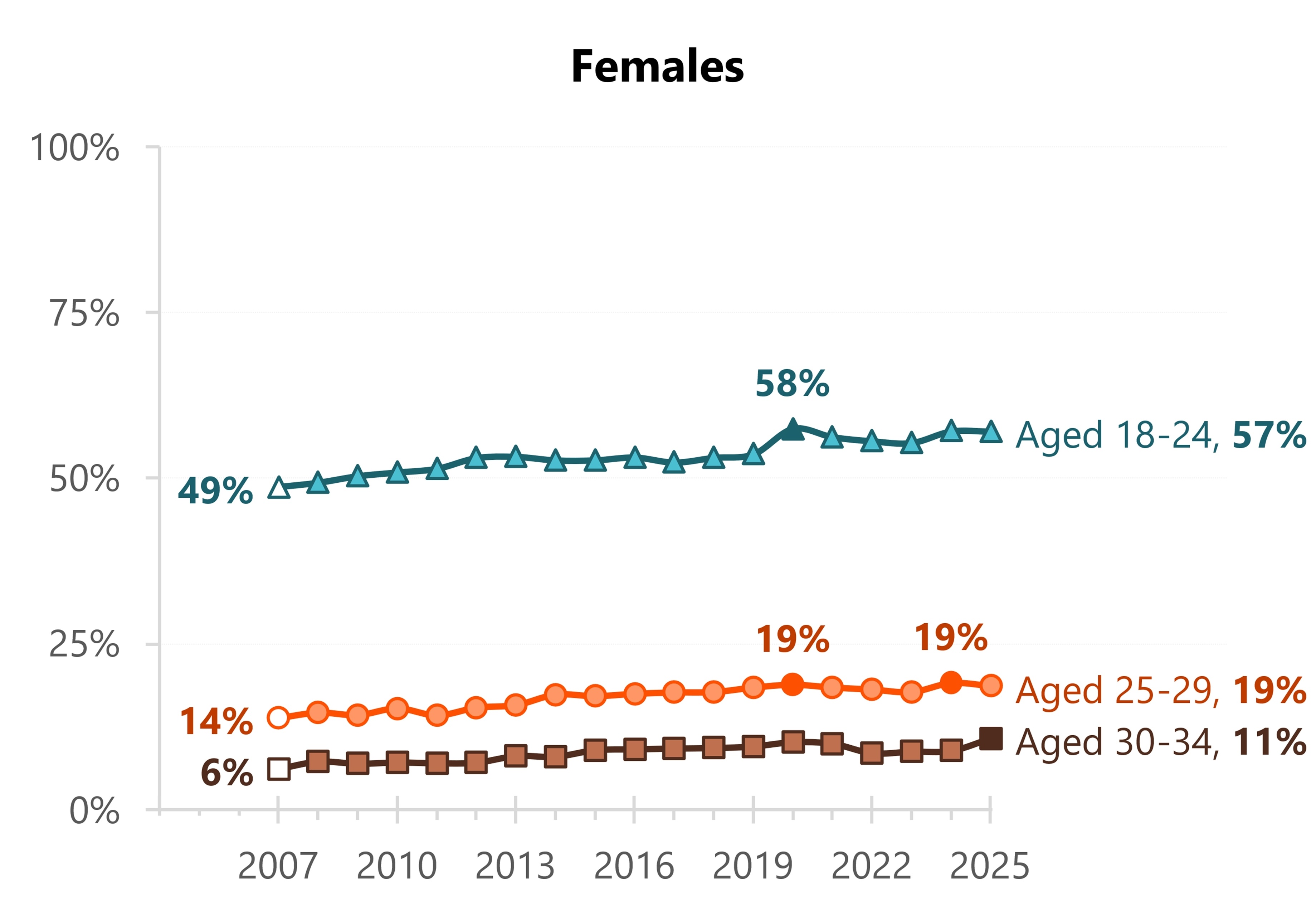
- Estimates of young adults co-residing with a parent increased across all age groups from 2007 to 2025, regardless of sex. The rates remained higher among males than females.
- The share of young adults co-residing with a parent was highest among those in the youngest age group.
- In 2025, 59% of 18–24-year-old males and 57% of 18–24-year-old females were living in a parent’s home compared to 16% of 30–34-year-old males and 11% of 30–34-year-old females.
- For females, co-residence rates peaked in 2020 for those aged 18-24, in 2024 for those aged 25-29, and in 2025 for those aged 30-34.
- For males, co-residence peaked at 61% in 2012, 2020, and 2021 among those aged 18-24. Among those aged 30-34, it peaked at 17% in 2020, while those aged 25-29 reached a peak of 28% in both 2018 and 2020.
- In 2025, the rates of co-residence for 25–29-year-old males and females were 24% vs. 19%, respectively.
Figure 2. Share of Young Adults Living in the Parental Home by Age Group for Males and Females, 2007-2025
Source: NCFMR analyses of IPUMS-CPS, Current Population Survey, ASEC, 2007-2025
Share of Young Adults Aged 18-24 Living in the Parental Home by College Enrollment
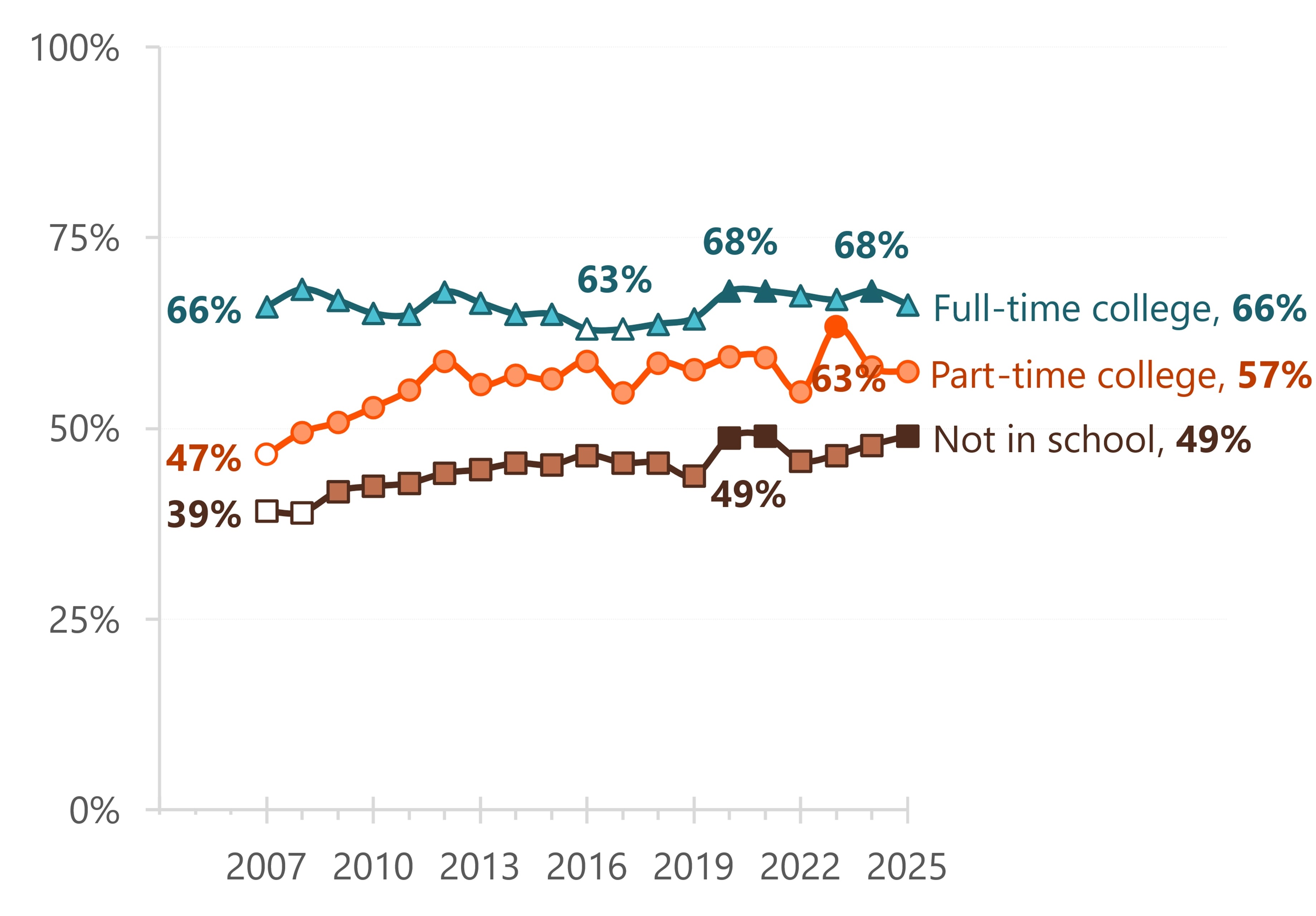
- A greater share of young adults aged 18-24 enrolled in college full time co-resided with parents compared to those enrolled part time or not enrolled.
- Among those enrolled part time and those not in school, the share co-residing with parents increased from 2007 to 2025.
- Co-residing among those enrolled full time remained relatively stable from 2007 to 2025.
- The largest year-over-year increase occurred among those enrolled part time from 2022 to 2023, when their co-residing share increased from 55% to 63%.
- Co-residence peaked among full-time students in 2020, 2021, and 2024 (68%), among part-time students in 2023 (63%), and among those not in school in 2020 and 2021 (49%).
Source: NCFMR analyses of IPUMS-CPS, Current Population Survey, ASEC, 2007-2025

Data Source:
Flood, S., King, M., Rodgers, R., Ruggles, S., Warren, J. R., Backman, D., Breton, E., Cooper, G., Rivera Drew, J. A., Richards, S., Van Riper, D. (2025). Integrated Public Use Microdata Series, Current Population Survey: Version 13.0 [dataset]. Minneapolis, MN: IPUMS.https://doi.org/10.18128/D030.V13.0
References:
Acolin, A., Lin, D., & Wachter, S. M. (2024). Why do young adults coreside with their parents? Real Estate Economics, 52, 7–44. https://doi.org/10.1111/1540-6229.12467
Acolin, A., Lin, D., & Wachter, S. M. (2026). Coresidence: How parental characteristics matter. Real Estate Economics, 1–27. https://doi.org/10.1111/1540-6229.70028
Brown, A. R. (2021). Young adults in the parental home, 2007-2021. Family Profiles, FP-21-23. Bowling Green, OH: National Center for Family & Marriage Research. https://doi.org/10.25035/ncfmr/fp-21-23
Loo, J. (2024). Young adults in the parental home, 2007-2023. Family Profiles, FP-24-02. Bowling Green, OH: National Center for Family & Marriage Research. https://doi.org/10.25035/ncfmr/fp-24-02
Payne, K. K. (2012). Young adults in the parental home, 1940-2010. Family Profiles, FP-12-22. Bowling Green, OH: National Center for Family & Marriage Research. https://www.bgsu.edu/content/dam/BGSU/college-of-arts-and-sciences/NCFMR/documents/FP/FP-12-22.pdf
Payne, K. K. (2016). Young adults in the parental home, 2007-2015. Family Profiles, FP-16-16. Bowling Green, OH: National Center for Family & Marriage Research. https://www.bgsu.edu/content/dam/BGSU/college-of-arts-and-sciences/NCFMR/documents/FP/payne-young-adults-parental-home-2007-2015-fp-16-16.pdf
Payne, K. K. (2019). Young adults in the parental home, 2007 & 2018. Family Profiles, FP-19-04. Bowling Green, OH: National Center for Family & Marriage Research. https://doi.org/10.25035/ncfmr/fp-19-04
Payne, K. K. & Copp, J. (2013). Young adults in the parental home and the Great Recession. Family Profiles, FP-13-07. Bowling Green, OH: National Center for Family & Marriage Research. https://www.bgsu.edu/content/dam/BGSU/college-of-arts-and-sciences/NCFMR/documents/FP/FP-13-07.pdf
Suggested Citation:
Poole, M. (2026). Young adults in the parental home, 2007-2025. Family Profiles, FP-26-19. Bowling Green, OH: National Center for Family & Marriage Research. https://doi.org/10.25035/ncfmr/fp-26-19
Updated: 10/22/2026 06:40PM