
Relationship Status and Cognition Among Females and Males 65+
Family Profile No. 11, 2026
Authors: Mia Hazard & Natalie Bankey
Dementia describes the decline in mental ability that becomes severe enough to interfere with daily life (Smith & Bondi, 2013; Alzheimer’s Association, 2026). In 2017, about 50 million people were reported to be living with dementia and that number is expected to more than triple by 2050 to 152 million (World Health Organization, 2017). Like dementia, cognitive impairment is characterized by memory and cognitive problems that exceed those expected with normal aging. Unlike dementia, however, these impairments are not severe enough to substantially interfere with everyday functioning (Smith & Bondi, 2013). A meta-analysis found that never married and widowed individuals were at greater risk of dementia than married individuals (Sommerlad et al., 2018). Likewise, a longitudinal study using the Health and Retirement Study (HRS) found that all unmarried groups—including cohabiting, divorced, widowed, and never married adults—had higher odds of developing dementia than married adults, with divorced adults experiencing the greatest odds (Liu et al., 2020). Using data from the 2018 HRS[1], this family profile examines differences in cognition by relationship status among females and males aged 65 and older. Cognition was a pre-constructed summary score[2] that differentiated among three groups: not impaired, has cognitive impairment but not dementia (CIND), and has dementia. These categories are consistent with previous research using the HRS to measure cognitive impairment in later life, known as the “Langa-Weir Classifications” (Crimmins et al., 2011; Health and Retirement Study, 2022b).
[1] The HRS (Health and Retirement Study) is sponsored by the National Institute on Aging (grant number NIA U01AG009740) and is conducted by the University of Michigan.
[2] Score and variables come from Langa-Weir Classification of Cognitive Function (1995-2022) on the HRS website (Health and Retirement Study, 2022).
Relationship Status Variation in Cognition Among Females 65+
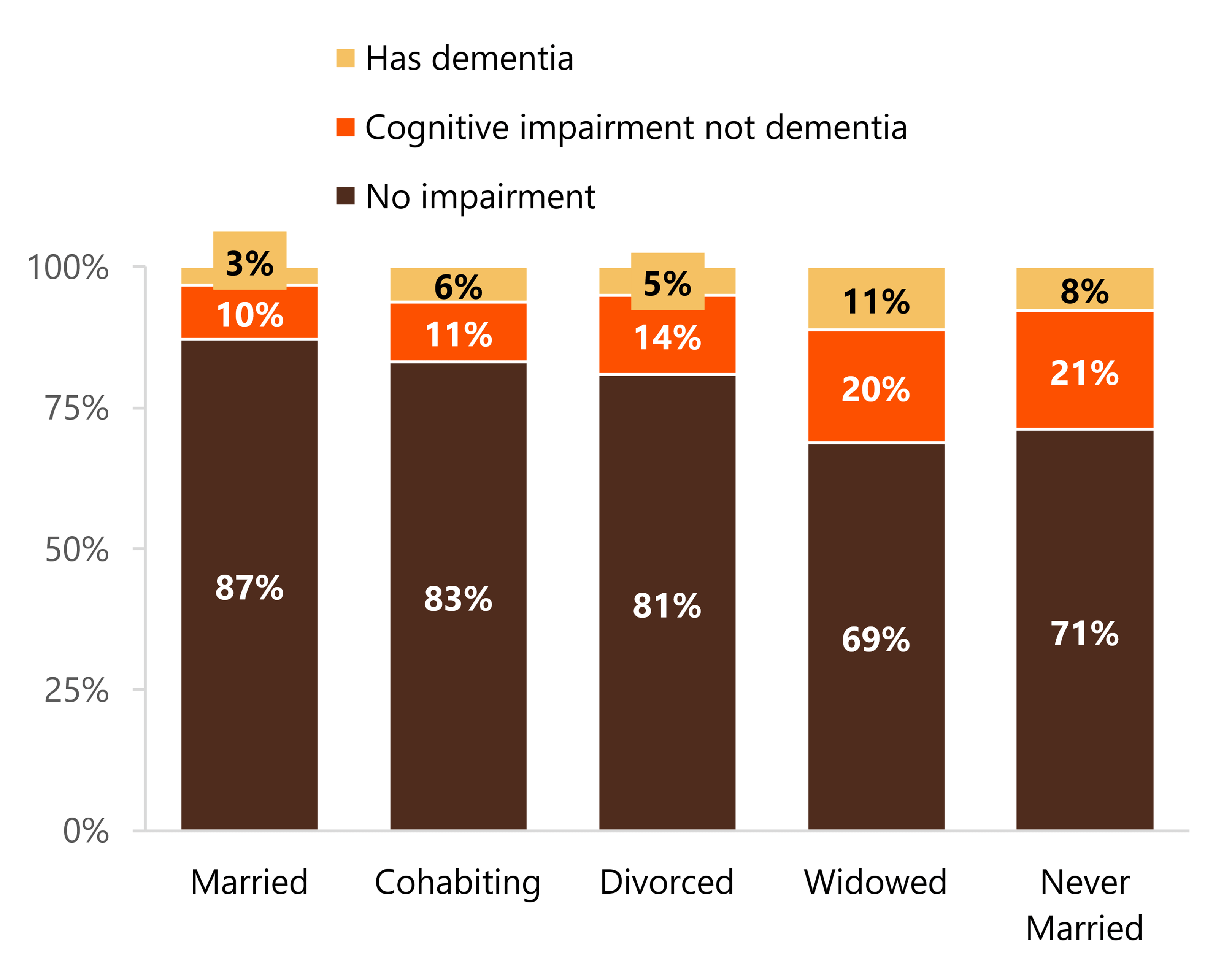
- The share of females with dementia varied by relationship status. The lowest share was observed among married females (3%) and the highest share among widowed females (11%).
- Similar to the patterns observed for dementia, the smallest share of females who experienced cognitive impairment was among those who were married (10%). The prevalence of impairment was notably higher among widowed (20%) and never-married females (21%).
- Approximately 87% of married females showed no cognitive impairment, dropping to around 70% for those who were widowed or never married.
Figure 1. Relationship Status Variation in Cognition Among Females 65+
Source: NCFMR analyses of the Health and Retirement Study, 2018
Relationship Status Variation in Cognition Among Males 65+
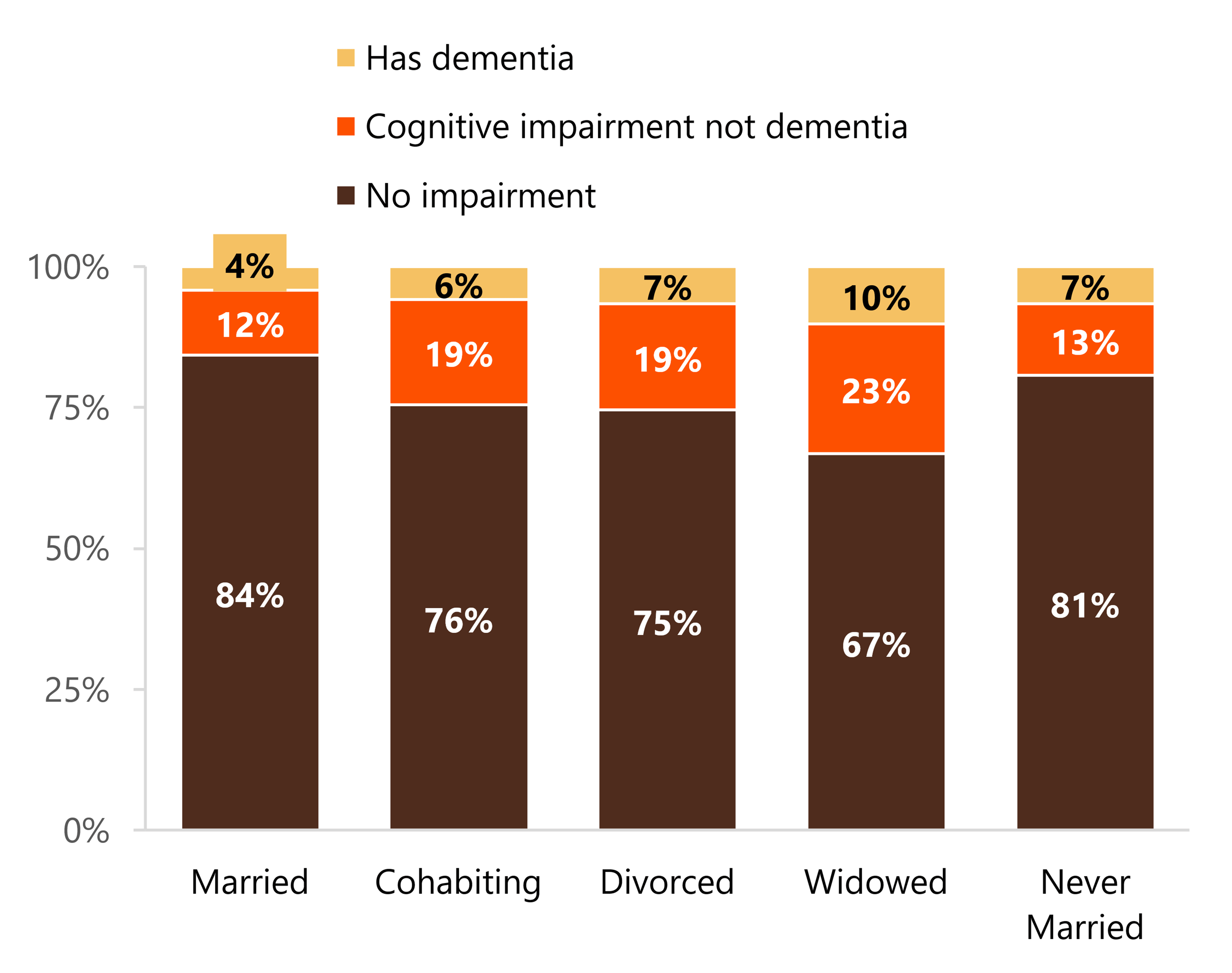
Figure 2. Relationship Status Variation in Cognition Among Males 65+
Source: NCFMR analyses of the Health and Retirement Study, 2018
- The share of males with dementia also varied by relationship status. The lowest share was observed among married males (6%), and the highest share among widowed males (11%).
- Similar to dementia, the lowest share of males who experienced cognitive impairment were married (12%) whereas widowed males had the highest (23%).
- About 84% of married males showed no cognitive impairment. The share among widowers was 67%.

Data Sources:
Health and Retirement Study (2018). RAND HRS Longitudinal File 2018 (V2) public use dataset. Produced and distributed by the University of Michigan with funding from the National Institute on Aging (grant numbers NIA U01AG009740 and NIA R01AG073289). Ann Arbor, MI, (May 2022).
Health and Retirement Study (2022). 2018 HRS Core (Final V2.0) public data set. Produced and distributed by the University of Michigan with funding from the National Institute on Aging (grant number NIA U01AG009740). https://doi.org/10.7826/DHBR7907
RAND HRS Longitudinal File 2018 (2022). Produced by the RAND Center for the Study of Aging, with funding from the National Institute on Aging (grant numbers NIA U01AG009740 and NIA R01AG073289) and the Social Security Administration. Santa Monica, CA.
References:
Alzheimer’s Association (2026). What is Dementia? Retrieved from https://www.alz.org/alzheimers-dementia/what-is-dementia
Crimmins, E. M., Kim, J. K., Langa, K. M., & Weir, D. R. (2011). Assessment of cognition using surveys and neuropsychological assessment: the Health and Retirement Study and the Aging, Demographics, and Memory Study. The Journal of Gerontology. Series B, Psychological Sciences and Social Sciences, 66 Suppl 1(Suppl 1), i162–i171. https://doi.org/10.1093/geronb/gbr048
Health and Retirement Study (2022b). Langa-Weir Classification of Cognitive Function (1995-2022). Produced and distributed by the University of Michigan with funding from the National Institute on Aging (grant number NIA U01AG009740). https://doi.org/10.7826/DHBR7907
Liu, H., Zhang, Z., Choi, S. W., & Langa, K. M. (2020). Marital Status and Dementia: Evidence from the Health and Retirement Study. The Journal of Gerontology. Series B, Psychological Sciences and Social Sciences, 75(8), 1783–1795. https://doi.org/10.1093/geronb/gbz087
Sommerlad, A., Ruegger, J., Singh-Manoux, A., Lewis, G., & Livingston, G. (2018). Marriage and risk of dementia: Systematic review and meta-analysis of observational studies. Journal of Neurology, Neurosurgery, and Psychiatry, 89, 231–238. https://doi.org/10.1136/jnnp-2017-316274
Smith, G. E., & Bondi, M. W. (2013). Mild cognitive impairment and dementia: Definitions, diagnosis, and treatment. New York: Oxford University Press.
World Health Organization. (2017). Dementia [Fact sheet]. Retrieved from https://www.who.int/en/news-room/fact-sheets/detail/dementia
Suggested Citation:
Hazard, M., & Bankey, N. (2026). Relationship status and cognition among females and males 65+. Family Profiles, FP-26-11. Bowling Green, OH: National Center for Family & Marriage Research. https://doi.org/10.25035/ncfmr/fp-26-11
Updated: 07/24/2026 12:03PM