
Prevalence of Grandparenthood in the U.S., 2025
Family Profile No. 20, 2026
Author: Krista K. Westrick-Payne
In 2025, approximately 60.5 million adults aged 50 and older were grandparents, according to the Survey of Income and Program Participation (SIPP, 2025). The SIPP is a nationally representative household-based survey and is designed to provide comprehensive family and social information on individuals and families. The SIPP gathers information on all individuals who live in a surveyed household and directly asks respondents if they are a grandparent. For these reasons, the SIPP is one of the few surveys that identifies nonresident grandparents. In this profile, we examine the prevalence of grandparenthood among adults aged 50 and older by race/ethnicity, educational attainment, and current relationship status. This profile is an update of profiles FP-14-14 (Stykes, Manning, & Brown, 2014), FP-18-03 (Wu, 2018), FP-23-01 (Westrick-Payne, 2023), and FP-24-21 (Westrick-Payne, 2024).
Trend
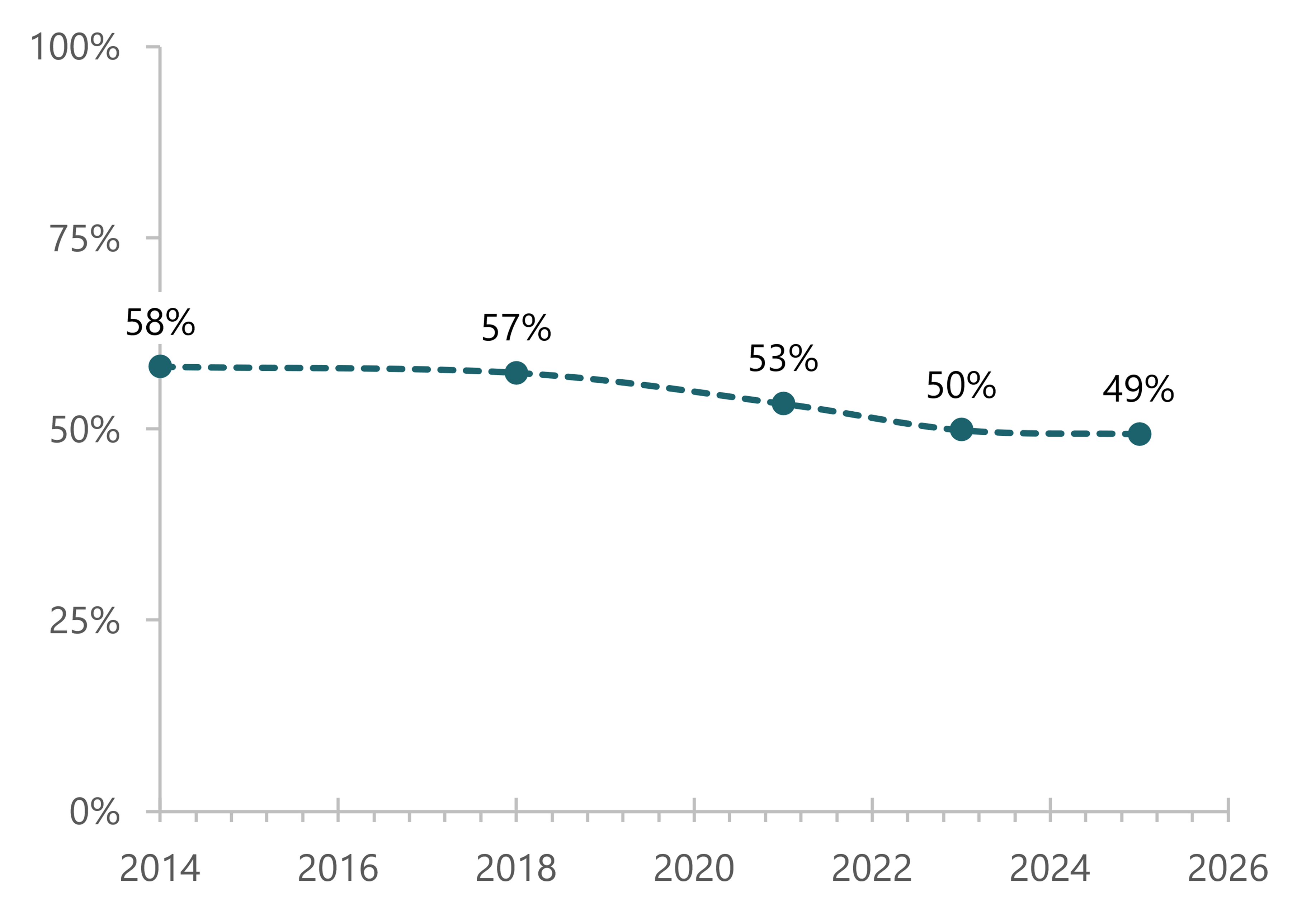
- The share of older adults who reported having a grandchild has declined from 58% of those aged 50 and older in 2014 to 49% in 2025. This represents about 60.4 million people.
Figure 1. Trend in the Prevalence of Grandparenthood, 2014, 2018, 2021, 2023, & 2025
Source: NCFMR analyses of U.S. Census Bureau, Survey of Income and Program Participation, 2014, 2018, 2021, 2023, & 2025
Race/Ethnicity
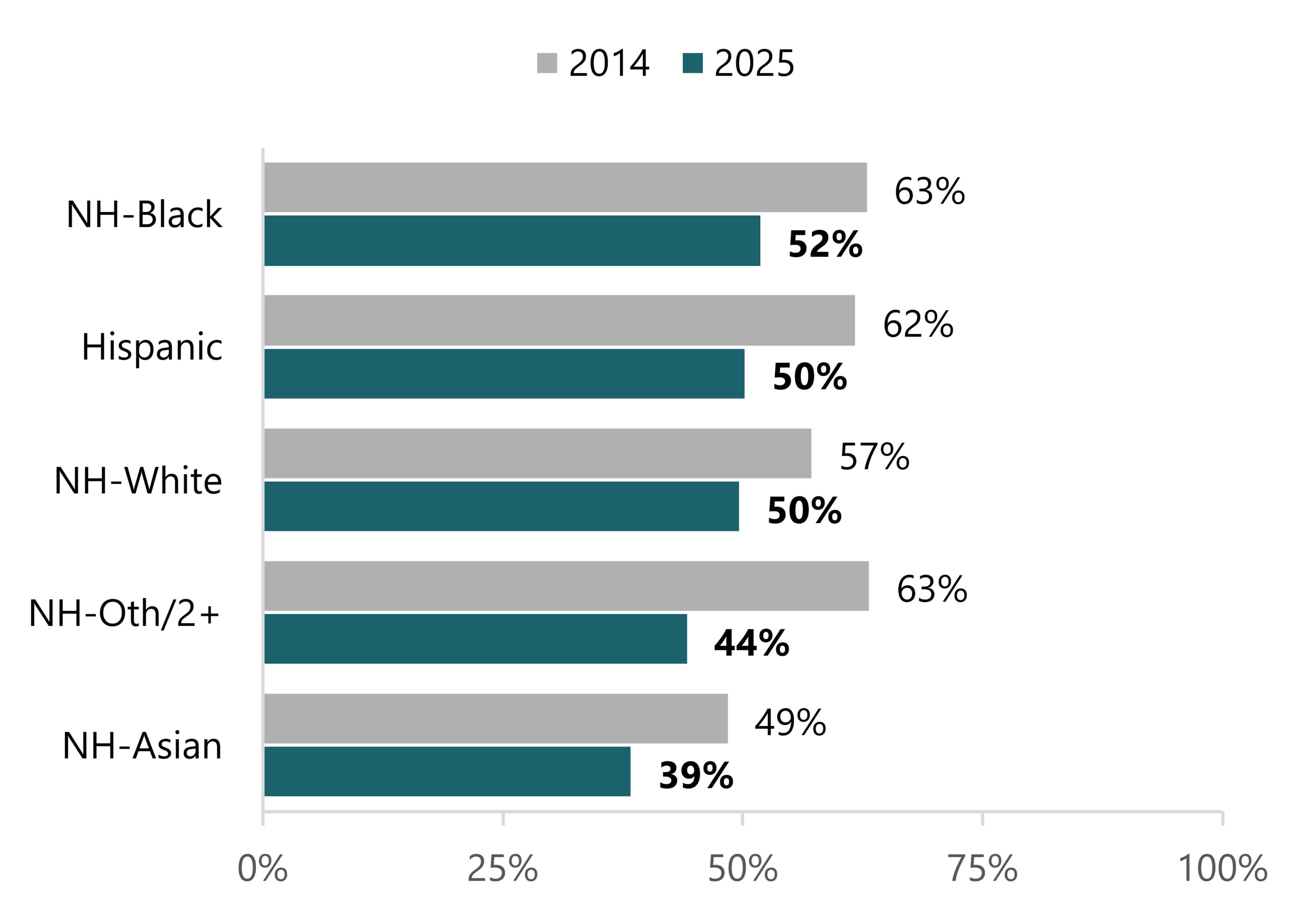
Figure 2. Prevalence of Grandparenthood by Race/Ethnicity, 2014 & 2025
Source: NCFMR analyses of U.S. Census Bureau, Survey of Income and Program Participation, 2025
Note. NH = Non-Hispanic. NH Asian includes non-Hispanic individuals identifying as Asian or Native Hawaiian and Other Pacific Islander. Other/2+ Races includes non-Hispanic individuals identifying as American Indian or Alaska Native alone, some other race alone, or two or more races.
- The share of adults aged 50 and older who reported being a grandparent declined since 2014 across racial and ethnic groups considered here. The largest decline was among non-Hispanic Other/2+ races.
- At 52%, non-Hispanic Black older adults (aged 50+) had the highest share who were grandparents in 2025.
- Half (50%) of non-Hispanic White and Hispanic older adults (aged 50+) were also grandparents.
- Non-Hispanic Other/2+ races and non-Hispanic Asian identifying individuals had the smallest shares who were grandparents (43% and 39%, respectively).
Educational Attainment
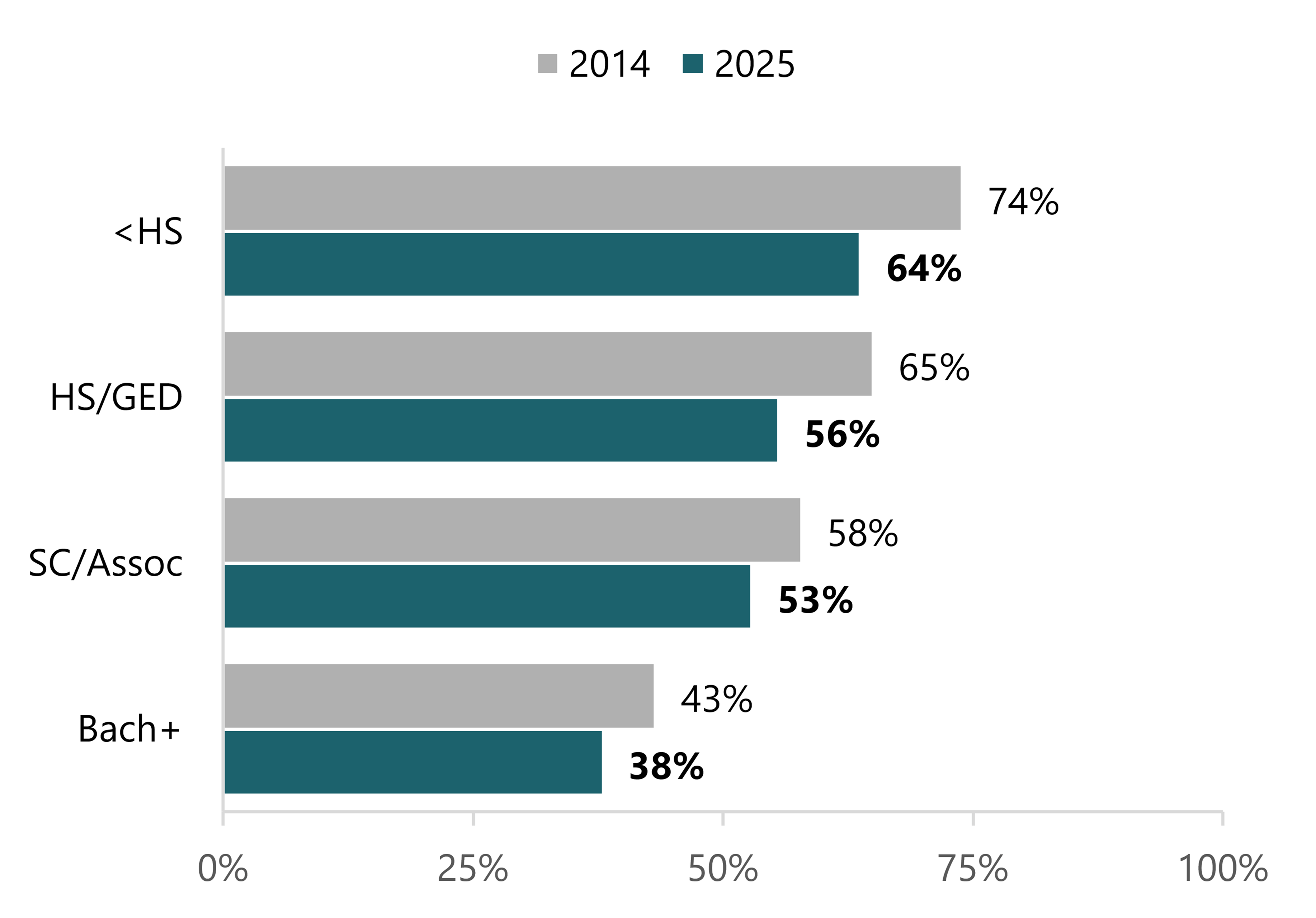
- The share of adults aged 50 and older who reported being a grandparent has also declined since 2014 across educational attainment groups considered here. The prevalence of grandparenthood was lower at higher levels of educational attainment.
- Among those aged 50 or older in 2025 without a high school diploma/GED, nearly two-thirds (64%) were grandparents.
- Fifty-six percent of those with a high school diploma/GED and 53% of those with some college education or an associate degree were grandparents in 2025.
- Being a grandparent was least common among older adults who had at least a bachelor’s degree (38%).
Figure 3. Prevalence of Grandparenthood by Educational Attainment, 2014 & 2025
Source: NCFMR analyses of U.S. Census Bureau, Survey of Income and Program Participation, 2025
Note. HS = high school; SC = some college; Assoc = associate degree; Bach+ = bachelor’s degree or higher.
Relationship Status
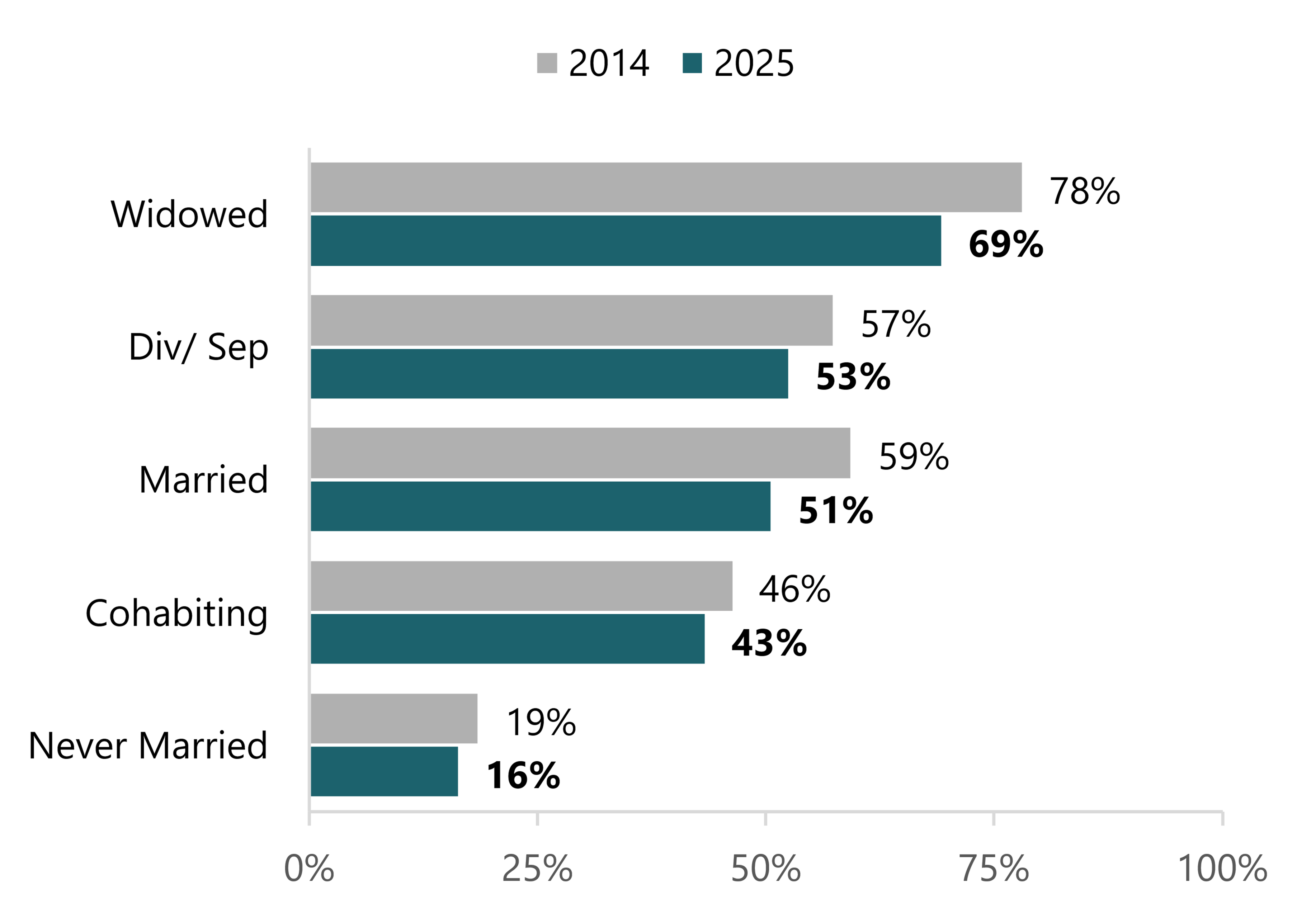
Figure 4. Prevalence of Grandparenthood by Relationship Status, 2014 & 2025
Source: NCFMR analyses of U.S. Census Bureau, Survey of Income and Program Participation, 2025
Note. Div/ Sep = divorced or separated
- The prevalence of grandparenthood was lower in 2025 than in 2014 among all older adults across all relationship statuses.
- Being a grandparent was most common among widowed adults, at 69%. This may reflect the older age composition of the widowed population.
- Similar shares of divorced/separated and married adults were grandparents (53% and 51%, respectively).
- Slightly more than two-fifths (43%) of cohabiting older adults were grandparents.
- Only 16% of never-married older adults reported being a grandparent in 2025.

Data Source:
U.S. Census Bureau, Survey of Income and Program Participation 2014, Wave 1, 2018, 2021, 2023, & 2025. https://www.census.gov/programs-surveys/sipp.html
References:
Stykes, B., Manning, W. D., & Brown, S. L. (2014). Grandparenthood in the U.S.: Prevalence of grandparenthood among adults aged 50+. Family Profiles, FP-14-14. Bowling Green, OH: National Center for Family & Marriage Research. https://www.bgsu.edu/content/dam/BGSU/college-of-arts-and-sciences/NCFMR/documents/FP/FP-14-14-grandparent-50-plus.pdf
Westrick-Payne, K. K. (2023). Prevalence of grandparenthood in the U.S., 2021. Family Profiles, FP-23-01. Bowling Green, OH: National Center for Family & Marriage Research. https://doi.org/10.25035/ncfmr/fp-23-01
Westrick-Payne, K. K. (2024). Prevalence of grandparenthood in the U.S., 2023. Family Profiles, FP-24-21. Bowling Green, OH: National Center for Family & Marriage Research. https://doi.org/10.25035/ncfmr/fp-24-21
Wu, H. (2018). Prevalence of grandparenthood in the U.S. Family Profiles, FP-18-03. Bowling Green, OH: National Center for Family & Marriage Research. https://doi.org/10.25035/ncfmr/fp-18-03
Suggested Citation:
Westrick-Payne, K. K. (2026). Prevalence of grandparenthood in the U.S., 2025. Family Profiles, FP-26-20. Bowling Green, OH: National Center for Family & Marriage Research. https://doi.org/10.25035/ncfmr/fp-26-20
Updated: 11/03/2026 05:35PM