
Living With an Unmarried Partner or Spouse Among U.S. Adults Aged 50+, 2008-2024
An Aging Family Portrait (AFP-26-06)
Krista K. Westrick-Payne & Susan L. Brown

Introduction
A majority (61%) of U.S. adults aged 50 and older are in coresidential partnerships, whether because they are married or living with an unmarried partner, a level that remains unchanged from 2008. However, the patterns of marriage versus cohabitation likely have shifted in recent years, reflecting both the persistent consequences of union formation (and dissolution) experiences earlier in the life course and union transitions during various stages of older adulthood. Using 17 years of data from the American Community Survey (2008-2024), this portrait examines trends in the shares of U.S. adults aged 50-64, 65-74, and 75 and older living with an unmarried partner or spouse. It also examines trends by marital history and sociodemographic variation in 2024.
Living With an Unmarried Partner or Spouse, 2008-2024
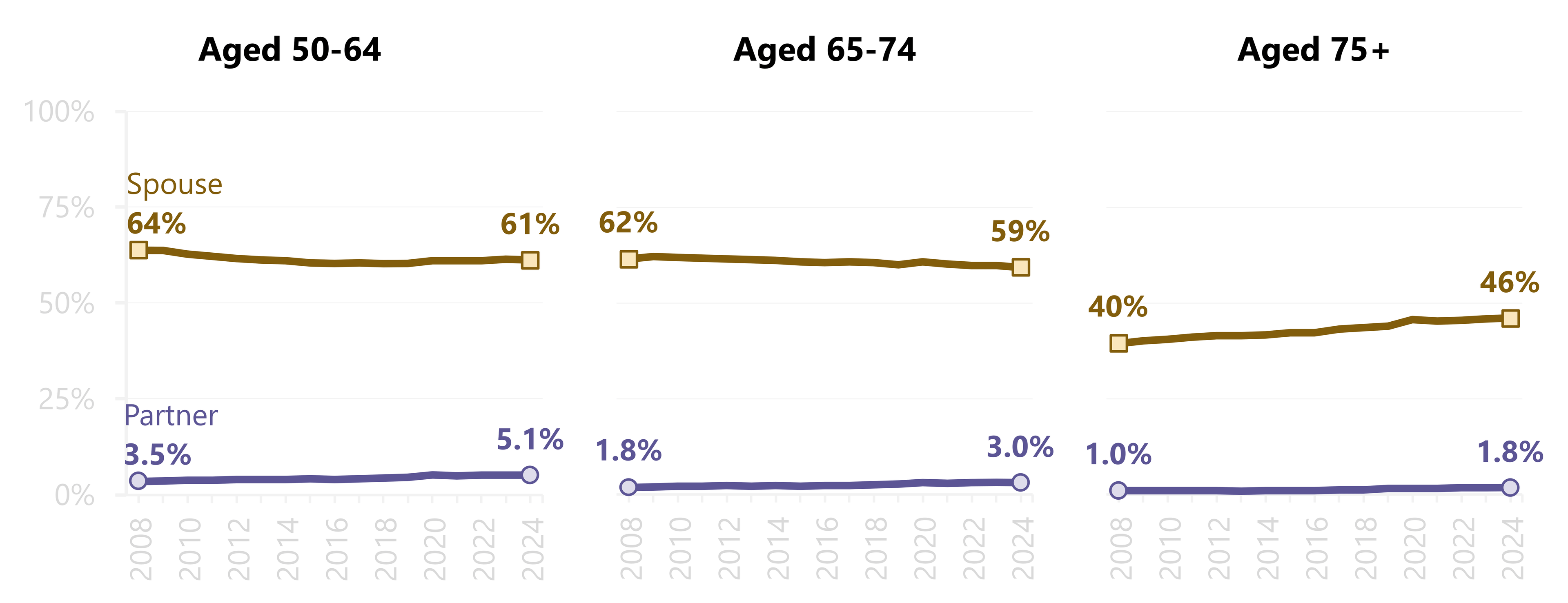
Living with an unmarried partner became more common among adults aged 50 and older between 2008 and 2024, increasing across all three age groups.
- Living with a spouse declined slightly among those aged 50-64 and 65-74 but increased among those aged 75 and older, from 40% to 46%.
Figure 1. Living With an Unmarried Partner or Spouse by Age Group, U.S. Adults Aged 50+, 2008-2024
Source: CAF analysis of U.S. Census Bureau, American Community Survey, 1-year files, 2008-2024 (IPUMS USA)
Marital History Among Those Living With an Unmarried Partner, 2008-2024
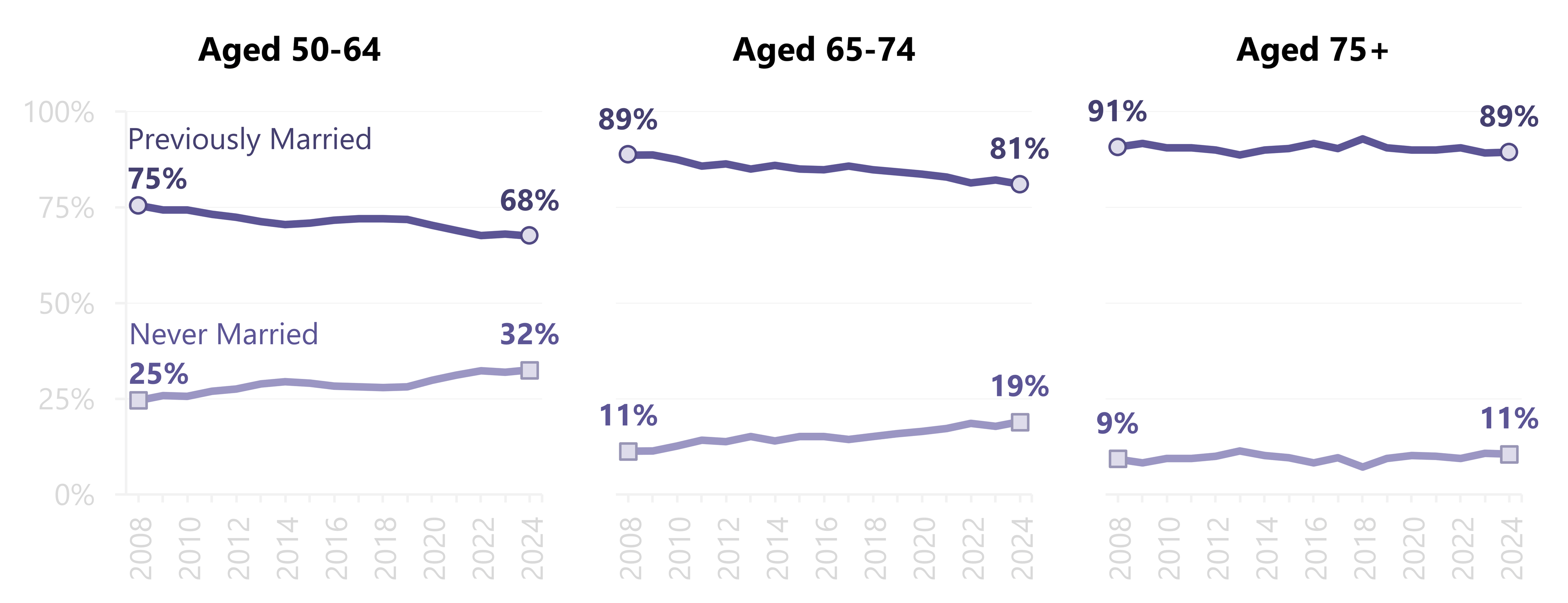
Most adults aged 50 and older living with an unmarried partner had been previously married, although this share declined between 2008 and 2024 among those aged 50-64 and 65-74.
- The share who had never married increased from 25% to 32% among those aged 50-64 and from 11% to 19% among those aged 65-74.
Figure 2. Marital History Among Those Living with an Unmarried Partner by Age Group, U.S. Adults Aged 50+, 2008-2024
Source: CAF analysis of U.S. Census Bureau, American Community Survey, 1-year files, 2008-2024 (IPUMS USA)
Marital History Among Those Living With a Spouse, 2008-2024
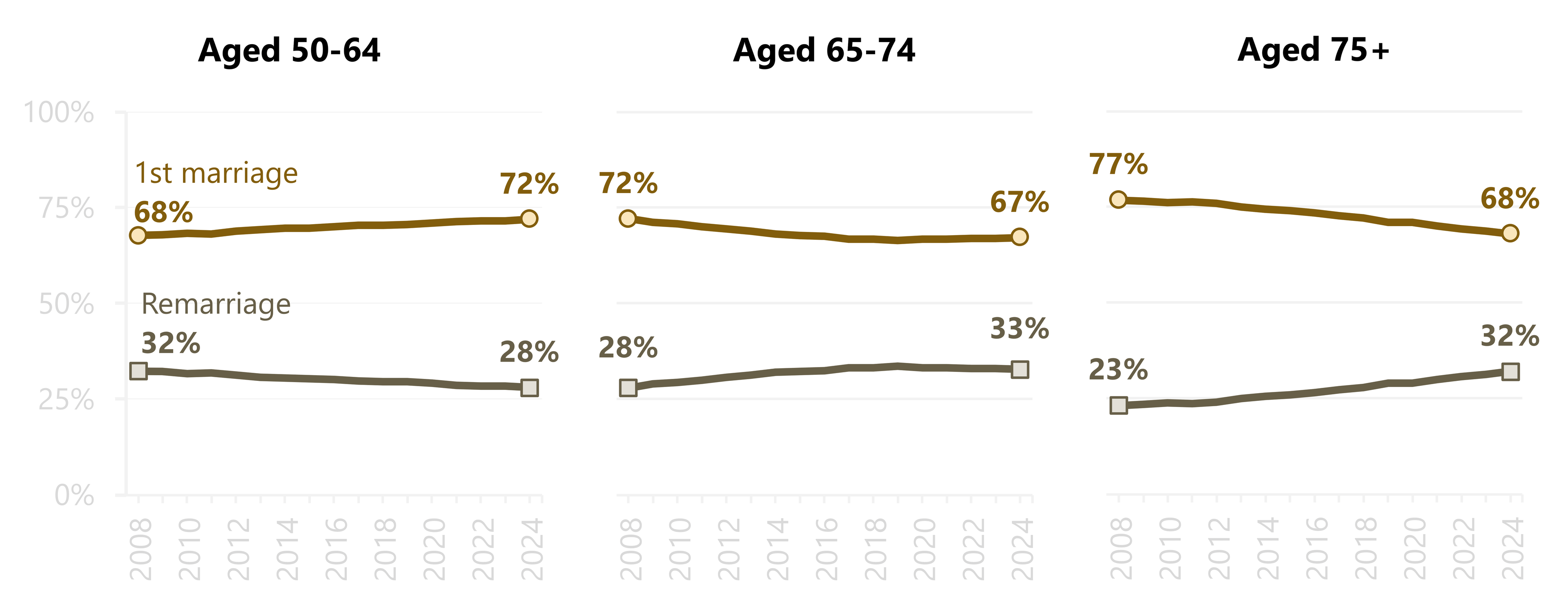
The age pattern of remarriage shifted between 2008 and 2024 among adults living with a spouse.
- In 2008, the share in a remarriage decreased with age, from 32% among those aged 50–64 to 23% among those aged 75 and older; by 2024, the share was lowest among those aged 50–64 (28%).
Figure 3. Marital History Among Those Living with a Spouse by Age Group, U.S. Adults Aged 50+, 2008-2024
Source: CAF analysis of U.S. Census Bureau, American Community Survey, 1-year files, 2008-2024 (IPUMS USA)
Living with an Unmarried Partner or Spouse by Sex, 2024
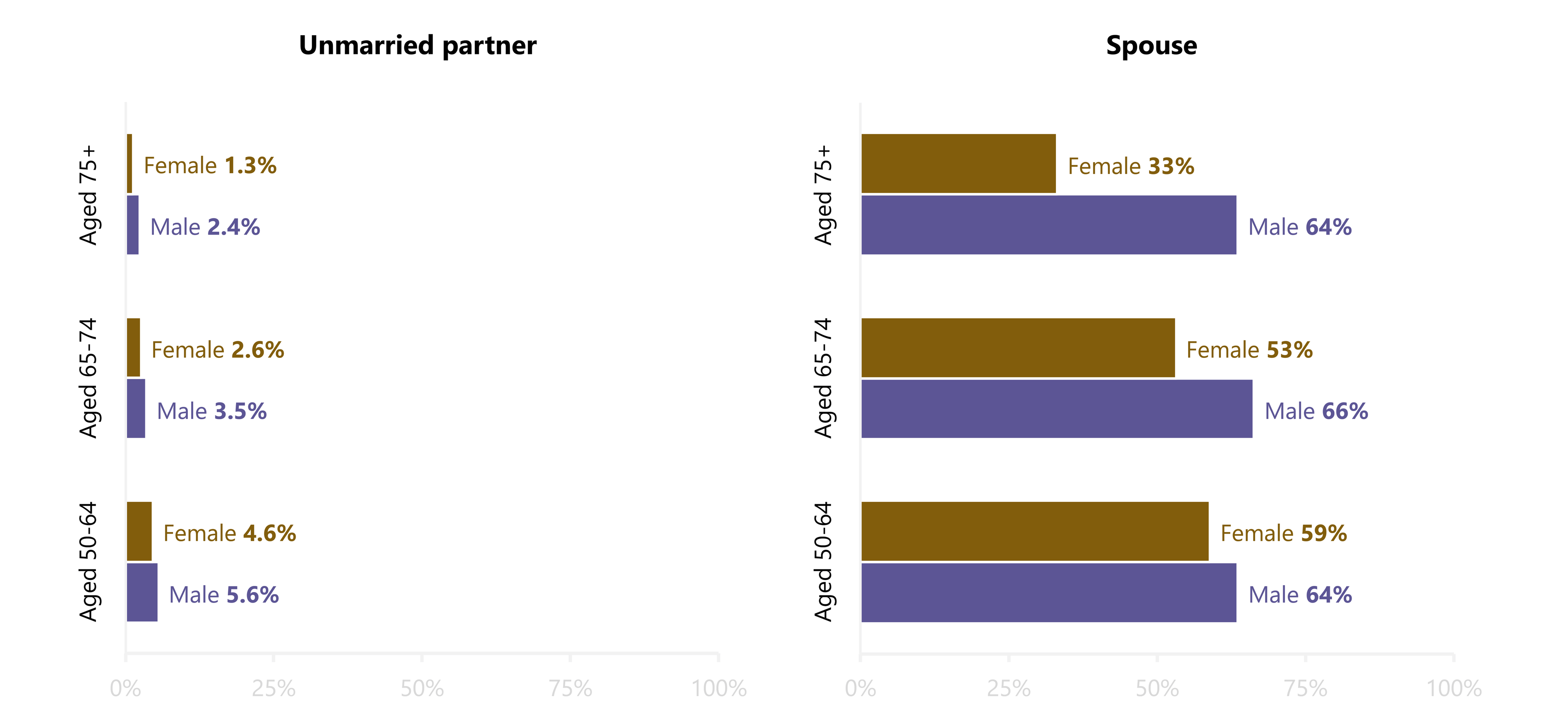
Males had higher shares than females living with either an unmarried partner or a spouse at every age in 2024.
- The sex difference in living with a spouse was largest at ages 75 and older: 64% of males lived with a spouse compared with 33% of females.
Figure 4. Share Living with an Unmarried Partner or a Spouse by Sex and Age Group, U.S. Adults Aged 50+, 2024
Source: CAF analysis of U.S. Census Bureau, American Community Survey, 1-year files, 2024 (IPUMS USA)
Living with an Unmarried Partner or Spouse by Race and Ethnicity, 2024
Racial and ethnic differences were considerably larger in the share living with a spouse than in the share living with an unmarried partner in 2024.
- Across age groups, NH Asian adults had the highest share living with a spouse, while NH Black adults had the lowest.
Figure 5. Share Living with an Unmarried Partner or a Spouse by Race/Ethnicity and Age Group, U.S. Adults Aged 50+, 2024
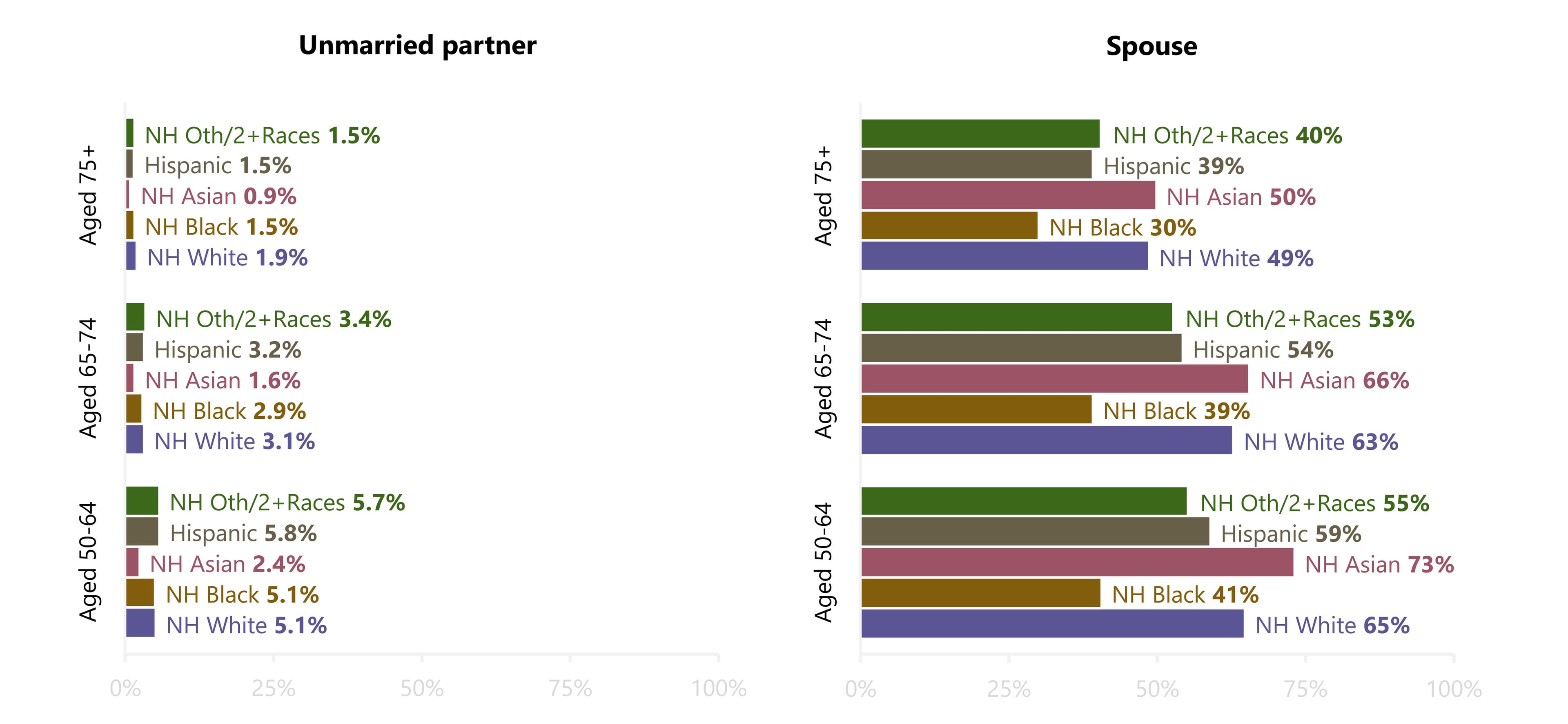
Source: CAF analysis of U.S. Census Bureau, American Community Survey, 1-year files, 2024 (IPUMS USA)
Note. NH = Non-Hispanic; Oth = Other. “NH Asian” includes non-Hispanic individuals identifying as Asian or Native Hawaiian and Other Pacific Islander. “Oth/2+ Races” includes non-Hispanic individuals identifying as American Indian or Alaska Native alone, some other race alone, or two or more races.
Living with an Unmarried Partner or Spouse by Educational Attainment, 2024
The share living with a spouse was higher at each successive level of educational attainment across all three age groups.
- Among those aged 50-64, the share living with an unmarried partner generally decreased as educational attainment increased, from 6.4% among those with less than a high school education to 3.4% among those with a master’s or professional degree or higher.
Figure 6. Share Living with an Unmarried Partner or a Spouse by Educational Attainment and Age Group, U.S. Adults Aged 50+, 2024
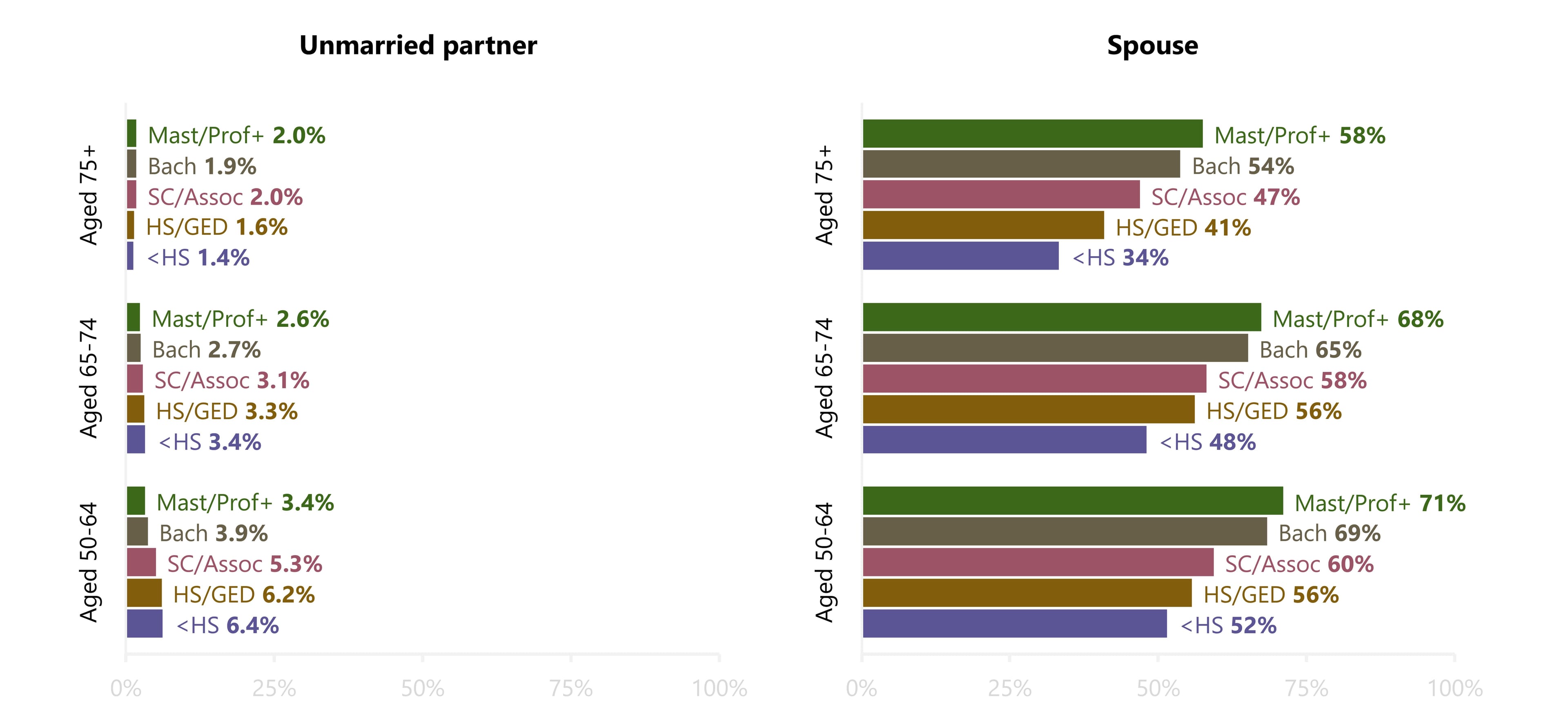
Source: CAF analysis of U.S. Census Bureau, American Community Survey, 1-year files, 2024 (IPUMS USA)
Note. HS = high school; GED = General Educational Development credential; SC = some college; Assoc = associate degree; Bach = bachelor’s degree; Mast/Prof+ = master’s or professional degree or higher.
Data Source
Ruggles, S., Flood, S., Sobek, M., Backman, D., Cooper, G., Rivera Drew, J. A., Richards, S., Rodgers, R., Schroeder, J., & Williams, K. C. W. (2025). IPUMS USA: Version 16.0 [Dataset]. Minneapolis, MN: IPUMS. https://doi.org/10.18128/D010.V16.0
Suggested Citation
Westrick-Payne, K. K., & Brown, S. L. (2026). Living with an unmarried partner or spouse among U.S. adults aged 50+, 2008-2024. An Aging Family Portrait, AFP-26-06. Bowling Green, OH: Center for Aging Families. https://doi.org/10.25035/caf/afp-26-06
Research reported in this publication was supported by the National Institute on Aging of the National Institutes of Health under award number P30AG096979. The content is solely the responsibility of the authors and does not necessarily represent the official views of the National Institutes of Health.
Updated: 09/11/2026 12:34PM