
Paleontology Laboratory and Fossil Collections
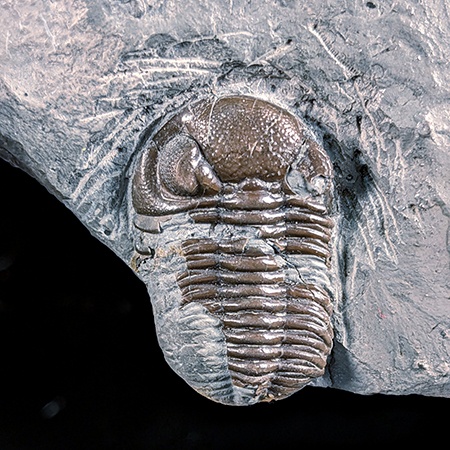
Welcome to BGSU’s Paleontology Laboratory and Fossil Collections! BGSU is one of the only universities in the United States to offer an undergraduate specialization in Paleobiology, completed within our Geology B.S. degree program. In support of this program, the School of Earth, Environment & Society maintains one of the largest collections of fossils in the state of Ohio.
Undergraduate and graduate students in paleontology pursue research on how organisms have responded to climate changes during Earth’s long history, using phylogenetics, morphometrics, and ecological techniques to link processes of evolution, ecology, and extinction in marine and terrestrial organisms.
Please explore the tabs below to learn more about our collections, research, teaching, and outreach activities.

Dr. Peg Yacobucci | Professor of Geology, Professor of Service Excellence, Faculty Mentor for Paleobiology Specialization
Caroline Rosner | MS Student
MS Thesis - Covariation between Cretaceous ammonoid cephalopod morphology and climate perturbations
Jasper Shaw | MS Student
MS Thesis - Morphological and survivorship patterns of the ammonoid family Haploceratidae through Jurassic-Cretaceous cooling events: A Bayesian phylogenetic approach
Ina Terry | Adjunct Instructor and Alumna
MS thesis - The Ohio Pleistocene Mammal Database (OPMDB): Creation and Preliminary Taphonomic and Spatial Analyses, http://rave.ohiolink.edu/etdc/view?acc_num=bgsu1377456136
Allen Uycoque | MS Student (2026)
MS Thesis - Impact of Ocean Anoxic Event 3 (OAE3) on the Paleobiogeography of Coniacian-Santonian Ammonoids
Fitzroy Walsh| BS Geology (Paleobiology) Student
Honors Thesis - Assessing Historical Lake Erie Fish Biomass through an Investigation of Teeth Preserved in Sediment
Niamh Winright | BS Geology (Paleobiology) Student
Honors Thesis - The Effects of Heavy Metal Exposure on the Shell Microstructure and Pigment of Modern and Fossil Gastropods
RECENT ALUMNI
Camden Cornelius| MS Student (2023)
MS Thesis - Evaluation of Conventional Analog and New Digital Modeling Methods for Describing Ammonoid Suture Patterns, http://rave.ohiolink.edu/etdc/view?acc_num=bgsu1683745822743357
Roya Franseth | BS Geology (Paleobiology) Student (2023)
Honors Thesis - Testing Pedagogical Approaches to Online Lecture: Effects of Background Music and Interactive Video Series on Student Retention of Prior Conception-Correcting Information on Climate Change
Bart Frazier | MS Student (2024)
MS Thesis - North American Tayassuidae Ecological Niche Modeling and Correlations with Early Humans, http://rave.ohiolink.edu/etdc/view?acc_num=bgsu1720124518439699
Ken Layton | MS Student (2024)
MS Thesis - Baculitid Phylogenetic Reconstruction from a Bayesian Perspective, http://rave.ohiolink.edu/etdc/view?acc_num=bgsu1724581886924004
Joshua Luurtsema| MS Student (2025)
MS Thesis - Niche Breadth as a Constraint on Morphological Plasticity in the genus Teleoceras, http://rave.ohiolink.edu/etdc/view?acc_num=bgsu1763121922211407
Galen Schwartzberg| MS Student (2025)
MS Thesis - Quantifying 3D Spatial Relationships and Ecological Interactions of Devonian Sclerobionts on Brachiopod Shells Using Structure-from-Motion Photogrammetry, http://rave.ohiolink.edu/etdc/view?acc_num=bgsu1747667562747214
Sam Smith | BS Geology (Paleobiology) Student (2025)
Honors Thesis - Biogeochemical Analysis of the Mastodon Material at BGSU
Gabriel Soto | BS Geology (Paleobiology) Student (2024)
Research Project - Quantifying trends in ammonoid suture complexity through the Cenomanian-Turonian interval
Kaylee Walty | MS Student (2024)
MS Thesis - Deciphering Desmoceratoidea Turnover Rates during Cenomanian-Turonian Ocean Anoxic Event 2 using a Bayesian Phylogenetic Approach, http://rave.ohiolink.edu/etdc/view?acc_num=bgsu1720725593809948
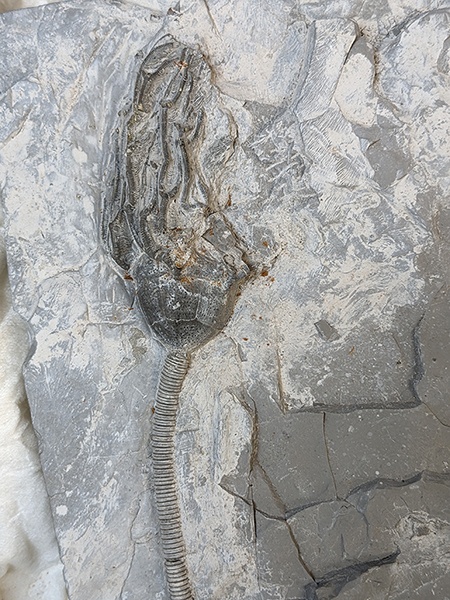
BGSU is home to one of the largest collections of fossils in the state of Ohio, including over 120,000 Paleozoic marine invertebrate fossils and smaller holdings of Mesozoic and Cenozoic marine and terrestrial specimens. We have particular strengths in marine life of the Devonian and Pennsylvanian periods, as well as a collection of Plio-Pleistocene marine macro- and microfossils from Florida.
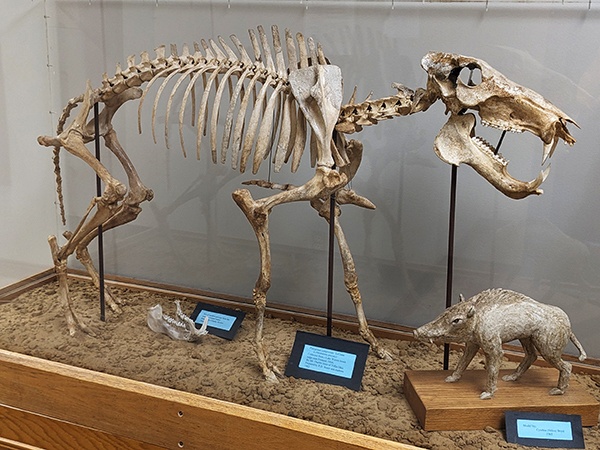
Among our Ice Age collection are BGSU's flat-headed peccary, Platygonus compressus, and our mastodon, Mammut americanum, both from northwest Ohio.
The paleontology lab includes mechanical and chemical fossil preparation equipment and a digital photography/photogrammetry set-up.
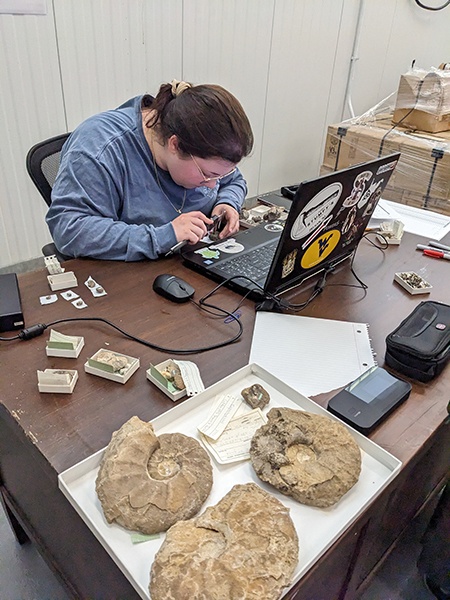
BGSU faculty and students pursue research on a wide range of paleontological topics. Two primary research areas are:
- Understanding how ancient life responded to environmental changes, which can inform efforts to mitigate the negative impacts of modern anthropogenic climate change
- Exploring causes of evolution and extinction: Why do some groups diversify and make lots of new species while others evolve slowly, if at all? Why do some groups suffer widespread extinction during Earth crises while other groups survive unscathed?
Our lab group has particular expertise in quantitative approaches to studying fossils, including morphometrics, phylogenetics, paleoecology, and paleobiogeography, and much of our work focuses on the Devonian, Cretaceous, and Pleistocene time intervals.
Current Externally Funded Projects
Collaborative research in partnership with University of Nebraska-Lincoln: Associations between climate shifts and ammonoid turnover across second-tier extinctions during the early Late Cretaceous greenhouse
National Science Foundation Award No. 2129629, April 2022-March 2026, $164,998
As climate changes, it will be important to accurately predict how environmental shifts will impact marine animals in order to assist conservation biology efforts. Cephalopods like squid and octopus are ecologically important, as both predator and prey, and economically important for the U.S. fisheries industry. This project will investigate patterns of evolution and extinction in fossil relatives of modern squid and octopus, the ammonoids. Between 90 and 100 million years ago, Earth experienced multiple episodes of cooling and warming. By investigating the traits that helped some ammonoid species survive these events, the project will identify key factors that control extinction risk in cephalopods. BGSU students Kaylee Walty (MS, Geology), Caroline Rosner (MS, Geology), and Gabriel Soto (BS, Geology) have worked on this project.
Recent Research Conference Presentations
* indicates BGSU student presenter or co-author; presenter underlined for multi-authored presentations
*Uycoque, Allen, and Yacobucci, Margaret M. 2025. Biogeographical response of Late Cretaceous ammonites during Ocean Anoxic Event 3 subevents. Geological Society of America Abstracts with Programs 57(6). doi: 10.1130/abs/2025AM-10879
Yacobucci, Margaret M., *Layton, Ken, and *Walty, Kaylee. Submitted 2025. The challenges and possibilities of homoplasy in cephalopod phylogenetics. Geological Society of America Abstracts with Programs 57(6). doi: 10.1130/abs/2025AM-9062.
Howard, L., Wagner, Peter J., *Layton, Ken, *Walty, Kaylee, and Yacobucci, Margaret. 2025. Cephalopod disparity over OAE2. Northeastern/North-Central Geological Society of America Meeting, Erie, Pennsylvania. Geological Society of America Abstracts with Programs 57(3). doi: 10.1130/abs/2025NE-409032.
*Smith, Samuel, and Yacobucci, Margaret, 2025. Geologic age and isotopic analysis of a young mastodon from northwest Ohio. Northeastern/North-Central Geological Society of America Meeting, Erie, Pennsylvania. Geological Society of America Abstracts with Programs 57(3). doi: 10.1130/abs/2025NE-408023.
*Smith, Tanner, Yacobucci, Margaret, and Devault, Nathan. 2025. Paleoecology of the Pecatonica and McGregor Members of the Platteville Formation, eastern Dane County, Wisconsin. Northeastern/North-Central Geological Society of America Meeting, Erie, Pennsylvania. Geological Society of America Abstracts with Programs 57(3). doi: 10.1130/abs/2025NE-408056.
Howard, L., *Layton, Ken, *Walty, Kaylee, Wagner, Peter J., and Yacobucci, Margaret. 2025. Varying modes of speciation in Cretaceous ammonoid clades. Northeastern/North-Central Geological Society of America Meeting, Erie, Pennsylvania. Geological Society of America Abstracts with Programs 57(3). doi: 10.1130/abs/2025NE-408397.
Howard, L.N., *Walty, Kaylee A., *Layton, Ken, Yacobucci, Margaret M., and Wagner, Peter J. 2024. Comparing models of character evolution in Late Cretaceous ammonoids using a Bayesian phylogenetic approach. Geological Society of America Abstracts with Programs 56(5). doi: 10.1130/abs/2024AM-405103.
*Layton, Ken, Yacobucci, Margaret M., and Wagner, Peter J. 2024. Baculitid phylogenetic reconstruction from a Bayesian perspective. Geological Society of America Abstracts with Programs 56(5). doi: 10.1130/abs/2024AM-404596.
*Walty, Kaylee A., and Yacobucci, Margaret M. 2024. Turnover in the ammonoid superfamily Desmoceratoidea due to Ocean Anoxic Event 2: Comparison of Bayesian and parsimony-based phylogenetic methods. Geological Society of America Abstracts with Programs 56(5). doi: 10.1130/abs/2024AM-404838.
*Walty, Kaylee A., *Layton, Kentaro, Howard, Lindsey, Yacobucci, Margaret M., and Wagner, Peter. 2024. Contrasting diversification patterns implied by fossilized birth-death analyses among three ammonoid clades over the Late Cretaceous. Geological Society of America Abstracts with Programs 56(5). doi: 10.1130/abs/2024AM-405449.
*Walty, Kaylee A., Yacobucci, Margaret M., Wagner, Peter, and Howard, L. 2024. Deciphering Desmoceratoidea (Ammonoidea) turnover rates during Cenomanian-Turonian Ocean Anoxic Event 2 using Bayesian and parsimony-based phylogenetic approaches. 12th North American Paleontological Convention, June 17-21, 2024.
Yacobucci, Margaret M. 2024. Paleontology at Bowling Green State University: Collecting, researching, and teaching about the ancient life of the Great Lakes region. 12th North American Paleontological Convention, June 17-21, 2024.
*Soto, Gabriel E., and Yacobucci, Margaret M. 2023. Analyzing Cretaceous ammonoid cephalopod suture pattern complexity using AutoCAD software. Geological Society of America Abstracts with Programs 55(6). doi: 10.1130/abs/2023AM-393335.
*Walty, Kaylee A., and Yacobucci, Margaret M. 2023. Westermann morphospace analysis of the Cretaceous ammonoid superfamily Desmoceratoidea. Geological Society of America Abstracts with Programs 55(6). doi: 10.1130/abs/2023AM-392985.
Witts, James, Yacobucci, Margaret M., Myers, Corinne, and *Linzmeier, Benjamin J. 2023. Friend to the Cephalopods: Honoring Neil Landman’s Contributions to Cephalopod Paleobiology. Geological Society of America Abstracts with Programs 55(6). doi: 10.1130/abs/2023AM-395961.
Yacobucci, Margaret M., Schopf, Kenneth M., and Goldsmith, David W. 2022. Perceptions of punctuated equilibrium: Survey results and guidance for teaching and learning. Geological Society of America Annual Meeting, October 2022, Denver, CO, United States. Geological Society of America Abstracts with Programs 55(5). doi: 10.1130/abs/2022AM-382254.
Yacobucci, Margaret M.2022. Species distribution modeling and ecomorphology of ammonoids during Oceanic Anoxic Event 2 (Late Cretaceous). 11th International Symposium of Cephalopods, Present and Past, September 2022, London, UK.
* indicates BGSU student author
Prothero, D.R., Ivany, L.C., Kelley, P.H., Yacobucci, M.M., and Lieberman, B.S. 2025. Punctuated equilibria at 50: half a century of stasis, cladogenesis, and macroevolutionary insights. Paleobiology 51(4): 589-598. https://doi.org/10.1017/pab.2025.10067
Yacobucci, M.M., Schopf, K.M., and Goldsmith, D.W. 2025. Taking the temperature of punctuated equilibrium on its semicentennial. Paleobiology 51(4): 614-630. https://doi.org/10.1017/pab.2025.10055
Peterman, D.J., Hebdon, N., Ciampaglio, C.N., Yacobucci, M.M., Landman, N.H., and Linn, T. 2020. Syn vivo hydrostatic and hydrodynamic properties of scaphitid ammonoids from the U.S. Western Interior. GeoBios 60: 79-98. https://doi.org/10.1016/j.geobios.2020.04.004.
Peterman, D.J., Shell, R., Ciampaglio, C., and Yacobucci, M.M. 2020. Stable hooks: biomechanics of heteromorph ammonoids with U-shaped body chambers. Journal of Molluscan Studies 86: 267-279. https://doi.org/10.1093/mollus/eyaa018.
Peterman, D.J., Yacobucci, M.M., Larson, N.L., Ciampaglio, C., and Linn, T. 2020. A method to the madness: Ontogenetic changes in the hydrostatic properties of Didymoceras (Nostoceratidae, Ammonoidea). Paleobiology 46(2): 237-258. https://doi.org/10.1017/pab.2020.14.
Peterman, D., Barton, C.C., and Yacobucci, M.M. 2019. The hydrostatics of Paleozoic ectocochleate cephalopods (Nautiloidea and Endoceratoidea) with implications for modes of life and early colonization of the pelagic zone. Palaeontologia Electronica 22.2.24A: 1-29. https://doi.org/10.26879/884.
Peterman, D.J., Ciampaglio, C.N., Shell, R.C., and Yacobucci, M.M. 2019. Mode of life and hydrostatic stability of orthoconic ectocochleate cephalopods: Hydrodynamic analyses of restoring moments from 3D-printed, neutrally buoyant models (Editors’ choice). Acta Palaeontologica Polonica 64. https://doi.org/10.4202/app.00595.2019.
Yacobucci, M.M. 2018. Confronting prior conceptions in paleontology courses. Pedagogy and Technology in the Modern Paleontology Classroom. Paleontological Society Short Course Volume; Elements of Paleontology. https://doi.org/10.1017/9781108681391.
Yacobucci, M.M. 2018. Postmortem transport in fossil and modern shelled cephalopods. PeerJ 6: e5909. https://doi.org/10.7717/peerj.5909.
*Gaetano, T.M., Yacobucci, M.M., and Bingman, V.P. 2017. On the paleontology of animal cognition: Using the brain dimensions of modern birds to characterize maniraptor cognition. Journal of Advanced Neuroscience Research, Special Issue, May-2017: 12-19. https://doi.org/10.15379/2409-3564.2017.03.
*Lockshin, S., Yacobucci, M.M., Gorsevski, P., and Gregory, A. 2017. Spatial characterization of Cretaceous Western Interior Seaway paleoceanography using foraminifera, fuzzy sets, and Dempster-Shafer theory. GeoResJ 14: 98-120. https://doi.org/10.1016/j.grj.2017.10.001.
Yacobucci, M.M. 2017. Marine life in a greenhouse world: Cephalopod biodiversity and biogeography during the early Late Cretaceous. Paleobiology 43(4): 587-619. https://doi.org/10.1017/pab.2017.3.
Allmon, W.D., and Yacobucci, M.M. (eds.) 2016. Species and Speciation in the Fossil Record. Chicago, University of Chicago Press.
Yacobucci, M.M. 2016. Towards a model for speciation in ammonoids. Pp. 238-277 in: W.D. Allmon and M.M. Yacobucci (eds.). Species and Speciation in the Fossil Record. Chicago: University of Chicago Press.
De Baets, K., Bert, D., Hoffmann, R., Monnet, C., Yacobucci, M.M., and Klug, C. 2015. Ammonoid intraspecific variability. In: C. Klug, D. Korn, K. De Baets, I. Kruta, and R.H. Mapes (eds.). Ammonoid Paleobiology: From Anatomy to Ecology. Topics in Geobiology, Vol. 43. Dordrecht, Springer.
Monnet, C., De Baets, K., Yacobucci, M.M. 2015. Buckman’s rules of covariation. Pp. 67-94 in: C. Klug, D. Korn, K. De Baets, I. Kruta, and R.H. Mapes (eds.). Ammonoid Paleobiology: From Macroevolution to Paleogeography. Topics in Geobiology, Vol. 44. Dordrecht, Springer.
Yacobucci, M.M. 2015. Macroevolution and paleobiogeography of Jurassic-Cretaceous ammonoids. Pp. 189-228 in: Christian Klug, Dieter Korn, Kenneth De Baets, Isabelle Kruta, and Royal H. Mapes (eds.). Ammonoid Paleobiology: From Macroevolution to Paleogeography. Topics in Geobiology, Vol. 44. Dordrecht, Springer.
Bardin, J., Rouget, I., Yacobucci, M.M., and Cecca, F. 2014. Increasing the number of discrete character states for continuous characters generates well-resolved trees that do not reflect phylogeny. Integrative Zoology 9(4):531-541. https://doi.org/10.1111/1749-4877.12076.
*Knauss, M.J., and Yacobucci, M.M. 2014. Geographic information systems technology as a morphometric tool for quantifying morphological variability in an ammonoid clade. Palaeontologia Electronica 17.1.19A. http://doi.org/10.26879/418.
Landman, N.H., Goolaerts, S., Jagt, J.W.M., Jagt-Yazykova, E.A., Machalski, M., and Yacobucci, M.M. 2014. Ammonite extinction and nautilid survival at the end of the Cretaceous. Geology 42(8): 707-710. https://doi.org/10.1130/G35776.1.
Yacobucci, M.M. 2013. Integrating critical thinking about values into an introductory geology course. Journal of Geoscience Education 61(4): 351-363.
Yacobucci, M.M. 2012. Meta-analysis of character utility and phylogenetic information content in cladistic studies of ammonoids. Geobios 45(1): 139-143.
Yacobucci, M.M. 2012. Using active learning strategies to promote deep learning in the undergraduate paleontology classroom. Pp. 135-153 in: M.M. Yacobucci and R. Lockwood (eds.). Teaching Paleontology in the 21st Century. Paleontological Society Special Publications, Vol. 12.
Yacobucci, M.M., and Lockwood, R. (eds.) 2012. Teaching Paleontology in the 21st Century. Paleontological Society Special Publications, Vol. 12.
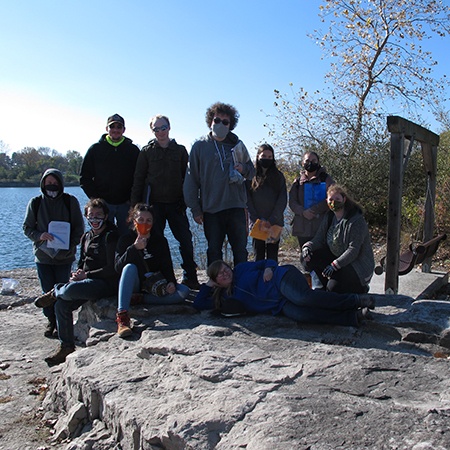
We offer a variety of courses in paleontology:
- GEOL 1050 Life Through Time (BG Perspective course)
- GEOL 2150 The Geologic History of Dinosaurs (BG Perspective course)
- GEOL 4150/5150 Paleontology (for upper-level undergraduates and MS students)
- GEOL 4190/5190 Vertebrate Paleontology (for upper-level undergraduates and MS students)
- GEOL 6310 Quantitative Paleontology (for MS students)
Undergraduate Paleobiology students also complete an independent research project in paleontology for course credit.
BGSU is one of the only universities in the United States to offer an undergraduate specialization in Paleobiology, completed within our Geology B.S. degree program. Paleobiology students gain a solid background in the anatomy, evolution, and paleobiology of major invertebrate and vertebrate fossil groups and their deep-time histories as well as experience with practical lab and research methods.
Read about recent Paleobiology alumnus Carlos Martinez's experience at BGSU.
We also offer a minor in Paleontology that is open to all majors. Please see the Undergraduate Catalog for current course requirements for this minor.
Interested in pursuing paleontology research in graduate school? Check out our MS in Geology degree program.
Have questions about our courses and programs in paleontology? Contact Dr. Yacobucci.
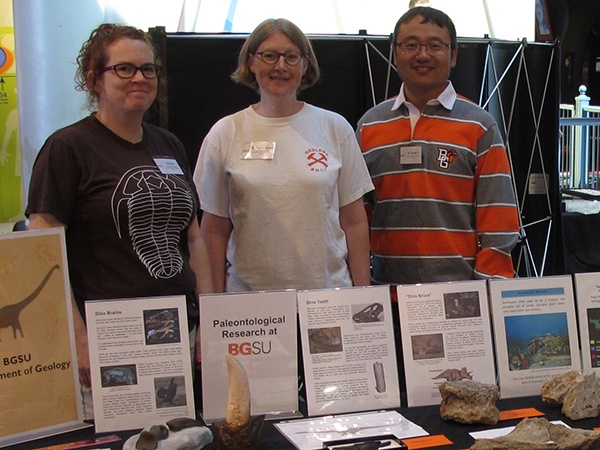
Hear Dr. Yacobucci talk about her career and advice for future paleontologists:
“Girl Power: Meet a STEM Professional” by Imagination Station Toledo https://www.youtube.com/watch?v=2Y16WHxv9y8
Dr. Yacobucci's profile for “Daring to Dig: Women in American Paleontology” virtual exhibit by the Museum of the Earth, Paleontological Research Institution, Ithaca, NY
Interested in inviting Dr. Yacobucci and the Paleo students to visit your classroom or give a talk to your group about paleontology and Earth’s fascinating history? Please contact Dr. Yacobucci for more information.
Updated: 01/25/2026 09:27PM