
Residential Instability, Calls for Service, and Crime in Toledo, Ohio: A 10-Year Lookback
Residential Instability, Calls for Service, and Crime in Toledo, Ohio: A 10-Year Lookback
Report Submitted: 2024
By: Melissa W. Burek, PhD, Julia C. Bell, MSCJ, & Eric M. Cooke, PhD
Contributing Authors: Sara Lucak, MSCJ, Stephanie DeCroix, MSCJ, & Jaryt Salvo, MSA, M.Ed.
Executive Summary
The aim of this study was to identify observable indicators that could be associated with crime in neighborhoods to ultimately inform community and justice agencies in developing and implementing proactive responses to lessen crime and disorder. Residential instability is an indicator that may have an observable effect on crime such that areas with higher residential turnover and/or less occupied housing tend to have higher crime rates. In addition, the variety of reasons for which people might call for assistance—including legal issues, emergencies, maintaining order, and other service-related concerns—can influence how often the police respond to incidents in neighborhoods. This is particularly relevant when it comes to crimes. Residential instability may also influence the frequency of calls for police services. Neighborhoods undergoing demographic changes might see an increase in the need for formal police assistance. This is because the usual informal community-based methods of maintaining order, such as neighbors looking out for one another, may be less effective or harder to establish in these changing environments.
To determine the significance of these indicators, we examined calls for service, crime incidents, and residential instability measures (i.e., the percentage of vacancies, renter occupied housing units, and residents living in same house one year ago) across 92 census tracts in the city of Toledo from 2010-2019. For these analyses, several datasets were utilized, including over 1.6 million calls for service and 500,000 crime incidents as reported by the Toledo Police Department, which were broken down into several categories (see list below). Residential and vacancy information from the
United States Department of Housing and Urban Development (HUD), and demographical characteristics per census tract from the 2010 Census Bureau and the American Community Survey (ACS) were considered.
Neighborhoods in this study are delineated by census tracts boundaries. We compared the census tracts to one another for each of the 10 years (i.e., between tracts) and then we examined the carryover effect of the residential instability and calls for service variables on crimes over consecutive timepoints (i.e., within each tract). In the latter analyses, we included cross-lags (i.e., time-lagged relationships) into the model to see how past values of these variables are related to future crime incidents. Cross-lags, or cross-lagged effects (i.e., time-lagged/lagged effects), refer to the relationships between two or more variables measured at multiple time points, where the value of one variable at an earlier time point is used to estimate change in the value of another variable at a later time point. This approach clarifies the direction and reciprocal influence between variables over time (i.e., from one year to the next). For example, in this study, we examined the relationship between residential instability and crime and the relationship between calls and crime types from 2010 to 2019. Cross-lags helped us assess if residential instability and/or call type measures at one time point (e.g., 2010) influence the level of crime at a later time point (e.g., 2011).
Among the three residential mobility variables studied, vacancies (i.e., the percentage of vacant addresses in each census tract), were found to be the most common correlate associated with a significant increase in calls for service and crime incidents. This increase was observed across various offense categories including Part 1 personal and property crimes, Part 2 personal and property crimes, public order, substance offenses, and non-crime related calls over the 10-year study period. We also examined how calls for service influenced crimes while taking into consideration the effect of vacancies on crime as a separate analysis.
The major findings noted below present the average increment values of crimes, calls, and percent vacant addresses where we found significant changes between tracts and within tracts rounded to the nearest whole number. The between tract findings compare data from one tract to data from another tract at the same point in time. The within tract findings compare changes within a single tract from one year to the next over the 10-year period (i.e., how things have changed internally within that same tract over time). Thus, between tract findings compare data between different tracts for each year under study while within tract findings focus on year-to-year changes within a single tract over the decade. Results from between tracts and within tract are presented in incremental increases and decreases such that for every time an independent variables increases/decreases by a certain amount, the dependent variable will increase/decrease proportionally. For example, a 9% incremental increase in the percentage of vacant addresses corresponded to an additional 13 Part 1 property crimes. Predicting further increases, if the percentage of vacancies were to double to 18% (which is 2 times 9%), we would expect the number of additional Part 1 property crimes to also double to 26 (which is 2 times 13). Thus, there is a linear relationship between the percentage of vacant addresses and the number of Part 1 property crimes: as the percentage of vacancies increases, the number of Part 1 property crimes increases proportionally. Additional findings, study limitations, and future research recommendations are presented in the full report.
Major Findings
Overall, we found that residential instability as measured by the percentage of vacancies had significant influences on the number of crimes and calls for service when comparing census tracts to one another (i.e., between tracts) and within the census tracts themselves over the 10-year study period. This is particularly evident when the percentage of vacant addresses is higher.
Between Tracts
- Every 9% increase in vacant addresses was associated with an average increase of 193 calls for service and 84 crime incidents of any kind.
- Specifically, Part 1 and 2 personal, Part 1 and 2 property, public order, and substance offenses increased as the percentage of vacant addresses increased.
Within Tracts
- When vacancies increased by 9%, we can expect an additional 16 crimes from one year to the next.
- Part 1 personal and substance offenses increased as the percentage of vacancies rose by 9%, corresponding to 1 and 12 crime incident count, respectively.
In sum, vacancies had the most substantial influence on the number of calls and crime incidents, while the other measures of residential instability (i.e., the percentage of renter occupied housing and geographic mobility) had more limited and varied impacts over time.
Part 1 Personal
Aggravated Assault, Homicide, Rape, Sexual Assault
Part 1 Property
Arson, Burglary, Property and Vehicle Theft, Robbery
Part 2 Personal
Abduction, Aggravated Harrassment/Menacing, Aggravate Trespassing, Assault, Abuse of Corpse, Child Abuse, Domestic Violence, Endangerment, Extortion, Importuning, Intimidation, Kidnapping, Other Sexual Offenses, Stalking, Terrorism, Trafficking, Violate Protection Order, Voyeurism
Part 2 Property
Bad Checks/Credit Card, Counterfeiting, Computer Crime, Criminal Damaging, Defraud, Disposing Stolen Property, Embezzlement, Falsification, Forgery, Fraud, Identity Fraud, Property Offenses, Unauthorized Use of Property, Vandalism, Welfare Fraud
Substance Related
Child - Possession/Use, Disorderly Conduct – Intoxication, Drug/Liquor Violation, Open Container, Vehicle Operation Under Influence
Public Order
Bomb Threat, Bribery, Carrying Concealed Weapon, Coercion, Conspiracy, Criminal Child Enticement, Criminal Trespass, Cruelty to Animals, Curfew, Deception, Disorderly Conduct, Escape, Failure to Register, Fireworks, Fugitive, Gambling, Harassment/Menacing, Impersonation, Indecent Behavior, Inducing Panic, Interference with Civil rights/Custody, Juvenile Gang Activity, Littering, Loitering, Missing Juvenile, Misuse of 911, Obstruction, Pandering Obscenity, Perjury, Prostitution, Public Indecency, Resisting Arrest, Riot, Telecommunications Harassment, Truancy, Unruly Juvenile, Weapon Violation
Part 1 Personal
Agg. Assault, Homicide, Mass Casualty Disaster, Rape, Sexual Assault
Part 1 Property
Arson, Burglary, Break-in, Robbery, Property and Vehicle Theft
Part 2 Personal
Assault, Child Abuse, Domestic Violence, Harassment, Hostage/Kidnapping, Hit and Run, Person Shot/Stabbed, Hate Crimes, Stalking, Physical Threat
Part 2 Property
Bad Checks, Criminal Damage, Forgery, Hit and Run – Property, Purse Theft, Shoplifting, Tampering with Vehicle
Substance-Related
DUI, Drunk Call, Drug Complaint or Violation
Public Order
Alarms, Animal Problems, Argument/Fight, Bomb Threat, City Violation, Custody Dispute, Dangerous Substance, Disorderly Conduct, Domestic Argument, Gunshots, Illegal Gambling/Hunting, Juvenile Problem, Loitering, Menacing, Noise, Person Wanted by Police, Prostitution, Prowler, Reckless Operation, Speed Complaint, Suicide/Attempt, Traffic Offense, Trespassing, Unwanted Entry, Weapons Call
Service - Non-Crime - Calls for Service Only
Abandoned/Disabled Vehicle, Assist, Check Safety of Person, Death, Emergency, Escort, Found Property, House Check, Labor Dispute, License Plate/Registration, Mental Crisis, Missing Person, Parking Violation, Peculiar Circumstance – Person/Property, Person Down, Police-Citizen Communication, Problem Person, Screams, Secure Property, Slumped Driver, Traffic Accident, Traffic Flow Problem, Utility Problems
Introduction
Scholars have identified neighborhood characteristics that contribute to community crime. One notable relationship presented in the literature is the association between residential instability, social control, and crime. Neighborhoods riddled with physical disorder, civil unrest, and social disorganization have been found to experience increased residential turnover and crime (Perkins & Taylor, 1996; Steenbeek & Hipp, 2011; Nobles et al., 2016). Additionally, members of these neighborhoods may be less likely to contribute to the common good or rely on police intervention to solve community problems (Benson et al., 2003; Gau, 2014). Examining the relationship between neighborhood characteristics and crime may provide insight on how various environmental and societal factors may contribute to crime and inform targeted intervention strategies to reduce crime and disorder within a community.
Residential Instability and Crime
Social disorganization theory, a recognized structural theory of crime, alludes that crime often occurs in communities that are disorganized and unstructured. Members of disorganized communities are less likely to interact with other community members, share similar values or goals, and to conform to community norms (Kubrin, 2009). Further, these communities may display physical cues of disorganization, such as graffiti, broken windows, and vacant housing. When examining the link between social disorganization and neighborhood crime, researchers have identified a variety of neighborhood characteristics that influence community crime and repeat victimization (Kirk & Hyra, 2012; Nobles et al., 2016). Some characteristics include residential instability, racial heterogeneity, spatial proximity, residential vacancy, limited resources and services, and physical disorder (Chamberlain & Hipp, 2015; Nobles et al., 2016; Roth 2019; Chen & Rafail, 2020). Increased residential instability and vacancies contribute to neighborhood crime as it limits economic resources, weakens informal social control, yields crime opportunity, and draws offenders into the community (Gau, 2014; Nobles et al., 2016). As a result, crime increases, social control dissipates, social networks are broken down, and participation within the community dissolves (Boggess & Hipp, 2010). Further, the level of disorder experienced in a neighborhood may influence the likelihood that community members will rely on police intervention (Gau, 2014). Residents may be more hesitant to call for police intervention because they have weak ties to their
neighborhood, do not find it customary to contribute to the common good, or may feel that they are expected to “mind their business” (Benson et al., 2003).
Residential areas comprised of rentals have traditionally been linked to higher crime rates. Vacant rentals have been found to be positively associated with property offenses including burglary, larceny, and robbery. This relationship remains evident even when rentals are occupied for a short period of time (Roth, 2019). While not as strongly associated, vacant homes are also linked to an uptick in community crime and violence (Chen & Rafail, 2020). Roth (2019) advised that residential areas with vacant rentals might experience more crime than areas with vacant homes because communities with more homes tend to be better maintained, while areas with vacant rentals often display more physical cues of disorder. However, both vacant rentals and homes have been associated with increased crime, which suggests that generally, vacant residencies are a robust correlate of crime (Chen & Rafail, 2020).
Some prior research suggests that the linkage between neighborhood crime and residential instability is a reciprocal relationship. Boggess and Hipp (2010) found that residential instability, community disadvantage, and political influence contribute to neighborhood crime. Communities with higher rates of violent crime also experienced higher rates of residential turnover (Boggess & Hipp, 2010). However, studies examining the relationship between neighborhood crime and residential instability as a reciprocal relationship is limited within the literature.
Calls for Service and Crime Incidents
Exploring and identifying factors that contribute to neighborhood crime may be helpful in predicting and reducing community crime. O’Brien et al. (2021) highlighted that exploring characteristics that contribute to community crime without considering differences within the community can be challenging. Traditionally, communities experience an uneven distribution of crime as influenced by a variety of factors including demographic make-up, routine activities of the residents, level of pedestrian and commercial traffic, and vulnerability of the area (i.e., areas with subsidized housing versus those without). As a result, crime may occur at higher rates in some areas of a community, even at street level, than others (Lee et al., 2017; O’Brien et al., 2021). Exploring the relationship between community factors, including residential instability, and crime at a more granular level, such as census tracts, may provide specific detail about where crime occurs in a community.
Another way to explore where crime and disorder occur within a community is by considering how often community members call the police and what those calls are for. Calls for service data can provide additional information on temporal and spatial crime patterns, community fear of crime, and police presence, which may be lacking when solely analyzing crime incident data (Barnett-Ryan, 2022). Thus, utilizing calls for service and crime incident data may be helpful at leveraging police knowledge on where and when crime occurs in a community, which may contribute to the development and implementation of predictive policing programs (Fitzpatrick et al., 2019) and prosocial social service and community initiatives to reduce crime and disorder and support residential stability.
Data and Methods
The present study examined how the transitionary nature experienced in some Toledo neighborhoods affected the relationship with police and crime. Accordingly, calls for service, crime incidents, demographic information, and residential instability were examined across 92 census tracts in the City of Toledo from 2010 through 2019. For this analysis, several datasets were considered, including over 1.6 million calls for service and 500,000 crime incidents provided by the Toledo Police Department (TPD). Further, residential information, vacancies, and demographic characteristics per census tract were collected from the United Stated Department of Housing and Urban Development (HUD) department, the 2010 Census Bureau, and the American Community Survey (ACS). The following sections discuss our data collection process and the methods of this study.
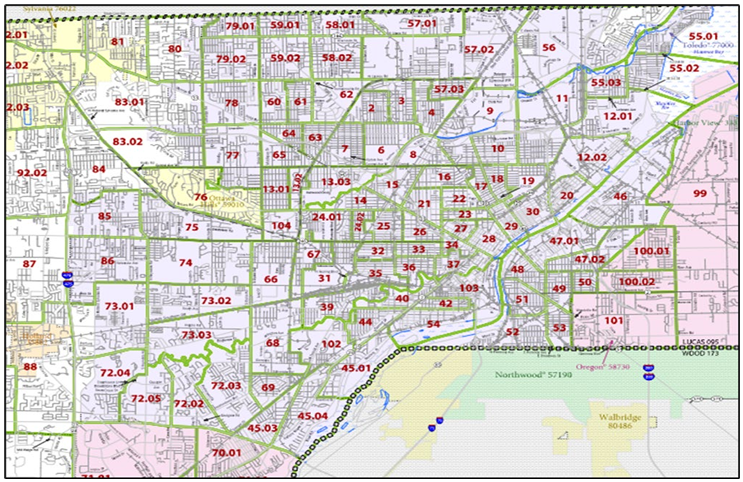
2010 Census Tract Geographical Borders
For the purposes of this study, data were examined on the census tract level, which provides a finer unit of analysis compared to other levels such as neighborhoods or police sectors (Smith & Blizard, 2021). Tracts included in the final sample were identified by the 2010 Census and were included only if they completely fell within the 2010 city limits of Toledo. A 2010 map (see Figure 3) depicting the overlap of Toledo city limits and the corresponding census tracts was referenced to determine the inclusion of tracts in the final sample. Overall, tracts were discarded if they (1) housed the University of Toledo, (2) contained the village of Ottawa Hills, (3) did not fall completely within the 2010 city limits of Toledo, or (4) were in Lucas County, but not the City of Toledo. A total of 35 tracts were removed resulting in a final sample of 92 census tracts.
Calls for Service and Crime Incident Data
Toledo Police Department’s (TPD) Intelligence and Special Investigations Bureau provided the calls for service and crime data from 2010 through 2019. The original calls for service data included the following variables: initial call type, final call type, disposition, address, and date and time of the incident, while the crime incident data included the variables: crime type, address, and date and time of the incident. It should be noted that the crime data used for this project only includes crime incidents reported by law enforcement at TPD, and does not contain information on arrests, citations, or other actions taken by the Toledo police. TPD did indicate that they conducted an initial cleaning process using their Computer Aided Dispatch (CAD) browser prior to providing the CJR data. The following describes the cleaning and recoding process conducted by the TPD and the CJR of the calls for service and crime data.
The original calls for service data had over 2 million cases and was provided to the CJR team in a secured Microsoft Access file. This data houses all calls for service for Toledo from 2010 through 2019, along with dispatch calls across Lucas County. Thus, the data also included calls for non-emergency situations, fire, and medical calls. Prior to providing the data, using their Computer Aided Dispatch (CAD) browser, TPD removed duplicate cases (i.e., if there were multiple calls for one incident), cancelled calls, cases with missing addresses, and calls that were self-initiated in nature. The call data received by the CJR had a total of 358 unique call type codes. Along with the data, TPD provided law, medical, and fire codebooks, which provided a description of most of the call types, and indicated which emergency service is the prioritized responder for each call code. It should be noted that not all call codes were included in the provided codebooks as they are considered “no-brainers” for dispatch. For codes that required additional information, the CJR corresponded with TPD for clarification. Calls in the fire and medical codebooks, and those that were self-initiated in nature or were
administrative codes (i.e., police car maintenance or training codes), were removed from the sample. The crime data provided by TPD, with over 800,000 incidents, went through a similar initial cleaning process. Crime incident data considered in this study are based off of police reports, thus, the hierarchy rule does not apply (i.e., if more than one crime was committed at an address, all incidents were reported separately). Further, the data does not indicate the outcome of each incident, such as arrests or citations given.
The crime data contained a total of 257 crime codes. Unlike the calls for service data, the crime type codes were clear. 112 crime types were removed from the data as these crime types aligned with traffic incidents, were incidents marked as an offense but not of a criminal nature, or that would not have the potential to result in an arrest or citation.
Referencing the provided law codebook from Toledo and the crime classifications outlined by the Uniform Crime Report (UCR) of the Federal Bureau of Investigation (FBI) and the National Incident-Based Reporting System (NIBRS), the calls for service codes and crime incidents were collapsed into the following classifications: Part 1 personal, Part 1 property, Part 2 personal, Part 2 property, public order, and substance offenses. According to the UCR, Part 1 offenses “are serious crimes, they occur with regularity in all areas of the country, and they are likely to be reported to the police” (UCR, 2019, p. 1). The FBI collects more in-depth information on Part 1 offenses, including the outcome of the incidents (i.e., arrest or cleared by exceptional means) and demographic data of the arrested. Part 2 offenses are considered less serious crimes yet occur more often than Part 1 offenses, but the FBI only collects arrest data for Part 2 crimes. The CJR recategorized the calls and crime data based on the FBI’s definitions and classifications of Part 1 and Part 2 offenses.
Based on NIBRS classifications, the calls and crime data were further categorized as being personal, property, public order, or substance offenses. Personal offenses are those where the victim is an individual, while property offenses result in damage to property or that is committed with the intent to obtain money, opportunity, or some other benefit. NIBRS’ third classification, crimes against society, “represent society’s prohibition against engaging in certain types of activity; they are typically victimless crimes in which property is not the object” (NIBRS, 2018, p.1). Accordingly, a majority of the calls and crime incidents in TPD’s data are considered crimes against society. To provide a more detailed analysis of the calls and crime incidents occurring withing Toledo, these types of incidents were categorized as either being a public order or substance offense. Lastly, an additional category, non-crime service calls, was added to the calls for service data to include calls where police services were needed, but where there was not a criminal nature to the incident (e.g., abandoned vehicle, house check, or safety check). These calls were included in the final sample as they provide insight on the willingness of some community members to call the police for service. Table 3 and 4 provide detailed information of the classifications and the call and crime codes that are included in each.
After this initial cleaning process, the calls for service and crime data were separated into multiple Excel files containing 10,000 cases each. Each file was submitted to the online Census Geocoder. The Census Geocoder is an address look-up tool that allows users to submit a batch of addresses or location coordinates to match geographical locations and entities. After processing, the Geocoder provides the following variables: Tiger output address, interpolated longitude and latitude, TIGER/Line ID, TIGER/Line ID side, Census Tract, Census Block, and GEOIDS. Geoids are the Census’ official identification for each tract, which are in numerical format. Each Geoid provides the following information: state code, county code, and tract code. After all cases were processed through the Geocoder, it was revealed that several addresses provided by TPD had formatting issues. Formatting issues included misspelled addresses, missing information, additional spaces, and the use of “+” instead of “and.” These errors were corrected to the best of the research team’s abilities, and the cases were resubmitted to the Geocoder. Cases that came back as “no-match” or “tie” meant that the Geocoder was unable to locate census tract information for that particular address. As a result, those cases were removed from the datasets.
Finally, calls for service and crimes that took place in a census tract not in our interest area were removed from the data. All calls for service and crime incidents were then separated into different Excel files by year, and the Excel files were converted into SPSS for further analysis. The final samples consisted of a total of 1,618,537 calls for service and 548,154 crime incidents. Table 2 depicts the total crimes per year.
Total Calls for Service and Crime Incidents Per Year
| Year | Calls for Service | Crimes |
| 2010 | 166,791 | 55,529 |
| 2011 | 175,324 | 55,687 |
| 2012 | 175,348 | 54,691 |
| 2013 | 162,308 | 53,890 |
| 2014 | 168,112 | 54,495 |
| 2015 | 157,454 | 53,232 |
| 2016 | 157,417 | 55,436 |
| 2017 | 158,143 | 54,686 |
| 2018 | 150,413 | 55,133 |
| 2019 | 147,227 | 55,375 |
| Total | 1,618,537 | 548,154 |
Part 1 Personal
Aggravated Assault, Homicide, Mass Casualty Disaster, Rape, Sexual Assault
Part 1 Property
Arson, Bank Robbery, Break-in, Burglary – Commercial/Residential, Motor Vehicle Theft, Property Theft, Robbery – Commercial/Private Citizen/Residential, Robbery with Injury
Part 2 Personal
Assault Offenses, Child Abuse, Child Molestation – Under 13, Domestic Violence, Harassment, Hit and Run with Injury, Hostage Incident, Kidnapping, Person Shot, Person Stabbed, Racial/Religious/Ethnically Based Incidents-Hate Crimes, Shots Fired at Person, Stalking, Threat of Physical Injury
Part 2 Property
Bad Checks/Credit Cards, Criminal Damaging, Criminal Damage – All Property/, Commercial/Residential/Vehicle, Forgery or Counterfeiting, Hit and Run – Property Damage, Purse Theft/Pocket Picking, Shoplifting, Tampering with a Motor Vehicle
Substance Offense
Driving Under the Influence, Drug Complaint, Drug Violation, “Drunk” Call, Marijuana Law Violation
Public Order
Alarm – Including Burglary/Robbery, Animal Problems, Bomb Threat, City Violation, Civil Disorder/Riot, Custody Dispute, Disorderly Conduct, Domestic Argument, Excessive Speed Complaint, Gambling, Gunshot, Gunshot Heard, Illegal Hunting, Investigate Dangerous Device/Substance, Juvenile Problem, Keep the Peace/Prevent Argument, Loitering, Menacing, Neighbor Trouble, Noise Complaint/Disturbance, Obscene Activity, Person with Gun , Person Wanted by Police, Physical Fight in Progress, Prostitution, Prowler, Public Argument, Reckless Operation of MV, Shots Fired, Suicide, Suicide Attempt, Trespassing, Unauthorized Use of Motor Vehicle, Unwanted Entry/Presence, Violation of City Ordinance, Violation of Traffic Offense, Weapon Violation – Person with Gun or Knife, Weapon Call
Non-Crime Service Calls
Abandoned Vehicle, Adult Subject of Police Concern, Assist – Citizen/Lockout/Outside Agency , Bad License Plate/Registration, Check Safety of Person – Adult/Juvenile, Death/Dead Body, Disabled Vehicle, Door Check/Securing Property, Driver Slumped at the Wheel, Emergency – Unknown, Emergency Escort, Found Property – Lost/Stolen, General Broadcast – Information of Police Concern, House Check, Labor Dispute, Meet Complainant, Mental Health Crisis/Disorder, Missing – Adult Patient/Child/Person, Missing Vehicle Plate, Motor Vehicle/Traffic Accident – Pedestrian Struck/Property Damage/Injury, Motorcycle Accident/Injury, Open Door/Window, Parking Complaint/Violation, Peculiar Circumstances, Person Down, Person Wants to Give Information, Problem Person – Patient/ Restraint Needed/Student, Railroad Crossing Blocked, Recovered Stolen Vehicle, Roadblock, Screams Heard, Suspicious – Person/Property/Unattended Vehicle, Traffic Flow Problems, Traffic Signal/Sign Disorder, Utility Problem, “Wagon Call” – Transporting Detainees/Prisoners
Part 1 Personal
Aggravated Assault, Homicide – Aggravated/Vehicular, Involuntary Manslaughter, Murder, Rape, Sexual Assault
Part 1 Property
Arson, Burglary, Larceny Theft, Motor Vehicle Theft, Property Theft, Robbery
Part 2 Personal
Abduction, Aggravated Harassment/Menacing, Aggravated Trespassing, Assault, Assault of a Police Officer, Abuse of Corpse, Child Abuse, Child Stealing, Corruption of Minor (Sexual), Domestic Dispute, Domestic Violence, Endangerment Adult/Child/Elder/Mental, Extortion, Importuning, Intimidation, Kidnapping, Other Sexual Offenses, Safe School Assault, Sex Battery, Sexual Imposition, Stalking, Terrorism, Trafficking - Persons, Unlawful Restraints, Vehicular Assault, Violation of Protection Order, Voyeurism
Part 2 Property
Confidence Game/False Pretense/Swindle, Counterfeiting, Computer Crimes/Misuse, Credit Card/Atm Fraud, Criminal Damaging, Criminal Mischief, Criminal Simulation, Defraud Innkeeper/Livery/Restaurant, Defrauding Creditors, Disposing Stolen Property, Embezzlement, False Info to a Police Officer Issuing Ticket, Falsification, Food Stamp Trafficking, Forgery, Fraud, Identity Fraud, Misc. Property Offense, Misuse of Credit Card, Passing Bad Check(s), Property Damage, Property Stolen, Receiving Stolen Property, Retaining Stolen Property, Safe Cracking, Secure Writings by Deception, Telecommunications Fraud, Unauthorized Use of Motor Vehicle/Property, Vandalism, Welfare Fraud
Public Order
Begging/Loitering/Soliciting, Bomb Threat, Bribery, Carrying Concealed Weapon, Coercion, Complicity, Comply with Order of a Police Officer, Compounding a Crime, Conduct - All Else, Conspiracy, Contribute to the Delinquency of a Minor, Criminal Trespass, Conveying Contraband, Criminal Child Enticement, Cruelty to Animals, Deception, Discharging Fireworks, Disorderly Conduct/Disturbance, Disseminating Matter Harmful to Juveniles, Drop Item from Bridge, Elude/Flee, Escape - Aiding, Escape - Detain Elsewhere/Local, Escape - from Officer, Failure to Appear/Contempt, Failure to Aid Police Officer, Failure to Report Crime, Failure to Secure Dangerous Ordinance, Failure to Send Child to School, Fugitive, Gang - Juvenile, Harassment/Menacing, Harboring a Juvenile, Illegal Gambling, Immigration Laws, Impersonating an Officer, Impersonation, Improper Compensation/Solicitation, Improper Discharge, Improper Handling in Motor Vehicle, Indecent Behavior - Juvenile Present, Inducing Panic, Interference with Civil Rights, Interfering with Custody, Juvenile Curfew Violation, Keep Peace/Peace Bond, Littering, Missing/Runaway Juvenile, Misuse of 911 System, Obstruction, Paint - Juvenile Buy/Possessing Spray, Pandering Obscenity, Park Curfew Violation, Participating in Criminal Activity, Perjury, Possession of Criminal Tools, Prostitution, Public Disturbance, Public Indecency, Resisting Arrest, Riot – Aggravated/Incite, Safe School, Sex Offender; Fail to Register, Tampering, Telecommunications Harassment, Truancy, Unruly Juvenile, Weapon Violation
Substance Offense
Child Possession/Purchase/Use, Disorderly Conduct - Intoxication, Drug Violation, Liquor Violation, Operating a Vehicle Under the Influence of Alcohol/Drug, Open Container Violation, Permit Drug Use - Owner/Operator Permit Use of Vehicle
HUD Data
To measure residential instability, 2010 through 2019 data were collected from the United States Department of Housing and Urban Development (HUD), which is a department of the U.S. Federal Government administering federal housing and urban development laws. HUD provides both public and private data. For this project, data were gathered from the “HUD Aggregated USPS Administrative Data on Address Vacancies.” This private dataset, accessed using the CJR’s HUD account, was created in 2005 as HUD entered an agreement with the United States Postal Service (USPS) to receive quarterly aggregate data on addresses that have been identified by the USPS as being “vacant” or “no-stat” in the previous quarter. Addresses are identified as being “Vacant” when USPS workers on urban routes identify the address as being unoccupied. USPS workers make this determination if the mail at the address has not been collected for 90 days or longer. Addresses are identified as “no-stat” for the following reasons: (1) rural route addresses that have been vacant for 90 days or longer, (2) addresses for businesses or home under construction and not yet occupied, or (3) addresses in urban areas identified by a carrier as not likely to be active for some time. HUD updates this data every three months and is reported on the census tract level.
Based on population changes, the Census Bureau moves and redefines the outline of some tracts per decennium. Being that HUD reports on the census tract level, HUD transitioned from using the 2000 census to the 2010 census beginning in 2012. Minor changes were made from the 2000 to the 2010 census for the tracts of our interest. In 2000, tract 102 was tracts 43.01 and 43.02. In 2010, these two tracts were combined to form tract 102. Similarly, the 2010 tract 103 was tracts 38 and 41 in 2000. In both instances, the two tracts were simply combined to create a new tract while the area of land remained the same. To account for this transition, the research team aggregated the HUD information for the former tracts for years 2010-2011 to consistently represent tracts 102 and 103 throughout the data. This change negligibly impacted the crime data, and Social Explorer automatically updates tract information. As a result, “tract 102” and “tract 103” cover the same area throughout all 10 years and in all sets of data.
To acquire HUD data, the research team downloaded quarterly values from the “HUD Aggregated USPS Administrative Data on Address Vacancies” files for years 2010 through 2019. After downloading, data for the tracts of interest were extracted and relocated to an Excel file. Only two variables were obtained from the HUD data and utilized in this study, (1) AMS_RES, which reports the total count of residential addresses per tract, and (2) RES_VAC, which conveys the total count of vacant residential addresses per tract. To determine percent vacancy per census tract (i.e., the vacancies variable), the following formula was used: (RES_VAC) / (AMS_RES). The data were cleaned, recoded, and compiled into an Excel file for further analysis.
Demographic Data
Using Social Explorer, demographic data per tract were gathered from the American Community Survey (ACS) 5-Year Estimates. Social Explorer is an online research tool that provides census data and other sources of demographic information using organized reports, charts, and maps. ACS demographic data were collected on the tract level from 2010 through 2019 from Social Explorer. Table 5 provides an outline of the final demographic and residential instability variables used for this project.
Statistical Analyses Used
We utilized descriptive, multivariate regression, and Vector Autoregressive Analysis (VAR) analyses to examine
our data.
- Descriptives: The percentages, means, and standard deviations for all variables in the study were calculated using SPSS Statistics software.
- Multivariate regression: Multivariate regression was used to examine relationships between key variables (e.g., crime incidents and calls for service). This study sought to examine how calls for services or crimes are influenced by changes in residential instability variables while controlling for other demographic factors known to contribute to calls for service and crime incidents. Multivariate regression is a statistical method used for examining the relationships between one dependent variable and one or more independent variables. It involves regressing the outcome or dependent variable (DV) on the independent variable (IV) while keeping the other IVs constant in the study (e.g., regressing Part 1 personal crimes on the percent of vacant properties while holding the influence of the other IVs on Part 1 personal crimes). The output yields coefficients for each DV on IV relationship, the value of which indicates for every unit increase in the IV, the DV will change by that amount. The sign of the coefficient, positive or negative, indicates whether there will be an increase or decrease for every unit of the IV on the DV. The p-value indicates whether this relationship is statistically significant, which helps to determine whether the observed effect is a true effect and not due to chance alone. Our multivariate regression analyses are based on models examining one point in time (i.e., 2010 dependent variables (DV) regressed on the 2010 independent variables (IV), 2011 DV on 2011 IVs, and so forth) and comparisons can be made between tracts.
- Vector Autoregressive Analysis (VAR): A Vector Autoregressive (VAR) Cross-Lagged Panel (i.e., time-lagged/longitudinal) design was used to examine the current time series data (e.g., residential instability and crime incidents) that was obtained from census tracts between 2010 and 2019. A VAR model is a multivariate time series model that estimates relationships between multiple variables measured at consecutive points in time. The autoregressive Part of the model accounts for time linked interdependencies between the same values. For instance, examining the carryover effect that the same variable has on itself at each consecutive timepoint. Cross-lags are incorporated into the model to examine the association between previous values of one variable to future values of another variable. For example, estimating the effect that geographic mobility in 2010 has in relation to changes in crime in 2011. Hence, this model allows for the examination of effects between each variable at the same time point (i.e., contemporaneous effects) and at the previous time point (i.e., lagged effect) within tracts to gain a better understanding of the directional association between two or more variables.
Descriptives and Trends
Descriptives
Table 6, starting on the following page, displays the means and standard deviations of the variables under study from 2010-2019. In general, the average values for the demographic characteristics follow a declining trend from their higher values in the early half of the 2010s and then decreasing slightly in the latter half of the decade. Though, some demographic variables experienced notable changes over the study period. The unemployment variable, representing the average percentage of those 16 and up in the labor force who are unemployed, increased from 17.5% in 2010 to 20% in 2013. Following 2013, the average percentage of those unemployed continued to decline, reaching a low in 2019 at 11.1%. The average median household income also fluctuated, dropping from $41,965 to $36,782 from 2010 to 2014. Following 2014, the average median household income continued to rise, reaching $39,588 in 2019. Lastly, the government supplemental income variable, representing the percentage of people living in a household who received supplemental income in the past 12 months, experienced an overall increase from 43.4% in 2010 to 51.1% in 2019. Trend lines based on mean totals for the variables measuring residential instability, calls for service, and crime incidents are plotted on the pages that follow.
Descriptive Characteristics of Census Tracts: Demographics - Mean percentages/totals and (standard deviations)
| Year | 2010 | 2011 | 2012 | 2013 | 2014 | 2015 | 2016 | 2017 | 2018 | 2019 |
| Total Population | 3035.07 (1267.75) | 3005.74 (1287.45) | 2985.89 (1304.34) | 2960.18 (1285.01) | 2934.73 (1285.75) | 2934.73 (1285.75) | 2914.35 (1261.82) | 2885.47 (1318.72) | 2872.83 (1335.67) | 2872.83 (1335.67) |
| Population Density | 4,488.6 (1,982.87) | 4,417.4 (1,937.62) | 4,375.6 (1,927.78) | 4,332.1 (1,859.25) | 4,308.6 (1,904.16) | 4,271.5 (1,863.11) | 4,252.0 (1,890.26) | 4,252.0 (1,890.26) | 4,215.2 (1,946.72) | 4,184.6 (1,969.90) |
| Percent Population Aged 15-24 | 15.7% (6.15) | 15.8% (6.09) | 16.0% (6.11) | 15.6% (6.39) | 14.9% (5.70) | 14.5% (5.30) | 14.1% (5.21) | 13.6% (4.92) | 13.5% (4.77) | 13.4% (4.80) |
| Racial/Ethic Heterogeneity | .31 (.17) | .32 (.18) | .33 (.17) | .34 (.17) | .36 (.17) | .37 (.16) | .37 (.16) | .38 (.16) | .38 (.16) | .39 (.15) |
| Percent Female-Headed Households | 20.6% (10.85) | 21.6% (10.27) | 21.6% (10.93) | 21.3% (10.70) | 21.6% (10.80) | 21.6% (9.98) | 20.8% (10.09) | 21.1% (10.21) | 21.0% (9.85) | 20.5% (9.24) |
| Percent Less Than High School | 18.1% (10.31) | 17.7% (10.03) | 17.5% (9.85) | 17.9% (9.71) | 17.2% (9.62) | 17.3% (9.44) | 17.0% (9.27) | 17.1% (9.41) | 18.0% (10.97) | 16.2% (9.13) |
| Unemployment Rate | 17.5% (11.26) | 18.8% (10.44) | 19.2% (10.41) | 20.0% (10.68) | 18.1% (10.03) | 16.5% (9.57) | 14.8% (9.00) | 13.4% (8.99) | 11.8% (8.55) | 11.1% (7.75) |
| Median Household Income | $41,965 (18,375.50) | $40,638 (17,232.03) | $38,958 (17,110.38) | $37,652 (16,491.28) | $36,782 (17,135.08) | $37,017 (17,260.57) | $37,683 (17,425.45) | $38,499 (17,192.05) | $39,262 (17,634.23) | $39,588 (17063.66) |
| Gini Index | .42 (.07) | .42 (.07) | .43 (.07) | .44 (.08) | .44 (.07) | .44 (.07) | .45 (.07) | .44 (.07) | .44 (.08) | .38 (.24) |
| Percent Poverty 18 and Older | 24.2% (16.62) | 25.5% (16.44) | 27.0% (16.12) | 27.4% (15.81) | 28.1% (15.62) | 28.2% (15.39) | 27.6% (14.97) | 26.5% (14.60) | 25.6% (14.62) | 25.2% (13.76) |
| Supplemental Government Assistance | 43.4% (25.13) | 46.5% (23.97) | 50.4% (24.19) | 51.4% (24.87) | 51.7% (24.08) | 54.0% (24.66) | 52.9% (23.92) | 51.6% (24.18) | 51.0% (23.96) | 51.1% (24.70) |
Descriptive Characteristics of Census Tracts: Residential Instability - Mean percentages and (standard deviations)
| Year | 2010 | 2011 | 2012 | 2013 | 2014 | 2015 | 2016 | 2017 | 2018 | 2019 |
| Percent Same House 1 Year Ago (ACS) | 81.1% (9.36) | 81.2% (8.96) | 80.9% (8.21) | 81.4% (8.24) | 80.9% (8.32) | 79.9% (9.03) | 79.6% (8.99) | 80.3% (9.10) | 80.3% (9.14) | 81.0% (9.39) |
| Percent in Renter Occupied Housing Units (ACS) | 41.4% (21.50) | 42.7% (21.07) | 43.8% (20.16) | 43.5% (18.75) | 44.8% (18.10) | 46.5% (17.66) | 46.9% (17.66) | 47.3% (17.98) | 48.2% (18.03) | 48.5% (18.11) |
| Percent Vacant Addresses (HUD) Per Census Tract | 11.1% (7.16) | 11.5% (7.80) | 11.4% (7.61) | 11.9% (7.96) | 11.7% (8.29) | 11.4% (8.65) | 11.0% (8.74) | 11.6% (9.35) | 12.1% (9.88) | 12.5% (10.27) |
Descriptive Characteristics of Census Tracts: Calls for Service Incidents - Means and (standard deviations)
| Year | 2010 | 2011 | 2012 | 2013 | 2014 | 2015 | 2016 | 2017 | 2018 | 2019 |
| Part 1 Personal | 2.4 (2.05) | 2.0 (2.08) | 2.3 (2.06) | 2.0 (1.99) | 2.3 (2.33) | 2.1 (2.15) | 2.5 (2.10) | 2.3 (2.00) | 2.5 (2.07) | 2.2 (1.88) |
| Part 1 Property | 173.6 (96.97) | 194.4 (105.57) | 174.0 (93.38) | 149.7 (74.20) | 126.8 (67.17) | 95.9 (51.32) | 87.8 (48.98) | 90.8 (50.78) | 83.6 (46.50) | 78.5 (45.01) |
| Part 2 Personal | 245.1 (153.33) | 232.3 (142.93) | 233.3 (141.49) | 209.1 (125.25) | 206.1 (124.91) | 195.7 (115.58) | 206.0 (119.66) | 215.4 (126.80) | 217.8 (125.68) | 220.8 (130.10) |
| Part 2 Property | 50.4 (44.23) | 49.8 (41.96) | 46.2 (37.84) | 41.2 (36.20) | 34.6 (32.84) | 26.8 (32.40) | 25.9 (31.52) | 26.3 (25.84) | 24.0 (23.70) | 24.6 (20.20) |
| Public Order | 735.5 (378.68) | 726.3 (379.08) | 738.3 (370.73) | 682.7 (334.71) | 694.6 (344.59) | 655.5 (325.74) | 635.8 (325.01) | 643.3 (343.93) | 597.2 (299.72) | 580.8 (292.73) |
| Substance Offenses | 21.7 (16.10) | 20.1 (12.81) | 20.2 (12.42) | 18.2 (11.39) | 18.7 (12.99) | 17.3 (12.00) | 19.4 (12.24) | 18.6 (12.13) | 15.7 (10.42) | 13.2 (8.88) |
| Non-Crime Related | 608.0 (293.71) | 613.7 (291.94) | 626.9 (296.27) | 606.6 (286.66) | 653.96 (314.55) | 614.3 (297.19) | 631.4 (316.65) | 623.6 (298.56) | 598.5 (283.85) | 589.0 (287.55) |
Descriptive Characteristics of Census Tracts: Crime Incidents - Means and (standard deviations)
| Year | 2010 | 2011 | 2012 | 2013 | 2014 | 2015 | 2016 | 2017 | 2018 | 2019 |
| Part 1 Personal | 16.2 (11.34) | 15.1 (10.65) | 19.1 (13.46) | 16.8 (11.67) | 17.9 (11.57) | 18.1 (11.90) | 15.7 (10.87) | 11.7 (8.52) | 12.1 (7.94) | 11.8 (8.39) |
| Part 1 Property | 208.3 (120.41) | 222.1 (129.18) | 199.5 (117.09) | 173.6 (104.61) | 152.4 (87.94) | 145.7 (92.08) | 129.8 (79.68) | 126.1 (75.42) | 116.9 (69.25) | 110.5 (66.52) |
| Part 2 Personal | 117.2 (65.94) | 112.5 (64.73) | 111.3 (64.14) | 119.2 (67.65) | 117.8 (67.91) | 123.5 (68.05) | 163.6 (87.24) | 165.7 (92.97) | 171.9 (97.05) | 180.8 (101.07) |
| Part 2 Property | 76.6 (37.21) | 75.0 (36.02) | 70.4 (35.73) | 71.8 (33.73) | 73.9 (36.28) | 73.1 (35.05) | 71.9 (36.93) | 75.3 (35.92) | 71.8 (34.41) | 72.6 (37.47) |
| Public Order | 144.4 (81.58) | 136.1 (76.54) | 140.5 (79.94) | 140.2 (80.36) | 152.8 (86.53) | 144.5 (76.55) | 145.9 (81.25) | 144.6 (79.09) | 148.0 (76.99) | 157.1 (84.65) |
| Substance Offenses | 40.9 (31.36) | 44.5 (34.55) | 53.8 (40.72) | 64.2 (49.72) | 77.6 (59.70) | 73.6 (56.68) | 75.7 (56.88) | 71.0 (53.49) | 78.6 (60.98) | 69.1 (48.39) |
Trend Lines for Calls for Service with Residential Instability Measures
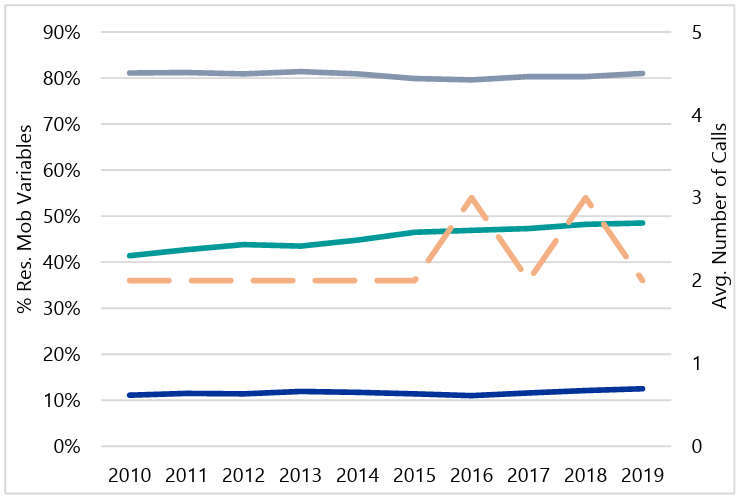
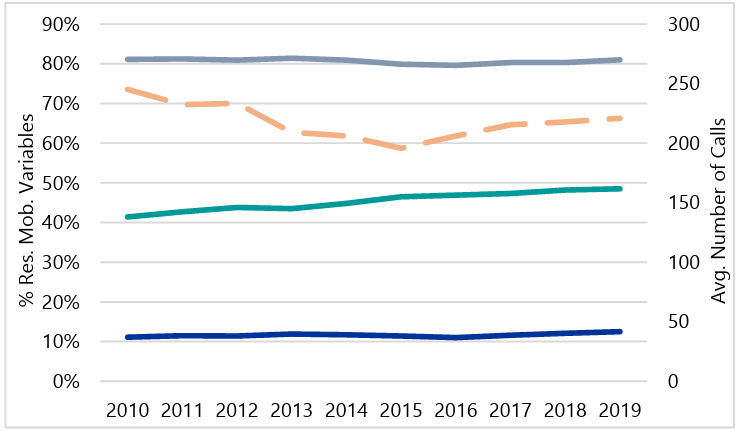
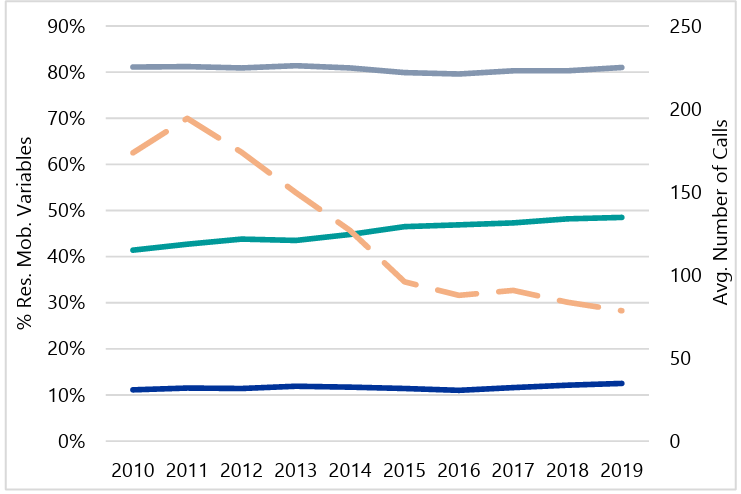
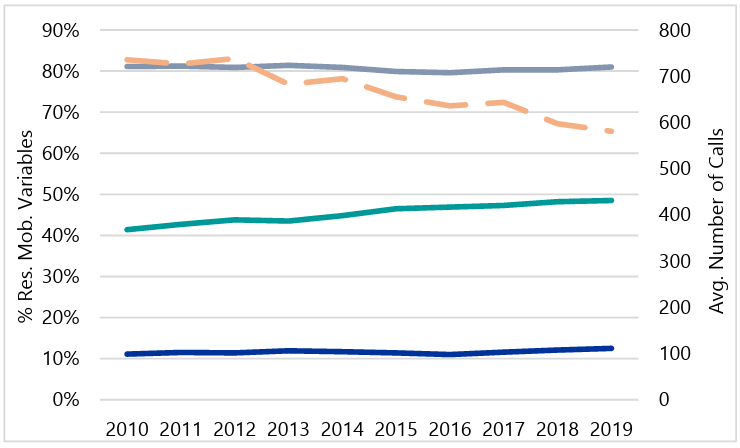
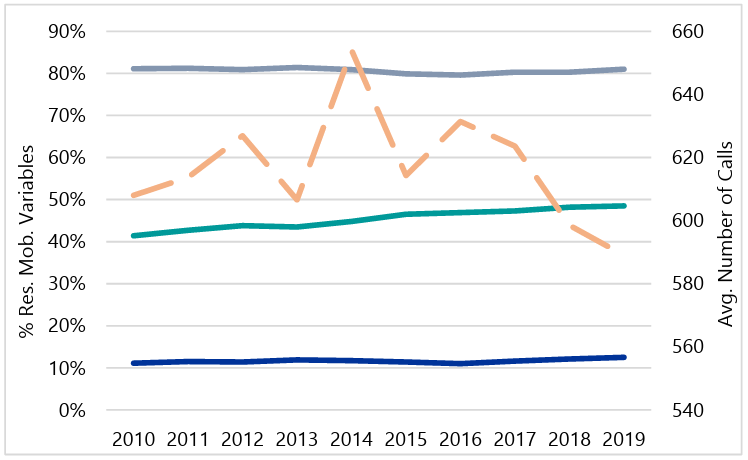
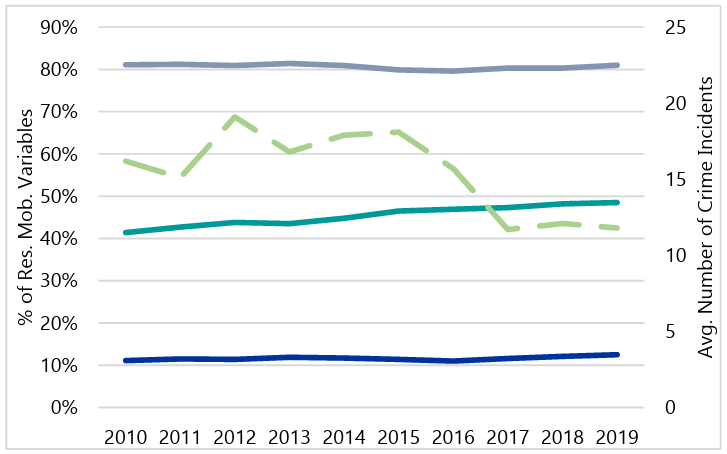
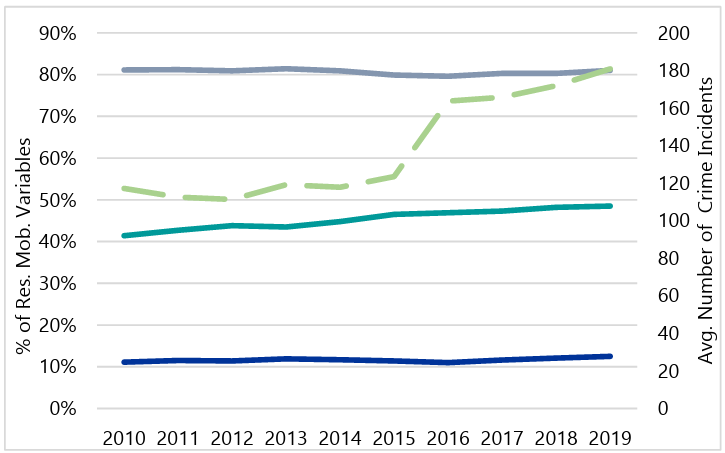
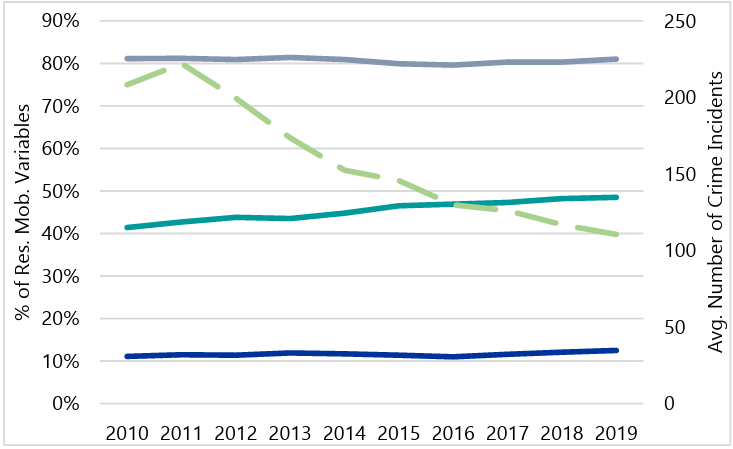
Depicted in the following line graphs, the residential instability variables, marked with solid lines, do not fluctuate markedly over the years. However, the percent in renter-occupied housing variable does show a continuous upward trend. The trend lines for the other two residential instability variables, namely geographic mobility and vacancies, are relatively stable aside from a slight increase in the percentage of vacant addresses after 2016. Almost half of the population in the Toledo census tracts were living in renter occupied housing units by 2019.
Part 1 Personal Calls
Part 2 Personal Calls
Part 1 Property Calls
Part 2 Property Calls
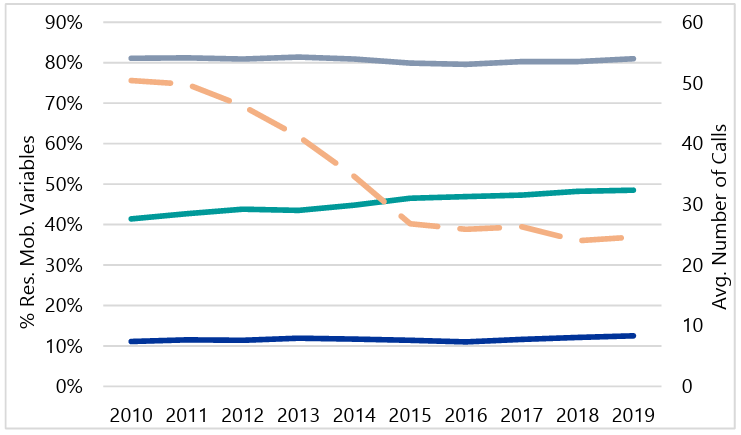

Average values for Part 1 personal calls for service remained relatively stable at an average of two calls for each year besides 2016 and 2018, which experienced an average of three calls per year. Given the nature of these offenses and rarity at which they occur, a limited number of Part 1 personal calls would be anticipated. The trend lines for Part 1 property and Part 2 property calls followed similar patterns, excluding an increase in Part 1 property calls from 2010 to 2011. The average number of Part 1 property calls dropped by nearly half from 2011 through 2015, which was also observed for Part 2 property calls from 2010 through 2015. The average number of calls then remained relatively stable for both call types until 2019, when a slight decrease in Part 1 property calls and a slight increase in Part 2 property calls occurred. The mean calls for Part 2 personal calls declined from 2010 to 2015, with a minor increase in 2012, followed by a continuous increase from 2015 to 2019.
Public Order Calls
Non-Crime Service Calls
Substance Offense Calls
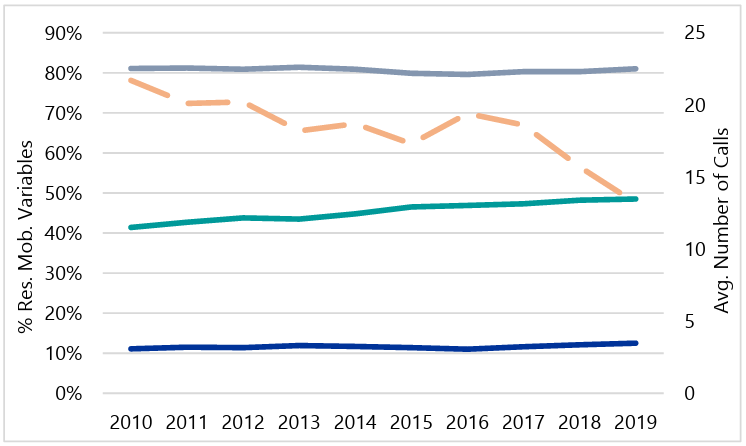
The average number of calls for public order continuously declined throughout the study period, except for a marginal increase in calls for years 2012, 2014, and 2017. Similarly, the trend line for calls regarding substance offenses had an overall declining trend from 2010 through 2019, though, slight increases in substance offense calls occurred in 2012, 2014, and 2016. The trend line for non-criminal service calls remained sporadic throughout the study’s timeframe. Increases in the average number of non-crime related service calls were observed in 2012, 2014, and 2016, with the increase in service calls from 2013 to 2014 being the most drastic, from an approximate average of 605 calls to 655, respectively. The average number of non-criminal service calls started to decline in 2016 and continued to do so through 2019.
Trend Lines for Crime Incidents with Residential Instability Measures
Part 1 Personal Crimes
Part 2 Personal Crimes
Part 1 Property Crimes
Part 2 Property Crimes
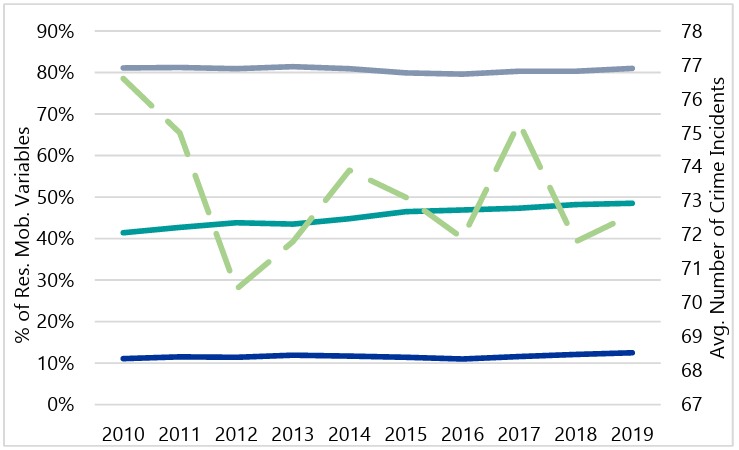
Mean values for Part 1 personal crimes slightly decreased from 2010-2011, followed by minor fluctuations before declining from 2015-2017 and remained stable from 2017 to 2019. Average Part 1 property incidents trends increased from 2010-2011 before steadily decreasing by more than half through 2019. Part 2 personal crimes held steady until 2015, when the trend showed a sharp increase, followed by a more gradual rise from 2016 onward. The trend line for Part 2 property crimes fluctuated greatly over the study period, reaching a low in 2012; however, the average number of incidents each year remained between 70 and 77, exhibiting an overall decline from 2010 to 2019.
Public Order Offenses
Substance Offences
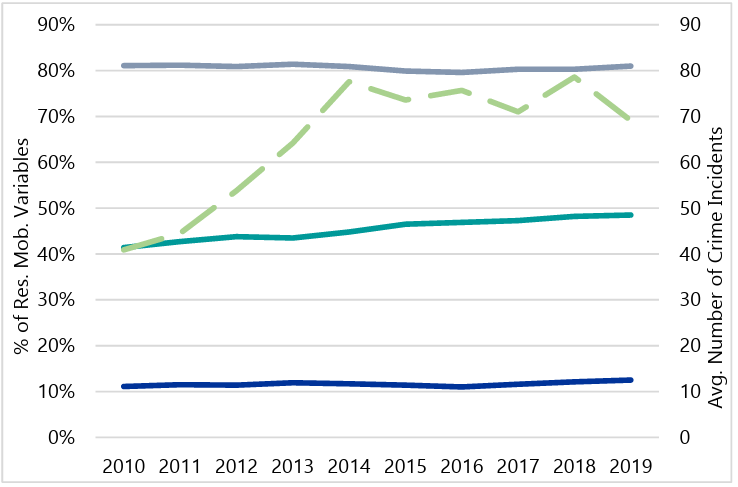
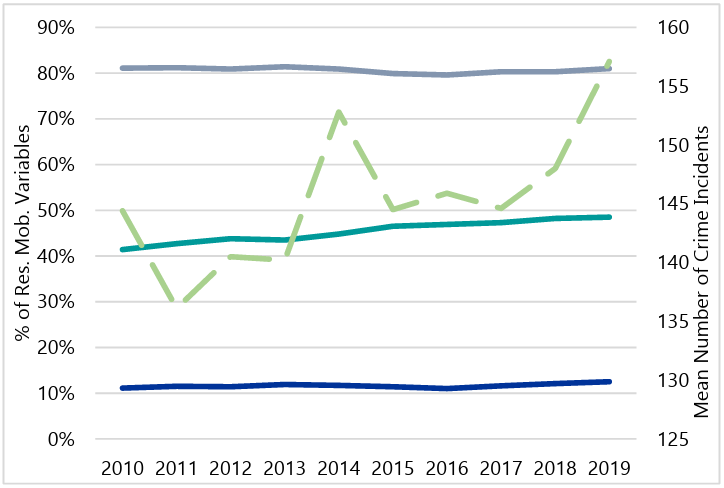
Similar to Part 2 property crimes, the trend line for public order incidents wavered. Initially, there was a decrease in these crimes from 2010-2011, followed by a slight increase through 2013. In 2014, there was a sharp spike before returning to lower averages in 2015 and continuing the gradual increase from prior years. A more dramatic incline began in 2017 and persisted through 2019. Substance offenses nearly doubled from 2010 to 2014, at which point the totals alternated yearly rising and falling slightly before showing a more notable decline starting in 2018.
Trend Lines for Calls for Service with Crime Category Measures
In the line graphs that follow, the mean totals for the calls for service variables and crime categories are depicted. Trends for Part 1 personal and Part 2 property crimes remained stable, experiencing minimal changes throughout the study’s timeframe. Average totals for Part 2 personal crime stayed relatively stable until 2015 where an upward trend started and continued through 2019, while the average for Part 1 property crimes dropped by half from 2011 to 2019. Trends for public order incidents and substance offenses experienced an increase in 2014. For the years following 2014, public order incidents saw an increase, while substance offenses remained relatively stable with a slight decrease from 2018 to 2019. More detailed information on the trends for the crime categories under study can be found in the previous section.
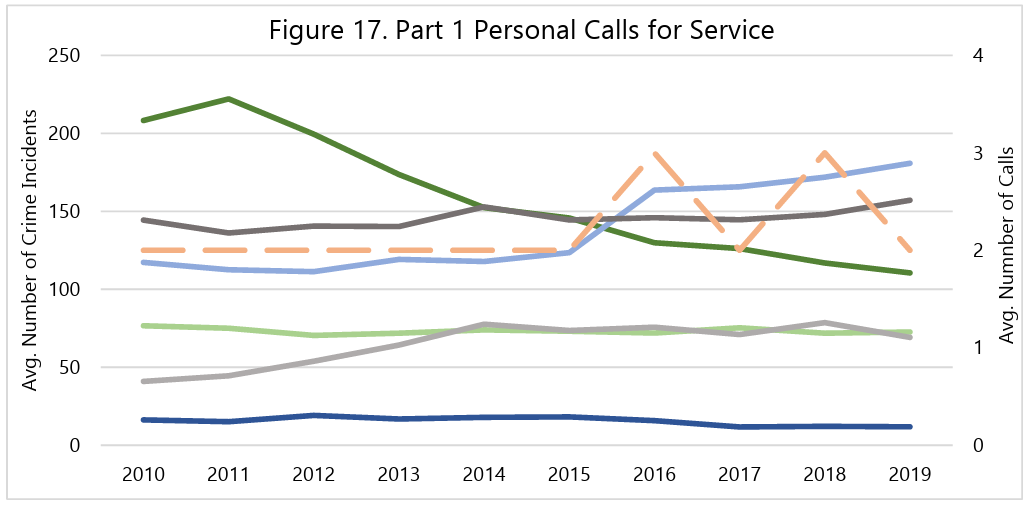
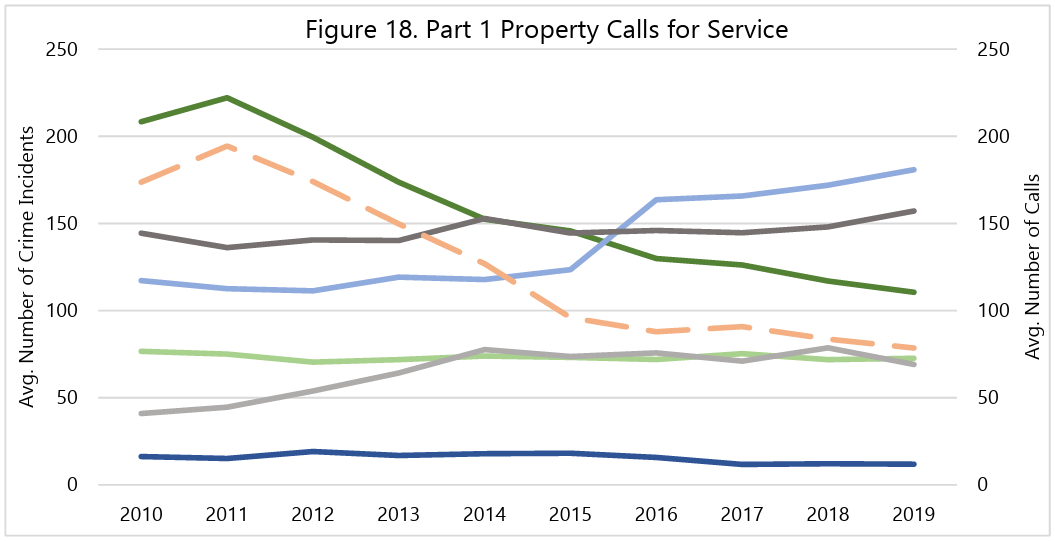
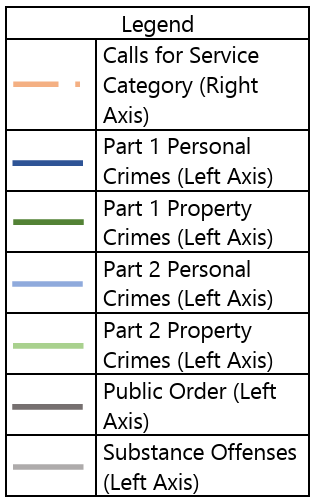
The average number Part 1 personal calls for service and crime incidents remained stable throughout the study’s timeframe. Although it appeared to be spikes in Part 1 personal calls in 2016 and 2018, the increases in both years were due to only one additional call. Trends for Part 1 property calls for service and crime followed almost identical patterns. These trend lines exhibited an increase from 2010 to 2011, followed by a steady decline through 2015 and 2016. Calls and crime incidents for Part 1 property continued to decline through 2019, but at a slower rate than in previous years.
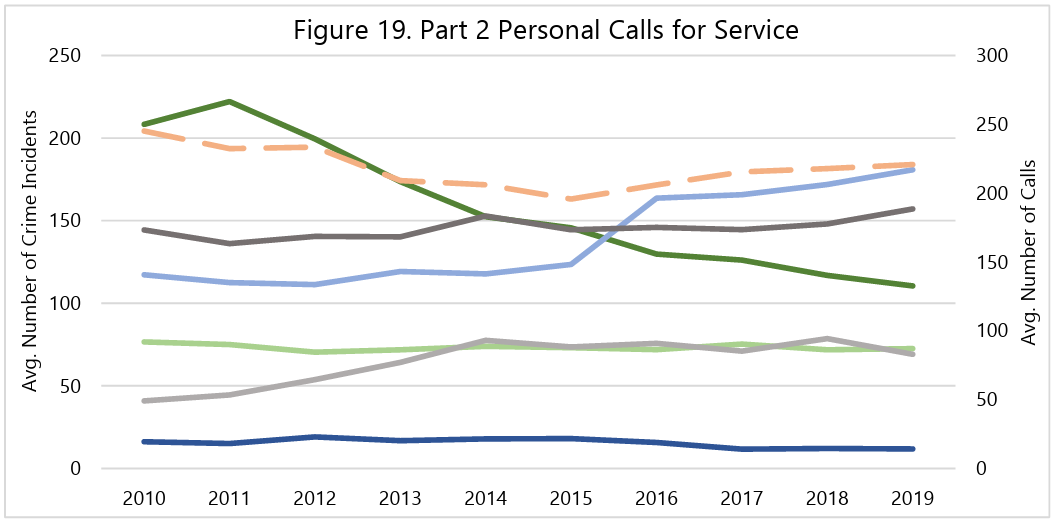
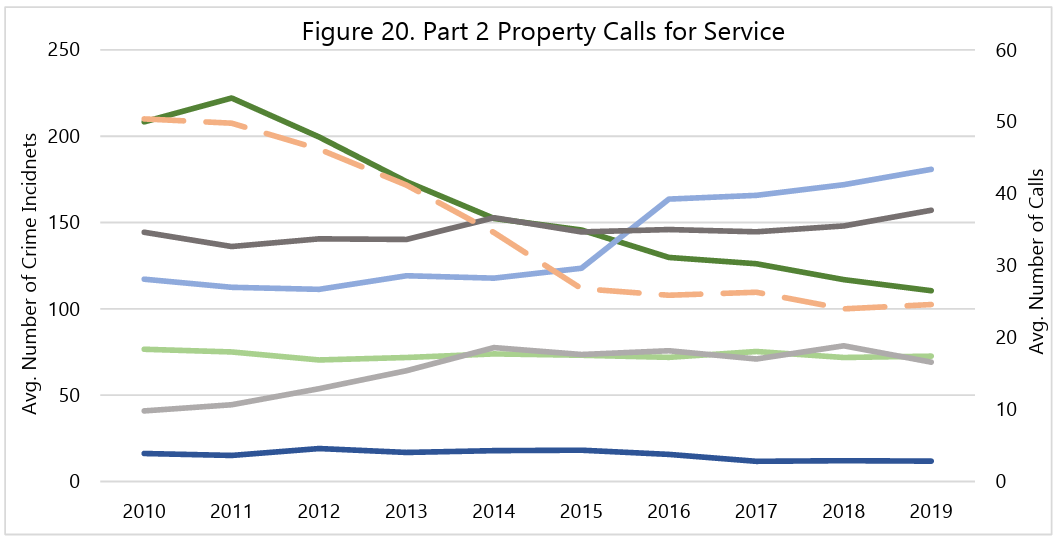
The average number of Part 2 personal calls for service was higher than Part 2 personal crime incidents for all years. After an increase in Part 2 personal offenses in 2015, the averages of calls for service and crime incidents for this category became similar. Trend lines for the average calls for service and crime incidents for Part 2 property did not follow similar trends throughout the study period. The average for Part 2 property calls for service decreased by nearly half from 2010 to 2015 before leveling out. Meanwhile, trends for Part 2 property crime incidents remained consistent, ranging between 70 and 77 incidents per year. For all Part 1 and Part 2 categories, except for Part 2 personal, the average number of calls for service remained lower than the average number of crime incidents.
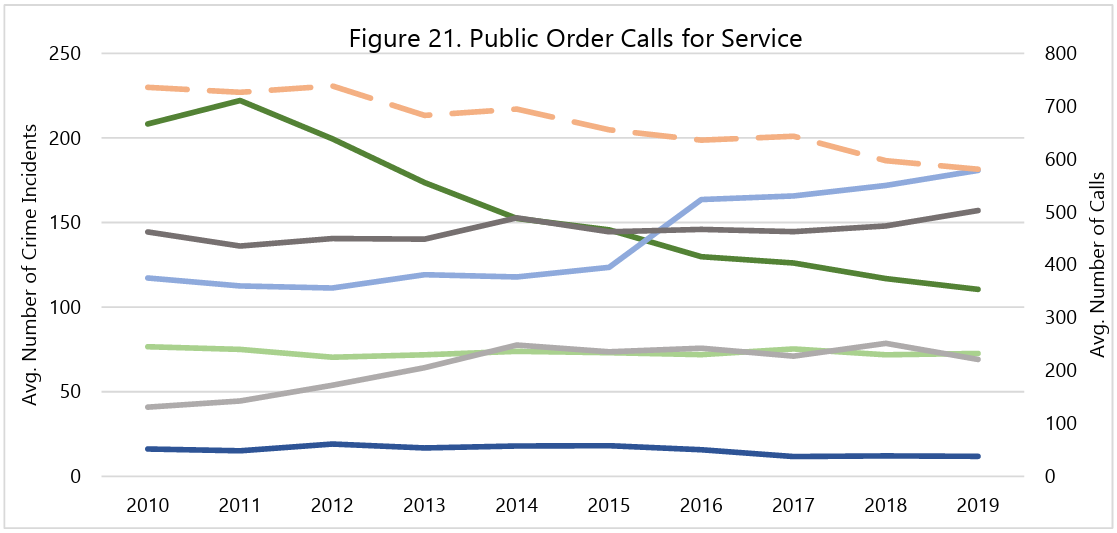
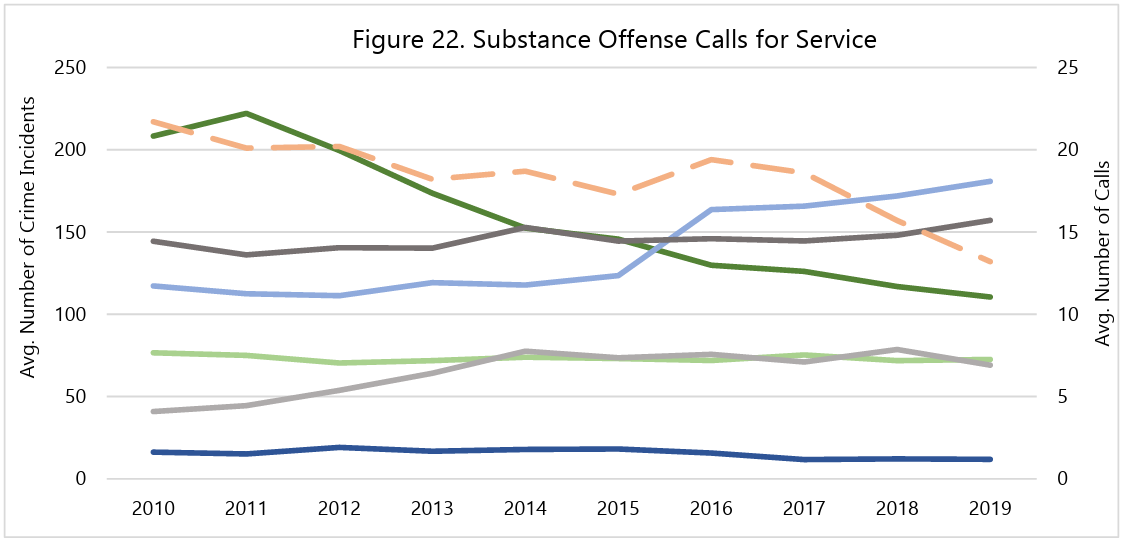
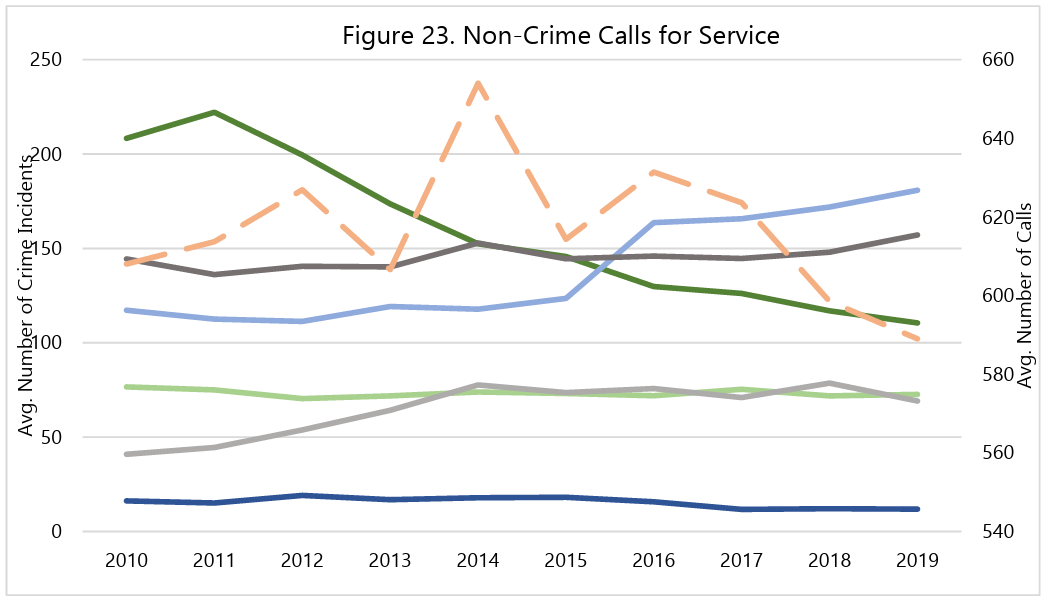
The average number of public order calls for service remained significantly higher than the average number of public order incidents through the study period. Interestingly, while the trend line for public order calls for service steadily decreased, the overall trend line for public order crime incidents increased. The average number of calls for substance offenses generally declined, except for a marginal increase from 2015 to 2016. In contrast, the average number of substance offenses increased from 2010 to 2014, followed by minimal changes from 2014 onward. The number of calls for substance offenses was consistently lower than the number of these incidents in any given year. The trend line for non-crime calls for service fluctuated throughout the study period, with notable peaks in 2012, 2014, and 2016. While these calls do not correspond with any of the crime categories under study, the average number of non-criminal calls for service remained significantly high, indicating that a large portion of calls for service were for non-criminal reasons.
Multivariate Results - Calls
Regression - Between Tract Findings
Table 8, found on the next page, provides a summary of the specific significant variables from the regression analyses examining the relationship between the demographic and residential instability indicators on the categories of crime incidents. In addition, to quantify the impact of each significant independent variable on the dependent variable two values are placed in parentheses in Table 8. The two numbers represent the following: the first number is the value of that independent variable’s incremental effect on crime incident category in that row; the second number is the additional number of crime incidents by category in that row that correspond to the first number’s value. For example, to interpret these values, in 2010 a 7.16% incremental increase in the percentage of vacant addresses, resulted in an additional 3.79 Part 1 personal, 15.56 Part 2 personal, and 12.13 Part 2 property crimes. At the between level, tracts are compared to each other. The results indicate that over the 10-year study period, tracts with an increase in the percentage of vacant addresses experienced a rise in crime incidents. Across all tracts, tracts with a 9% incremental increase in the percentage of vacant addresses had an increase, on average, of 84 crime incidents. Specific to each crime type, these were the significant findings across all tracts:
- An incremental 9% increase in the percentage of vacant addresses was associated with an average increase of 4 Part 1 personal, 20 Part 1 Property, and 22 Part 2 personal, and 25 substance offense incidents.
- An incremental 8% increase in the percentage of vacancies was associated with an average increase of 12 Part 2 property crime and 34 public order incidents.
Regression Summery: Significant Variables - Residential Instability and Calls for Service
2010
- Vacancies (7.16%, 0.59)*
- Total Pop (1267.75, 0.82)
2011
- None
2012
- Total Pop (1304.34, 0.74)
- Pop Density (1927.27, 0.43)
- Age 15-24 (6.11%, 0.62)
2013
- Total Pop (1285.01, 0.63)
2014
- Age 15-24 (5.7%, -0.69)
- Racial/Ethnic Heterogeneity (0.17, 0.61)
2015
- Racial/Ethnic Heterogeneity (0.16, 1.09)
- Female HH (9.98%, -0.96)
- Median Income ($17260.57, -1.12)
2016
- Racial/Ethnic Heterogeneity (0.16, 0.65)
2017
- Age 15-24 (4.92%, -0.56)
2018
- Total Pop (1335.67, 0.61)
- Age 15-24 (4.77%, -0.52)
- Gov. Supplemental Income (23.96%, 0.71)
2019
- Total Pop (1348.73, 0.71)
- Poverty (13.76%, -0.94)
2010
- Vacancies (7.16%, 34.52)
- Total Pop (1267.75, 65.07)
2011
- Total Pop (1287.45, 61.76)
- Pop Density (1937.62, 18.37)
2012
- Vacancies (7.61%, 29.69)
- Total Pop (1304.34, 61.44)
- Less than High School (9.85%, 21.66)
2013
- Vacancies (7.96%, 20.11)
- Total Pop (1285.01, 51.42)
- Less than High School (9.71%, 20.18)
2014
- Vacancies (8.29%, 25.86)
- Total Pop (1285.75, 44.06)
- Pop Density (1904.16, 9.27)
- Less than High School (9.62%, 25.26)
2015
- Vacancies (8.65%, 19.96)
- Total Pop (1261.82, 32.02)
- Gini Index (0.07, -12.06)
2016
- Vacancies (8.74%, 16.56)
- Total Pop (1278.7, 28.56)
- Racial/Ethnic Heterogeneity (0.16, 10.48)
2017
- Vacancies (9.35%, 12.80)
- Total Pop (1278.7, 28.56)
- Racial/Ethnic Heterogeneity (0.16, 12.54)
- Gini Index (0.07, -10.77)
2018
- Vacancies (9.88%, 14.37)
- Total Pop (1335.67, 32.50)
- Age 15-24 (4.77, -8.00)
2019
- Vacancies (10.27%, 16.25)
- Total Pop (1348.73, 33.17)
2010
- Vacancies (7.16%, 36.64)
- Total Pop (1267.75, 86.17)
- Pop Density (1982.87, 33.27)
- Less than High School (10.31%, 50.29)
2011
- Total Pop (1287.45, 72.03)
- Pop Density (1937.62, 26.87)
- Less than High School (10.03%, 51.02)
2012
- Vacancies (7.61%, 29.69)
- Total Pop (1304.34, 61.44)
- Less than High School (9.85%, 21.66)
2013
- Vacancies (7.96%, 31.31)
- Total Pop (1285.01, 64.50)
- Pop Density (1859.25, 22.42)
- Less than High School (9.71%, 42.86)
2014
- Vacancies (8.29%, 40.47)
- Total Pop (1285.75, 70.20)
- Pop Density (1904.16, 19.61)
2015
- Vacancies (8.65%, 37.91)
- Total Pop (1267.82, 58.95)
- Pop Density (1863.11, 21.04)
2016
- Vacancies (8.74%, 35.18)
- Total Pop (1278.70, 60.67)
- Pop Density (1890.26, 25.01)
- Poverty (14.97%, 51.33)
2017
- Total Pop (1318.72, 6.29)
- Pop Density (1915.27, 2.29)
- Age 15-24 (4.92%, -3.26)
- Racial/Ethnic Heterogeneity (0.16, 3.55)
- Gini Index (0.07, -2.73)
- Poverty (14.6%, 6.11)
2018
- Vacancies (9.88%, 32.30)
- Total Pop (1335.67, 70.63)
- Pop Density (1946.72, 24.00)
- Age 15-24 (4.77%, -29.66)
- Racial/Ethnic Heterogeneity (0.16, 20.86)
2019
- Total Pop (1348.73, 81.05)
- Pop Density (1969.90, 27.45)
2010
- Total Pop (1267.75, 26.85)
2011
- Total Pop (1287.45, 24.17)
- Racial/Ethnic Heterogeneity (0.18, -11.96)
2012
- Total Pop (1304.34, 23.57)
2013
- Total Pop (1285.01, 20.89)
- Racial/Ethnic Heterogeneity (0.17, -8.51)
2014
- Total Pop (1285.75, 15.37)
2015
- Total Pop (1261.82, 12.28)
2016
- Total Pop (1278.70, 13.68)
2017
- Total Pop (1318.72, 14.34)
2018
- Total Pop (1335.67, 12.73)
2019
- Total Pop (1348.72, 13.29)
- Racial/Ethnic Heterogeneity (0.15, -5.58)
2010
- Vacancies (7.16%, 122.31)
- Total Pop (1267.75, 224.56)
2011
- Total Pop (1287.45, 201.29)
2012
- Vacancies (7.61%, 111.59)
- Total Pop (1304.34, 218.36)
- Racial/Ethnic Heterogeneity (0.17, 64.14)
2013
- Vacancies (7.96%, 115.48)
- Total Pop (1285.01, 208.19)
2014
- Vacancies (8.29%, 130.26)
- Total Pop (1285.75, 220.19)
2015
- Vacancies (8.65%, 163.20)
- Total Pop (1261.82, 192.19)
- Racial/Ethnic Heterogeneity (0.16, 57.98)
2016
- Vacancies (8.74%, 136.50)
- Total Pop (1278.70, 180.38)
- Racial/Ethnic Heterogeneity (0.16, 87.10)
2017
- Vacancies (9.35%, 115.22)
- Total Pop (1318.72, 183.31)
- Age 15-24 (4.92, -73.95)
- Racial/Ethnic Heterogeneity (0.16, 101.12)
- Gini Index (0.07, -82.54)
2018
- Total Pop (1335.67, 175.34)
- Racial/Ethnic Heterogeneity (0.16, 59.04)
- Unemployment (8.55%, 91.41)
2019
- Total Pop (1348.73, 189.10)
2010
- Total Pop (1267.75, 7.16)
2011
- Total Pop (1287.45, 6.44)
2012
- Total Pop (1304.34, 7.61)
2013
- Total Pop (1285.75, 6.45)
2014
- Geo. Mobility (8.32%, -3.65)
- Total Pop (1285.75, 9.24
- Female HH (10.8%, -3.69)
- Gini Index (0.07, -3.12)
2015
- Total Pop (1261.82, 6.29)
- Female HH (9.98%, -4.73)
- Gini Index (0.07, -3.12)
2016
- Geo. Mobility (8.99%, -3.84)
- Total Pop (1278.70, 6.89)
- Female HH (10.09%, -5.64)
2017
- Total Pop (1318.72, 6.84)
- Gini Index (0.07, -3.46)
2018
- Total Pop (1335.67, 6.47)
2019
- Total Pop (1348.73, 5.78)
2010
- Vacancies (7.16%, 89.29)
- Total Pop (1267.75, 194.44)
2011
- Vacancies (7.8%, 64.81)
- Total Pop (1287.45, 191.22)
2012
- Total Pop (1304.34, 201.17)
2013
- Vacancies (7.96%, 74.24)
- Total Pop (1285.01, 208.69)
2014
- Vacancies (8.29%, 101.91)
- Total Pop (1285.75, 222.70)
2015
- Vacancies (8.65%, 138.19)
- Total Pop 1261.82, 205.95)
- Female HH (9.98%, 110.26)
2016
- Vacancies (8.74%. 96.26)
- Total Pop (1278.70, 214.06)
- Racial/Ethnic Heterogeneity (0.16, 58.26)
2017
- Total Pop (1318.72, 200.93)
- Racial/Ethnic Heterogeneity (0.16, 62.70)
2018
- Total Pop (1335.67, 193.59)
2019
- Total Pop (1348.72, 199.56)
Regression - Within Tract Findings
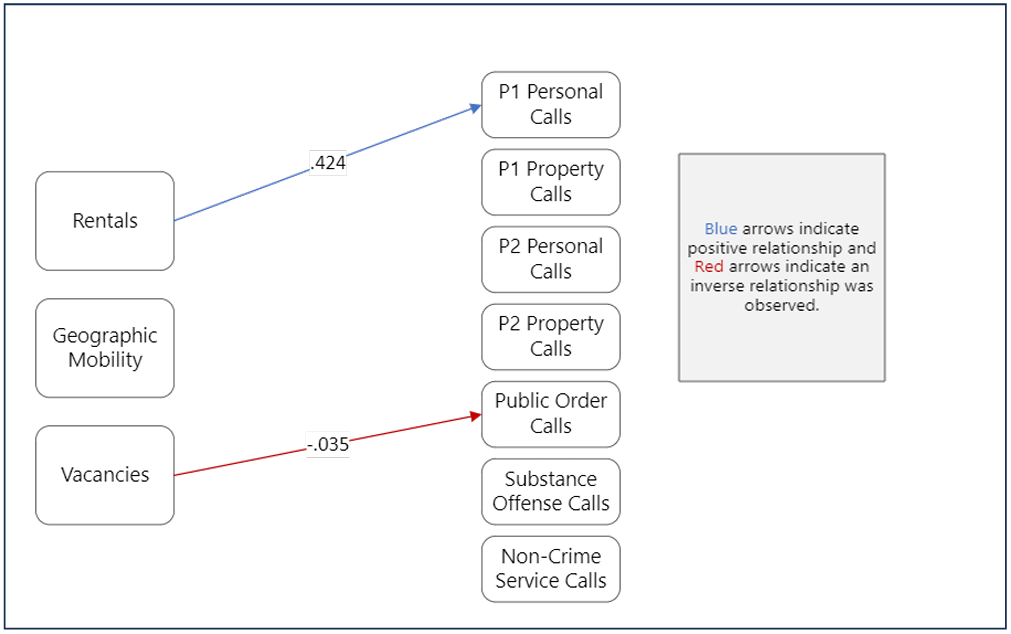
A Vector Autoregressive (VAR) Cross-Lagged Panel design was used to examine the current time series data (e.g., residential instability and calls for service) that was obtained from census tracts between 2010 and 2019. Recall that a VAR model is a multivariate time series model that estimates relationships between multiple variables measured at consecutive points in time and examines the carryover effect that the same variable has on itself over each consecutive timepoint. Cross-lags are incorporated into the model to examine the association between previous values of one variable to future values of another variable. For example, within the same tract, changes in the percentage of vacancies in 2010 predict changes in the number of crimes in 2011. Hence, this model allows for the examination of effects between each variable at the same time point (i.e., contemporaneous effects) and at the previous time point (i.e., lagged effect) to gain a better understanding of the directional association between two or more variables. See Figure 24 on page 29.
Within tract findings compare tracts to themselves over the 10-year period from 2010 to 2019. Calls for service for any type were largely unaffected by changes in residential instability across all years within the same tracts with the following exceptions:
- Tracts that had an incremental 19% increase in the percentage of renter occupied housing units, compared to their average, had an increase of less than 1 Part 1 personal crime.
- Tracts that had an incremental 9% increase in the percentage of vacant addresses, compared to their average, had 12 fewer public order calls.
Significant Carryover Effects Within Tracts: Residential Instability Measures and Calls for Service
Multivariate Results - Crimes
Regression - Between Tract Findings
Table 8, found on the next page, provides a summary of the specific significant variables from the regression analyses examining the relationship between the demographic and residential instability indicators on the categories of crime incidents. In addition, to quantify the impact of each significant independent variable on the dependent variable two values are placed in parentheses in Table 8. The two numbers represent the following: the first number is the value of that independent variable’s incremental effect on crime incident category in that row; the second number is the additional number of crime incidents by category in that row that correspond to the first number’s value. For example, to interpret these values, in 2010 a 7.16% incremental increase in the percentage of vacant addresses, resulted in an additional 3.79 Part 1 personal, 15.56 Part 2 personal, and 12.13 Part 2 property crimes.
At the between level, tracts are compared to each other. The results indicate that over the 10-year study period, tracts with an increase in the percentage of vacant addresses experienced a rise in crime incidents. Across all tracts, tracts with a 9% incremental increase in the percentage of vacant addresses had an increase, on average, of 84 crime incidents. Specific to each crime type, these were the significant findings across all tracts:
- An incremental 9% increase in the percentage of vacant addresses was associated with an average increase of 4 Part 1 personal, 20 Part 1 Property, and 22 Part 2 personal, and 25 substance offense incidents.
- An incremental 8% increase in the percentage of vacancies was associated with an average increase of 12 Part 2 property crime and 34 public order incidents.
Regression Summary: Significant Variables - Residential Instability and Crime
2010
- Vacancies (7.16%, 3.80)
- Total Pop (1267.75, 4.74)
- Pop Density (1982.87, 25.53)
2011
- Total Pop (1287.45, 2.80)
- Female HH (10.27%, 3.55)
2012
- Vacancies (7.61%, 5.30)
- Total Pop (1304.34, 4.70)
- Less than High School (9.85%, 3.97)
2013
- Vacancies (7.96%, 4.18)
- Total Pop (1285.01, 4.33)
2014
- Vacancies (8.29%, 6.77)
- Total Pop (1285.75, 4.76)
2015
- Vacancies (8.65%, 4.49)
- Total Pop (1261.82, 5.33)
- Pop Density (1863.11, 1.74)
2016
- Vacancies (8.74%, 5.16)
- Total Pop (1278.70, 4.08)
- Pop Density (1890.26, 1.72)
- Poverty (14.97%, 4.92)
2017
- Total Pop (1318.72, 2.60)
- Poverty (14.60%, 5.06)
2018
- Vacancies (9.88%, 2.53)
- Total Pop (1335.67, 3.25)
- Gini Index (0.08, -1.72)
2019
- Vacancies (10.27%, 2.92)
- Total Pop (1348.73, 2.90)
2010
- Total Pop (1267.75, 84.65)
- Median Income ($18375.50, 54.31)
- Gini Index (0.07, -32.39)
2011
- Total Pop (1287.45, 83.58)
- Median Income ($17232.03, 49.61)
2012
- Total Pop (1304.34, 79.74)
- Median Income ($17110.38, 53.74)
2013
- Total Pop (1285.01, 72.39)
2014
- Vacancies (8.29%, 27.17)
- Total Pop (1285.75, 58.01)
2015
- Total Pop (1261.82, 55.80)
2016
- Total Pop (1278.70, 48.84)
2017
- Total Pop (1318.72, 52.34)
2018
- Vacancies (9.88%, 14.61)
- Total Pop (1335.67, 46,26)
2019
- Vacancies (10.27%, 17.16)
- Total Pop (1348.73, 48.16)
2010
- Vacancies (7.16%, 15.56)
- Total Pop (1267.75, 42.66)
- Pop Density (1982.87, 11.01)
- Less than High School (10.31%, 17.74)
- Median Income ($18375.50, 29.74)
2011
- Total Pop (1287.45, 35.93)
- Pop Density (6.09, 9.72)
2012
- Vacancies (7.61%, 13.98)
- Total Pop (1304.34, 38.61)
- Pop Density (1927.78, 12.19)
2013
- Vacancies (7.96%, 20.84)
- Total Pop (1285.01, 35.85)
- Pop Density (1859.25, 10.42)
2014
- Vacancies (8.29%, 24.92)
- Total Pop (1285.75, 39. 52)
- Pop Density (1904.16, 11.14)
2015
- Vacancies (8.29%, 24.92)
- Total Pop (1285.75, 39. 52)
- Pop Density (1904.16, 11.14)
2016
- Vacancies (8.74%, 27.83)
- Total Pop (1278.70, 51.73)
- Pop Density (1890.26, 17.27)
- Racial/Ethnic Heterogeneity (0.16, 14.74)
- Poverty (14.97%, 32.80)
2017
- Total Pop (1318.72, 58.01)
- Pop Density (1915.27, 16.64)
- Racial/Ethnic Heterogeneity (0.16, 25.57)
- Poverty (14.60%, 43.14)
- Age 15-24 (4.92%, -18.59)
- Gini Index (0.07, -18.04)
2018
- Vacancies (9.88%, 22.03)
- Total Pop (1335.67, 64.15)
2019
- Vacancies (10.27%, 28.60)
- Total Pop (1348.73, 66.50)
- Pop Density (1969.90, 18.80)
2010
- Rentals (21.50%, 12.32)
- Vacancies (7.16%, 12.13)
- Total Pop (1267.75, 26.08)
2011
- Total Pop (1287.45, 23.30)
2012
- Vacancies (7.61%, 9.61)
- Total Pop (1304.34, 21.47)
2013
- Vacancies (7.96%, 14.47)
- Total Pop (1285.01, 23.88)
2014
- Vacancies (8.29%, 15.27)
- Total Pop (1285.75, 23.51)
2015
- Vacancies (8.65%, 12.93)
- Total Pop (1261.82, 23.52)
2016
- Vacancies (8.74%, 10.71)
- Total Pop (1278.70, 25.26)
2017
- Vacancies (9.35%, 11.17)
- Total Pop (1318.72, 25.68)
- Age 15-24 (4.92%, -6.03)
2018
- Vacancies (9.88%, 7.19)
- Total Pop (1335.67, 24.88)
- Median Income ($17634.23, 12.90)
2019
- Total Pop (1348.73, 29.30)
2010
- Total Pop (1267.75, 39.48
- Pop Density (1982.87, 17.54
- Median Income ($18375.50, 25.37)
2011
- Total Pop (1287.45, 29.85)
- Pop Density (6.09, 13.78)
- Median Income ($17232.03, 23.57)
2012
- Total Pop (1304.34, 35.81)
2013
- Vacancies (7.96%, 31.66)
- Total Pop (1285.01, 38.09)
2014
- Vacancies (8.29%, 39.80)
- Total Pop (1285.75, 46.29)
2015
- Vacancies (8.65%, 31.00)
- Total Pop (1261.82, 40.04)
2016
- Vacancies (8.74%, 31.85)
- Total Pop (1278.70, 41.68)
2017
- Total Pop (1318.72, 45.08)
- Age 15-24 (4.92%, -18.59)
2018
- Total Pop (1335.67, 41.81)
- Age 15-24 (4.77%, -16.32)
2019
- Total Pop (1348.73, 42.92)
- Pop Density (1969.90, 17.18)
2010
- None
2011
- None
2012
- Vacancies (7.61%, 12.05)
2013
- Vacancies (7.96%, 22.47)
- Total Pop (1285.01, 14.07)
2014
- Geo. Mobility (8.32%, -15.04)
- Vacancies (8.29%, 34.03)
- Total Pop (1285.75, 19.76)
- Median Income ($17135.08, 7.16)
- Female HH (10.8%, -18.81)
2015
- Vacancies (8.65%, 25.79)
- Total Pop (1261.82, 17.85)
2016
- Vacancies (8.74%, 25.71)
- Total Pop (1278.70, 19.57)
2017
- Vacancies (9.35%, 23.00)
2018
- Vacancies (9.88%, 26.89)
- Total Pop (1335.67, 16.53)
2019
- Vacancies (10.27%, 28.74)
- Total Pop (1348.73, 14.71)
Regression - Within Tract Findings - Crime
As we did with calls for service, Autoregressive (VAR) Cross-Lagged Panel design was used to analyze the current time series data to study the relationship between residential instability and crime incidents. Recall that a VAR model is a multivariate time series model that estimates relationships between multiple variables measured at consecutive points in time and examines the carryover effect of each variable on itself over
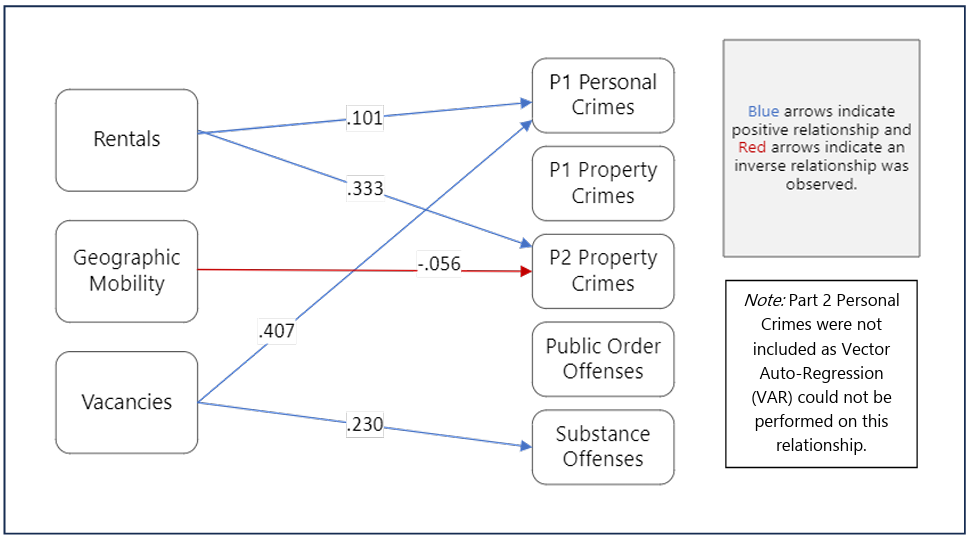
successive time points. Cross-lags are incorporated into the model to assess the relationship between past values of one variable and future values of another. For instance, it examines the effect of the percentage of renter occupied housing units in 2011 on changes in crime in 2012. This model allows for the examination of effects between each variable at the same time point (i.e., contemporaneous effects) and at the previous time point (i.e., lagged effects) to better understand the directional association between two or more variables from one year to the next. See Figure 25 below.
Within tract findings compare tracts to themselves over the 10-year period from 2010 to 2019. Within tracts over the ten years studied, the three measures of residential instability had a significant influence on certain types of crime. Tracts that had an incremental 12% increase in residential instability, compared to their average, had an increase of 9 crime incidents. Related to each significant association, we found:
- Tracts that had an incremental 8.59% increase in the percentage of vacant addresses, compared to their average, had an increase of 4 Part 1 personal crime incidents and nearly 12 substance offense crime incidents.
- Tracts that had an incremental 19% increase in the percentage of renter occupied housing units, compared to their average, had an increase of 1 Part 1 personal crime incidents and 12 Part 2 property crime incidents occurred.
- Tracts that had an incremental 9% increase in the percentage of population living in the same house as they did one year ago (i.e., geographic mobility), compared to their average, had a decrease of two Part 2 property crime incidents.
Significant Carryover Effects Within Tracts: Residential Instability Measures and Crime Incidents
Multivariate Results - Residential Instability and Calls Predicting Crimes
Regression - Between Tract Findings
Table 9 provides a summary of the specific significant variables from the regression analyses examining the relationship between the demographic characteristics, residential instability indicators, and types of calls for service and the categories of crime incidents. In addition, to quantify the impact of each significant independent variable on the dependent variable two values are placed in parentheses in Table 9. The two numbers represent the following: the first number is the value of that independent variable’s incremental effect on the crime incident category in that row; the second number is the additional number of crime incidents by category in that row that correspond to the first number’s value. For example, to interpret these values, in 2014, for every 8.29% increase in vacancies, there were 3.32 additional Part 1 personal crimes.
Recall that at the between level, tracts are compared to each other. The residential instability indicators did not have as large an effect on types of crime incidents after calls for service categories were included in the models. There were some significant associations, however.
- As the percentage of vacant addresses increased, so did some categories of crime incidents (i.e., Part 1 and 2 personal, Part 1 and 2 property, and substance offenses) in some years, specifically 2013, 2014-2016, and 2018-2019, even when accounting for the number of calls for service categories.
- An incremental 9% increase in the percentage of vacant addresses was associated with an average
increase of 15 crime incidents. - The percentage of renter occupied housing units and geographic mobility measures were found to have a significant relationship with a few crime incidents and years of study.
- An incremental 19% increase in the percentage of renter occupied housing units was associated with an average increase of 9 Part 2 property crimes in 2011 and 13 Part 2 personal crimes in 2018.
- In 2019, an incremental 9% increase in the percentage of those residing in the same house as they did a year ago (i.e., geographic mobility) was associated with an average increase of almost 2 Part 1 personal crimes and 8 Part 1 property crimes.
- We found that calls for service and crime incidents falling under any category, for every average incremental increase of 143 calls of any type, there was an average increase of 26 crimes. Related to the distinct crime categories:
- An average incremental increase of 177 calls for service was associated with an average increase of 3 additional Part 1 personal crimes, apart from the years 2011 and 2014.
- An average incremental increase of 69 calls for service was associated with an average increase of 35 Part 1 property calls.
- An average incremental increase of 132 calls for service was associated with an average increase of 42 Part 2 personal crimes.
- An average incremental increase of 152 calls for service was associated with an average increase of 13 Part 2 property crimes.
- Except for 2019, an average incremental increase of 205 calls was associated with an average increase of 30 public order crime incidents.
- From 2010 through 2016, on average, an incremental increase of 202 calls for service was associated with an average increase of 22 substance offense incidents.
Regression Summary: Significant Variables - Residential Instability and Calls for Service Predicting Crime
2010
- Substance Offense Calls (16.1, 2.32)
- Racial/Ethnic Heterogeneity (0.17, -2.02)
2011
- Female HH (10.27%, 2.40)
2012
- P2 Personal Calls (141.49, 7.62)
- Public Order Calls (370.73, 9.77)
- Non-Crime Related Calls (296.27, -4.93)
- Unemployment (10.41%, -.337)
2013
- P2 Personal Calls (125.25, 7.10)
- Non-Crime Related Calls (286.66, -4.10)
2014
- Vacancies (8.29%, 3.32)
- Gini Index (0.07, 2.85)
2015
- Public Order Calls (325.75, 6.41)
2016
- P2 Personal Calls (119.66, 6.04)
- Non-Crime Related Calls (316.5, -3.42)
- Vacancies (8.74%, 2.55)
2017
- P1 Personal Calls (2.00, 1.90)
- P2 Personal Calls (126.8, 6.38)
2018
- P2 Personal Calls (125.68, 4.10)
- Supp. Gov. Assistance (23.96%, -2.60)
2019
- P1 Property Calls (45.01, 3.95)
- Geo. Mobility (9.39%, 1.56)
- Total Pop (1348.73, -1.64)
2010
- P1 Property Calls (96.97, 85.97)
- P2 Personal Calls (153.33, -43.11)
- P2 Property Calls (44.23, 60.81)
- Median Income ($18,375.50, -18.06)
2011
- P1 Property Calls (105.57, 85.78)
- P2 Personal Calls (142.93, -36.95)
- P2 Property Calls (41.97, 64.59)
- Female HH (10.27%, 13.18)
2012
- P1 Property Calls (93.38, 55.97)
- P2 Property Calls (37.84, 64.40)
- Median Income ($17,110.40, -18.62)
2013
- P1 Property Calls (74.20, 36.82)
- P2 Property Calls (36.2, 62.56)
- Substance Offense Calls (11.39, 15.59)
2014
- P1 Property Calls (67.17, 37.02)
- P2 Property Calls (32.84, 52.50)
- Vacancies (8.29%, 11.70)
- Median Income ($17,135.10, 13.63)
- Supp. Gov. Assistance (24.08%, 10.90)
2015
- P1 Personal Calls (2.15, 11.33)
- P1 Property Calls (51.32, 40.52)
- P2 Property Calls (32.40, 58.84)
- Total Pop (1261.82, 10.50)
2016
- P1 Property Calls (48.98, 32.67)
- P2 Property Calls (31.52, 51.63)
- Total Pop (1278.70, 12.19)
- Less than High School (9.247%, -11.79)
2017
- P1 Property Calls (50.78, 54.23)
- P2 Personal Calls (126.80, -28.81)
- P2 Property Calls (25.84, 40.73)
- Female HH (10.21, -9.95)
2018
- P1 Property Calls (46.50, 27.42)
- P2 Property Calls (23.70, 44.39)
2019
- P1 Property Calls (45.01, 27.74)
- P2 Personal Calls (130.10, -20.22)
- P2 Property Calls (20.20, 37.25)
- Non-Crime Related Calls (287.55, 18.43)
- Geo. Mobility (4.39, 7.85)
2010
- P1 Personal Calls (2.05, 7.39)
- P2 Personal Calls (153.33, 41.54)
- Total Pop (1267.80, 12.07)
2011
- P2 Personal Calls (142.93, 33.85)
- Total Pop (1287.45, 10.10)
- Female HH (10.27%, 9.13)
- Median Income ($17232.03, 10.42)
2012
- P2 Personal Calls (141.49, 47.34)
- Female HH (10.93%, 6.22)
- Unemployment (10.41%, -7.76)
2013
- P2 Personal Calls (125.25, 59.53)
- Unemployment (10.68%, -10.22)
2014
- P2 Personal Calls (124.91, 53.78)
- Public Order Calls (344.59, 20.51)
- Non-Crime Related Calls (314.55, 11.88)
- Female HH (10.80%, 8.08)
- Median Income ($17135.08, 9.71)
2015
- P1 Personal Calls (2.15, 9.66)
- P2 Personal Calls (115.48, 53.22)
- Vacancies (8.65%, 9.32)
- Total Pop (1261.82, 16.20)
- Female HH (9.98%, 8.23)
- Less than High School (9.44%, 14.77)
2016
- P2 Personal Calls (119.66, 73.63)
- Female HH (10.09%, 12.21)
2017
- P2 Personal Calls (126.80, 74.47)
- Total Pop (1318.72, 19.06)
2018
- P2 Personal Calls (125.68, 97.15)
- Rentals (18.03%, 13.10)
- Total Pop (1335.67, 16.69)
- Median Income ($17634.23, 15.04)
2019
- P2 Personal Calls (130.10, 93.19)
- Substance Offense Calls (8.88, -21.12)
- Median Income ($17,063.66, 17.38)
2010
- P1 Property Calls (96.97, 18.72)
- Substance Offense Calls (16.10, 8.07)
- Total Pop (1267.80, 6.62)
2011
- P1 Property Calls (105.57, 13.33)
- Rentals (21.07%, 9.47)
- Total Pop (1287.45, 6.92)
2012
- P2 Property Calls (37.84, 7.32)
- Public Order Calls (370.73, 22.22)
- Unemployment (10.41%, -6.65)
2013
- P2 Personal Calls (125.25, 11.70)
- P2 Property Calls (36.20, 6.00)
- Vacancies (7.96%, 5.67)
- Total Pop (1285.01, 4.72)
2014
- P2 Property Calls (32.84, 5.70)
- Public Order Calls (344.59, 16.18)
2015
- Public Order Calls (325.74, 14.06)
2016
- Public Order Calls (325.74, 11.89)
- Age 15-24 (5.21%, 4.36)
- Racial/Ethnic Heterogeneity (0.16, -4.62)
- Female HH (10.09%, 5.91)
- Gini Index (0.07, 4.54)
2017
- P1 Property Calls (50.78, 15.12)
- Total Pop (1318.72, 7.08)
2018
- P2 Personal Calls (125.68, 14.76)
- Total Pop (1335.67, 7.54)
- Median Income ($17634.23, 8.81)
2019
- P2 Personal Calls (130.10, 18.17)
- Total Pop (1348.73, 8.47)
2010
- P2 Personal Calls (153.33, 26.68)
- Public Order Calls (378.68, 35.65)
- Non-Crime Related Calls (293.71, 30.18)
- Pop Density (1982.90, 9.14)
2011
- Public Order Calls (379.08, 53.12)
- Substance Offense Calls (12.81, 15.69)
2012
- P1 Property Calls (93.38, 41.49)
- P2 Personal Calls (141.49, 46.92)
- Public Order Calls (370.73, 43.57)
2013
- P2 Personal Calls (125.25, 37.77)
- Public Order Calls (334.71, 36.24)
- Total Pop (1285.01, -11.73)
2014
- Public Order Calls (344.59, 49.32)
2015
- P2 Personal Calls (115.48, 38.89)
- Public Order Calls (325.74, 32.07)
- Racial/Ethnic Heterogeneity (0.16, -8.96)
2016
- P1 Property Calls (48.98, 24.13)
- P2 Personal Calls (119.66, 54.19)
2017
- P2 Personal Calls (126.80, 39.70)
2018
- P2 Personal Calls (125.68, 41.57)
2019
- Pop Density (1969.90, 9.90)
2010
- Public Order Calls (378.68, 20.95)
- Substance Offense Calls (16.10, 8.18)
- Total Pop (1267.80, -9.41)
2011
- Public Order Calls (379.08, 38.35)
- Total Pop (1287.45, 11.33)
- Racial/Ethnic Heterogeneity (0.18, -9.26)
2012
- P1 Property Calls (93.38, 18.32)
- Public Order Calls (370.73, 29.60)
- Total Pop (1304.34, 13.11)
- Racial/Ethnic Heterogeneity (0.17, -8.18)
2013
- Public Order Calls (334.71, 35.05)
- Total Pop (1285.01, -12.38)
- Racial/Ethnic Heterogeneity (0.17, -10.09)
2014
- Substance Offense Calls (12.99, 19.34)
- Vacancies (8.29%, 21.37)
- Racial/Ethnic Heterogeneity (0.17, -12.60)
2015
- P2 Personal Calls (115.48, 38.43)
- Total Pop (1261. 82, 14.96)
- Racial/Ethnic Heterogeneity (0.16, -11.39)
2016
- P2 Personal Calls (119.66, 30.09)
- Racial/Ethnic Heterogeneity (0.16, -19.17)
2017
- Total Population (1318.72, 16.58)
2018
- Vacancies (9.88%, 15.73)
2019
- Vacancies (10.27%, 18.82)
- Total Pop (1348.73, 13.80)
Regression - Within Tract Findings
To better understand how residential instability and calls for service may have an influence on crime incidents within tracts, the VAR was conducted. As presented earlier in this report, a VAR model is a multivariate time series model that estimates relationships between multiple variables measured at consecutive points in time and examines how each variable influences itself over successive time points. Cross-lags are added to the model to explore the relationship between past values of one variable and future values of another. For example, it looks at the impact of the residential instability factors and the calls for crime categories’ values in 2013 and how they might be associated with changes in crime in 2014. This model allows for examining the effects between variables at the same time point (i.e., contemporaneous effects) and from the previous time point (i.e., lagged effects) to better understand the directional relationship between two or more variables. The types of calls for service and residential instability variables were found to have significant associations with some crime categories over time (i.e., from one year to the next).
Regarding calls for service and crime incidents, we found that within tracts, across all 10 years of data, tracts that had an incremental increase of 163 calls for service made for any type, compared to their average, had an increase of 8 crime incidents from one year to the next. Specific to each crime incident type over time,
- Tracts that had an incremental increase of 2 Part 1 personal crime calls for service, compared to their average, had an increase of nearly 2 Part 1 personal crime incidents.
- Tracts that had an incremental increase of 68 Part 1 property crime calls for service, compared to their average, had an increase, on average, of two crime incidents for Part 1 personal and 46 Part 1 property crime incidents; however, an incremental increase of 68 Part 1 property calls corresponded to a decrease, on average, in 23 Part 2 personal, 5 Part 2 property, 18 public order, and 11 substance offense incidents.
- Tracts that had an incremental increase of 131 Part 2 personal calls for service, compared to their average, had an increase of 3 Part 1 personal, 38 Part 2 personal, 11 Part 2 property, and 34 public order crime incidents. However, this same incremental increase in Part 2 personal calls was associated with decrease of 19 Part 1 property crimes within tracts over time.
- Tracts that had an incremental increase of 33 Part 2 property calls for service, compared to their average, had an increase of 33 Part 1 property and 4 Part 2 property crime incidents.
- Tracts that had an incremental increase of 340 public order calls for service, compared to their average, had an increase of 3 Part 1 personal crimes, 11 Part 1 property, 10 Part 2 property, 22 public order, and 17 substance offense crime incidents.
- Tracts that had an incremental increase of 297 non-crime related calls for service, compared to their average, had a decrease of 2 Part 1 personal crime and an increase in 6 Part 2 property crime incidents.
Significant effects were also observed with regards to the within-tract residential instability variables over time or one year to the next.
- Tracts that had an incremental 9% increase in the percentage of vacant addresses, compared to their average, had an increase of 4 Part 1 personal crimes and 11 substance offense incidents.
- Tracts that had an incremental 19% increase in the percentage of renter occupied housing, compared to their average, had 1 additional Part 1 personal crime and 12 Part 2 property crimes.
- Tracts that had an incremental 9% increase in the percentage of persons living in the same house as they did one year (i.e., geographic mobility), compared to their average, had a decrease of 2 Part 2 property crimes.
Significant Carryover Effects Within Tracts: Personal Calls for Service and Crime Incidents
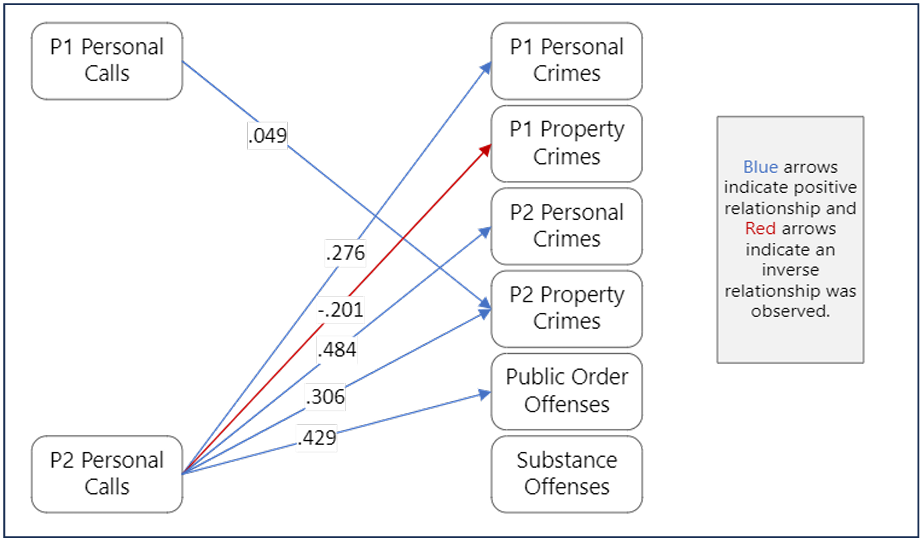
Significant Carryover Effects Within Tracts: Property Calls for Service on Crime Incidents
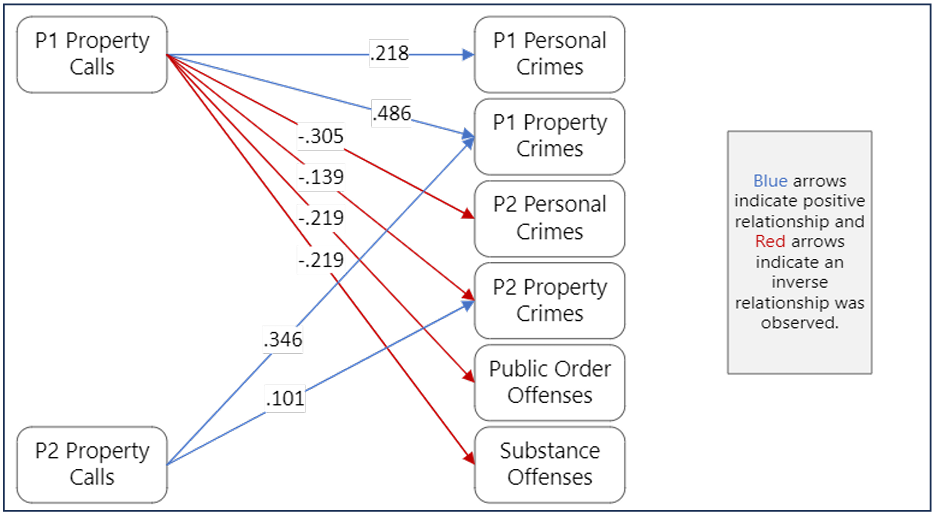
Significant Carryover Effect Within Tracts: Public Disorder, Substance Offenses, and Non-Crime Calls and Crimes
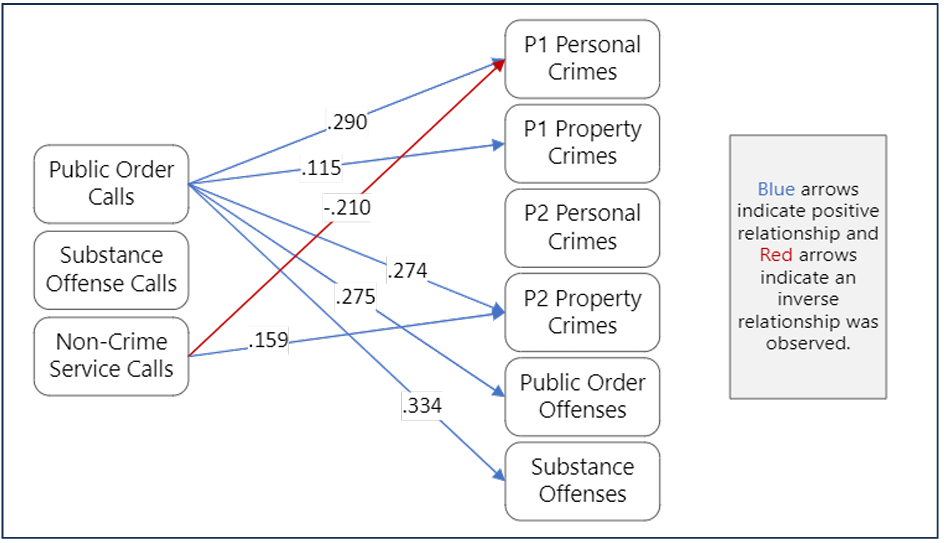
Summary of Study Results
Table 10 below provides the unrounded findings (reported as rounded figures in the Multivariate Results sections above) where the analyses resulted in a significant correlation between a residential instability variable between and within tracts. To best interpret these results, use the following statements as a template:
- In 2011, changes in the percent of vacancies were significantly associated with non-crime related service calls but no other call category when comparing tracts to one another (i.e., between tracts). To interpret the values noted in the table, in 2011 a 7.8% incremental increase in the percentage of vacant addresses was associated with an additional 64.81 calls of any type. Predicting further increases, if the percentage of vacancies were to double to 15.6% (which is 2 times 7.8%), we would expect the number of additional calls to also double to 129.62 (which is 2 times 64.81).
- Within tracts, where one tract is compared to itself from one year to the next, as opposed to the other tracts in the study, when averaging each tract’s change in the percentage of vacancies over time, we found that for every 8.59% increase, we would predict a corresponding increase of 16.36 crimes. Thus, if the percentage of vacancies would double in a tract from one year to the next, we would expect an additional 32.72 crimes.
Significant Changes in Calls and Crimes and Percent Vacancies Between Tracts
| Year | 2010 | 2011 | 2012 | 2013 | 2014 | 2015 | 2016 | 2017 | 2018 | 2019 |
| Vacancy Percent Change | 7.16% | 7.8% | 7.61% | 7.96% | 8.29% | 8.65% | 8.74% | 9.35% | 9.88% | 10.27% |
| Callls | 283.35 | 64.81 | 169.16 | 241.14 | 298.5 | 359.26 | 284.5 | 128.01 | 46.67 | 16.25 |
| Part 1 Personal | 0.59 | - | - | - | - | - | - | - | - | - |
| Part 1 Property | 34.52 | - | 29.69 | 20.11 | 25.86 | 19.96 | 16.56 | 12.8 | 14.37 | 16.25 |
| Part 2 Personal | 36.64 | - | 27.87 | 31.31 | 40.47 | 37.91 | 35.18 | - | 32.3 | - |
| Part 2 Property | - | - | - | - | - | - | - | - | - | - |
| Public Order | 122.31 | - | 111.59 | 115.48 | 130.26 | 163.20 | 136.50 | 115.22 | - | - |
| Substance | - | - | - | - | - | - | - | - | - | - |
| Service Calls | 89.29 | 64.81 | - | 74.24 | 101.91 | 138.19 | 96.26 | - | - | - |
| Crime | 31.49 | - | 40.95 | 93.62 | 147.97 | 102.93 | 101.26 | 34.17 | 73.26 | 77.43 |
| Part 1 Personal | 3.8 | - | 5.3 | 4.18 | 6.77 | 4.49 | 5.16 | - | 2.53 | 2.92 |
| Part 1 Property | - | - | - | - | 27.17 | - | - | - | 14.61 | 17.16 |
| Part 2 Personal | 15.56 | - | 13.98 | 20.84 | 24.92 | 28.72 | 27.83 | - | 22.03 | 28.6 |
| Part 2 Property | 12.13 | - | 9.61 | 14.47 | 15.27 | 12.93 | 10.71 | 11.17 | 7.19 | - |
| Public Order | - | - | - | 31.66 | 39.8 | 31 | 31.85 | - | - | - |
| Substance | - | - | 12.05 | 22.47 | 34.03 | 25.79 | 25.71 | 23 | 26.89 | 28.74 |
| Crime With Calls as Predictors | - | - | - | 5.67 | 36.39 | 9.32 | 2.55 | - | 15.73 | 18.82 |
| Part 1 Personal | - | - | - | - | 3.32 | - | 2.55 | - | - | - |
| Part 1 Property | - | - | - | - | 11.70 | - | - | - | - | - |
| Part 2 Personal | - | - | - | - | - | 9.32 | - | - | - | - |
| Part 2 Property | - | - | - | 5.67 | - | - | - | - | - | - |
| Public Order | - | - | - | - | - | - | - | - | - | - |
| Substance | - | - | - | - | 21.37 | - | - | - | 15.73 | 18.82 |
Significant Changes in Calls and Crimes and Percent Renter Occupied Housing Between Tracts
| Year | 2010 | 2011 | 2012 | 2013 | 2014 | 2015 | 2016 | 2017 | 2018 | 2019 |
| Renter Percent Change | 21.5% | 21.07% | 20.16% | 18.75% | 18.10% | 17.66% | 17.66% | 17.98% | 18.03% | 18.11% |
| Calls | - | - | - | - | - | - | - | - | - | - |
| Part 1 Personal | - | - | - | - | - | - | - | - | - | - |
| Part 1 Property | - | - | - | - | - | - | - | - | - | - |
| Part 2 Personal | - | - | - | - | - | - | - | - | - | - |
| Part 2 Property | - | - | - | - | - | - | - | - | - | - |
| Public Order | - | - | - | - | - | - | - | - | - | - |
| Substance | - | - | - | - | - | - | - | - | - | - |
| Service Calls | - | - | - | - | - | - | - | - | - | - |
| Crime | 12.32 | - | - | - | - | - | - | - | - | - |
| Part 1 Personal | - | - | - | - | - | - | - | - | - | - |
| Part 1 Property | - | - | - | - | - | - | - | - | - | - |
| Part 2 Personal | - | - | - | - | - | - | - | - | - | - |
| Part 2 Property | 12.32 | - | - | - | - | - | - | - | - | - |
| Public Order | - | - | - | - | - | - | - | - | - | - |
| Substance | - | - | - | - | - | - | - | - | - | - |
| Service Calls | - | - | - | - | - | - | - | - | - | - |
| Crime with Calls as Predictors | - | 9.47 | - | - | - | - | - | - | 13.10 | - |
| Part 1 Personal | - | - | - | - | - | - | - | - | - | - |
| Part 1 Property | - | - | - | - | - | - | - | - | - | - |
| Part 2 Personal | - | - | - | - | - | - | - | - | 13.10 | - |
| Part 2 Property | 9.47 | - | - | - | - | - | - | - | - | |
| Public Order | - | - | - | - | - | - | - | - | - | - |
| Substance | - | - | - | - | - | - | - | - | - | - |
| Service Calls | - | - | - | - | - | - | - | - | - | - |
Significant Changes in Calls and Crimes and Geographic Mobility Between Tracts
| Year | 2010 | 2011 | 2012 | 2013 | 2014 | 2015 | 2016 | 2017 | 2018 | 2019 |
| Geographic Mobility | 9.32% | 8.96% | 8.21% | 8.24% | 8.32% | 9.03% | 8.99% | 9.10% | 9.14% | 9.39% |
| Calls | - | - | - | - | -3.65 | - | -3.84 | - | - | - |
| Part 1 Personal | - | - | - | - | - | - | - | - | - | - |
| Part 1 Property | - | - | - | - | - | - | - | - | - | - |
| Part 2 Personal | - | - | - | - | - | - | - | - | - | - |
| Part 2 Property | - | - | - | - | - | - | - | - | - | - |
| Public Order | - | - | - | - | - | - | - | - | - | - |
| Substance | - | - | - | - | -3.65 | - | -3.84 | - | - | - |
| Service Calls | - | - | - | - | - | - | - | - | - | - |
| Crime | - | - | - | - | -15.04 | - | - | - | - | - |
| Part 1 Personal | - | - | - | - | - | - | - | - | - | - |
| Part 1 Property | - | - | - | - | - | - | - | - | - | - |
| Part 2 Personal | - | - | - | - | - | - | - | - | - | - |
| Part 2 Property | - | - | - | - | - | - | - | - | - | - |
| Public Order | - | - | - | - | - | - | - | - | - | - |
| Substance | - | - | - | - | -15.04 | - | - | - | - | - |
| Crime with Calls as Predictors | - | - | - | - | - | - | - | - | - | 9.41 |
| Part 1 Personal | - | - | - | - | - | - | - | - | - | 1.56 |
| Part 1 Property | - | - | - | - | - | - | - | - | - | 7.85 |
| Part 2 Personal | - | - | - | - | - | - | - | - | - | - |
| Part 2 Property | - | - | - | - | - | - | - | - | - | |
| Public Order | - | - | - | - | - | - | - | - | - | - |
| Substance | - | - | - | - | - | - | - | - | - | - |
Discussion and Conclusion
The purpose of our study was to determine whether changes in residential instability indicators could be associated with crime in neighborhoods. As reported, the results of our statistical analyses identified significant relationships between residential instability factors and both calls for service and crime incident categories over a 10-year period. At the between-tract level, we found that an increase in the percentage of vacant addresses was consistently linked to higher calls for service. Specifically, a 9% incremental rise in vacant addresses corresponded to an average increase of 193 calls for service, encompassing different types such as personal, non-crime related, and public order calls. Similarly, crime incidents rose with increased vacancies; a 9% increase led to an average rise of 84 crime incidents, including personal, property, and substance offense crimes. These findings illustrate the broader influence of residential instability across different neighborhoods and suggest that targeted interventions in areas with rising vacancies may be beneficial.
Within-tract analyses showed that changes in calls for service within the same tract were largely unaffected by changes in residential instability except for two: a 19% incremental increase in renter-occupied housing was linked to a slight rise in Part 1 personal crimes, and a 9% incremental increase in vacant addresses led to fewer public order calls. Also, within tracts, analyses revealed that incremental increases in residential instability measures significantly influenced certain crime types. For instance, a rise in vacant addresses or renteroccupied housing units led to increases in various crime incidents, while higher geographic stability (i.e., people living in the same house as the previous year) was associated with fewer property crimes. Localized interventions could consider some of these specific dynamics within each tract that could mitigate crime and calls for service.
Overall, we found that residential instability has an influence on the number of crime incidents when comparing census tracts to one another (i.e., between tracts) and within the census tracts themselves (i.e., within tracts) over the 10-year study period. This is particularly evident with the percentage of vacancies. Part 1 personal crimes and substance offenses increased as vacancies increased within census tracts from year to year. Census tracts with a higher percentage of renter-occupied housing experienced increases in Part 1 personal and Part 2 property crime incidents. The findings in this report can also be interpreted conversely as decreasing the percentages of vacant addresses and renter occupied housing, while increasing geographic mobility, we may be able reduce crime incidents. Investigating strategies to address significant relationships as noted could be a valuable approach to reducing crime incidents between and within neighborhoods.
One possible explanation for the significant associations observed could be that areas with higher residential stability have more long-term residents who are more likely to notice disorder and call the police for intervention. As such, would-be offenders may be discouraged from committing crimes in areas where more residents are familiar with one another and more easily identify visitors who may be there for unlawful reasons. Future studies should analyze the relationship between residential instability, other neighborhood characteristics, and crime in a larger section of neighborhoods/tracts to better understand how fluctuations in occupancies may affect crime.
Some limitations should be mentioned when considering the findings of this study. First, our study examined the relationship between residential instability and crime only in Toledo, Ohio. As a result, the generalizability of the findings should be considered as tract characteristics and determinants of crime may vary in other cities that are demographically different than Toledo. Second, the final sample omitted six census tracts because these tracts were not fully situated within the city limits of Toledo. As a result, sections of Toledo were not analyzed in this study. Future studies should consider how these areas of the city can be included to fully assess the relationship between residential instability and crime in Toledo. Specifically, given the consistent finding that vacancies led to more crime incidents across many crime categories both between and within census tracts, addressing changes in this residential factors may be an effective crime prevention strategy worth exploring.
The datasets used, while the best available, have their own limitations. The Toledo Police Department supplied calls for service and crime incident data in the format in which they record and store information. They indicated that the department conducted an initial cleaning of the data to remove duplicate incidents (i.e., when more than one call is made for a singular incident) and cancelled and self-initiated calls, and that they had switched data systems during our study timeframe which may have resulted in some missing data. After receiving the data, the CJR extensively cleaned the data. While we addressed data limitations to best of our ability, some calls for service and crime incidents were removed from the final sample for the following reasons: occurred in a tract not of our interest, there were spelling errors in the address that could not be accurately corrected, the Geocoder classified the incident as “no-match” or “tie,” or if the type of crime incident was not of our interest (including incidents that were intended for other service providers such as EMS and fire or were not criminal in nature). Therefore, while both the CJR and TPD controlled for data limitations to the best of their ability, human error may exist in the data.
Given the nature of the calls for service and crime incidents data, human error may have also occurred during the data collection process by TPD. The calls for service data are based on “dispatch logs” (i.e., what dispatchers enter in their system based on the call they are receiving). As a result, differences between how calls are coded may differ from one dispatcher to another. While it is evident that Toledo dispatchers refer to law, fire, and medical codebooks, the information in these codebooks is limited, does not include all codes identified in the data, and may not consider additional factors presented to the dispatcher during the call. Dispatchers may use some level of discretion when deciding on a final call type code. Similar to the calls for service data, the crime incidents data are based on crime incident reports entered by Toledo law enforcement. These incidents do not consider cleared cases, action taken by TPD, or official charges filed. Therefore, law enforcement determines the nature of an incident based on their discretion, likely resulting in differences in how each law enforcement officer codes a crime incident. Like dispatchers, police are trained to code incidents in a similar manner, however, some differences are still likely.
Lastly, demographic data per tract were gathered from the American Community Survey (ACS) 5-year estimates available online via Social Explorer. The 5-year estimates, although considered the most reliable with the largest sample size, may be less current than 1-year estimates (U.S. Census Bureau, 2020). However, the latter are not available for examining census tracts, which was the unit of analysis for the present study. The 1-year estimates are also missing data for many variables we studied herein, and the margins of error were substantial.
Barnett-Ryan, C. (2022). Crime and place: Differences in spatial relationship between calls for service and recorded incidents for municipal and campus law enforcement. Police Practice & Research, 23(4), 414-428. https://doi.org/10.1080/15614263.2021.2017933
Benson, M. L., Fox, G. L., DeMaris, A., & Van Wyk, J. (2003). Neighborhood disadvantage, individual economic distress and violence against women in intimate relationships. Journal of quantitative criminology,19, 207-235.
Boggess, L. & Hipp, J. (2010). Violent crime, residential instability and mobility: Does the relationship differ in minority neighborhoods? J Quant Criminology, 26, 351-370. https://doi.org/10.1007/s10940-010-9093-7
Chamberlain, A. W., & Hipp, J. R. (2015). It's all relative: Concentrated disadvantage within and across neighborhoods and communities, and the consequences for neighborhood crime. Journal of Criminal Justice, 43(6), 431-443.
Chen, X., & Rafail, P. (2020). Do Housing Vacancies Induce More Crime? A Spatiotemporal Regression Analysis. Crime & Delinquency, 66(11), 1579-1605. https://doi.org/10.1177/0011128719854347
Uniform Crime Report. (2019, September 13). Offense definitions. FBI. https://ucr.fbi.gov/crime-in-the u.s/2019/crime-in-the-u.s.-2019/topic-pages/offense-definitions
Fitzpatrick, D. J., Gorr, W. L., & Neill, D. B. (2019). Keeping score: Predictive analytics in policing. Annual Review of Criminology, 2(1), 473-491. https://doi.org/10.1146/annurev-criminol-011518-024534
Gau, J. (2014). Unpacking collective efficacy: The relationship between social cohesion and informal social control. Criminal Justice Studies, 27(2), 210-225. http://dx.doi.org/10.1080/1478601X.2014.885903
Kirk, D. & Hyra, D. (2012). Home foreclosures and community crime: Causal or spurious association. Social Science Quarterly, 93, 648-670. https://doi.org/10.1111/j.1540-6237.2012.00891.x
Kubrin, C. E. (2009). Social disorganization theory: Then, now, and in the future. In Handbook on crime and deviance (pp. 225-236). New York, NY: Springer New York.
Lee, Y., Eck, J. E., O, S., & Martinez, N. N. (2017). How concentrated is crime at places? A systematic review from 1970 to 2015. Crime Science, 6, 1-16.
National Incident-Based Reporting System. (2018). Crimes against persons, property, and Society. FBI. https://ucr.fbi.gov/nibrs/2018/resource-pages/crimes_against_persons_property_and_society-2018.pdf
Nobles, M., Ward, J., & Tillyer, R. (2016). The impact of neighborhood context on spatiotemporal patterns of burglary. Journal of Research in Crime and Delinquency, 53(5), 711-740. https://doi.org/10.1177/0022427816647991
O’Brien, D. T., Ciomek, A., & Tucker, R. (2021). How and why is crime more concentrated in some neighborhoods than others?: A new dimension to community crime. Journal of Quantitative Criminology, 1-27.
Perkins, D., & Taylor, R. (1996). Ecological assessments of community disorder: Their relationship to fear of crime and theoretical implications. American Journal of Community Psychology, 24, 63-107.
Roth, J. J. (2019). Empty homes and acquisitive crime: Does vacancy type matter? American Journal of Criminal Justice, 44, 770-787.
Smith, R. M., & Blizard, Z. D. (2021). A census tract level analysis of urban sprawl's effects on economic mobility in the United States. Cities, 115, 103232.
Steenbeek, W. & Hipp, J. (2011). A longitudinal test of social disorganization theory: Feedback effects among cohesion, social control, and disorder. Criminology, 49(3), 1-47. DOI: 10.1111/j.1745-9125.2011.00241.
U.S. Census Bureau, Understanding and Using American Community Survey Data: What All Data Users Need to Know, U.S. Government Publishing Office, Washington, DC, 2020.
Updated: 04/21/2026 04:39PM