
Pre- and Post-Outcomes: Ohio's Permitless Carry Law
Pre- and Post-Outcomes: Ohio's Permitless Carry Law
Report Submitted: 2023
By: Melissa W. Burek, PhD and Julia C. Bell, MSCJ
Contributing Author: Eric M. Cooke, PhD
On June 13, 2022, Ohio enacted a permitless carry law (PCL), allowing Ohioans to obtain a firearm without a concealed-carry license. The Center for Justice Research was tasked to explore the relationship between permitless carry and crime involving a firearm before and after the enactment of the PCL in the eight largest cities of Ohio. This exploratory study considers crime incidents involving a firearm, validated gunshot detection incidents, and the impact of PCL on law enforcement from June 2021 to June 2023. Major findings, study limitations, and future research recommendations are presented in the full report. In brief, we observed:
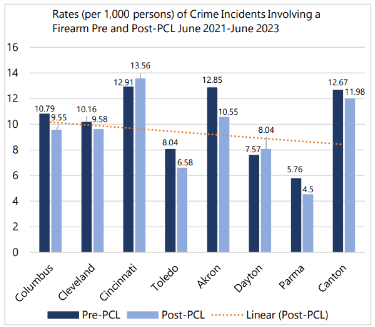
- Results from a trend analysis indicated a significant decrease in crime incidents involving a firearm for Akron, Columbus, and Toledo, and across all 8 cities combined from June 2021-June 2023.
- As displayed in the figure above, most cities’ crime rates decreased after the PCL was enacted. Rates in Dayton and Cincinnati increased slightly, however.
- Toledo, Parma, and Akron each experienced an average of 19% decrease in summed rates of crimes involving a firearm post-PCL.
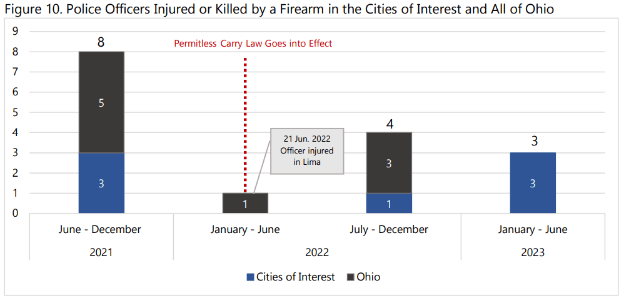
- Based on data from June 2021-June 2023, the enactment of the PCL does not appear to have any appreciable effect on law enforcement injuries or deaths by firearm in the cities of interest.
- Data on gunshot detection technology for Toledo and Columbus also captured a decrease in validated crime incidents post-PCL by 23.2% and 20.6%, respectively.
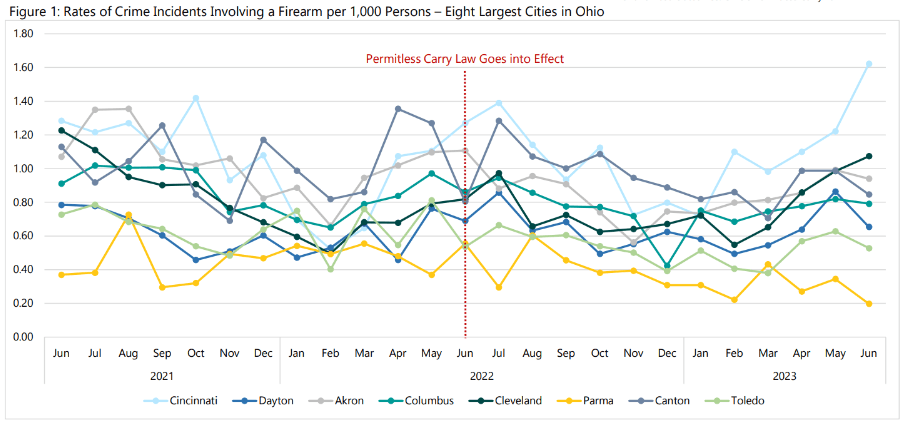
- Increases in crime rates in the spring-summer months appear both before and after the PCL went into effect for most cities (see Figure 1 in full report), but this observation could be due to the influence of other factors such as time of year or structural population characteristics. This slight acceleration in crimes involving firearms was also temporary.
Introduction
Over the last decade, nearly two dozen states have enacted a permitless or constitutional carry law allowing citizens to carry a concealed handgun without a permit. Permitless carry states, and proponents of the law, view that the right to keep and bear arms is a fundamental right protected by the U.S. Constitution, and that permitless carry laws uphold such right without the intervention or permission of the government (Ohio Attorney General, 2022; Brownlee, 2023). While proponents of the law maintain its importance to upholding individual rights, opponents of the law question if the loosening of gun laws contribute to public safety concerns and crime.
Permitless Carry in Ohio
On June 13, 2022, Ohio became the 23rd state to enact a permitless carry law (PCL). The new law allows Ohio citizens to carry concealed in two ways. First, the traditional system of completing firearm training and receiving an official concealed-carry license is preserved by the new law. Alternatively, citizens 21 or older can be deemed eligible to permitless carry by passing a firearm background check through the National Instant Criminal Background Check System (NICS). Individuals who are excluded from permitless carry laws include those who have a criminal record, although some crimes may not prohibit permitless carry, have a history of mental incompetency, are subject to a civil or temporary protection order, or if the sheriff denies the license application. While the new PCL eases restrictions surrounding concealed carry, some laws are still maintained, such as forbidden-carry zones, to help ensure public safety. Further, law enforcement agencies in Ohio will continue to examine any long-term impact that the PCL has on community safety and gun violence in general (Ohio Attorney General, 2022; Ohio Attorney General, 2022).
Literature Review
Permitless Carry and Crime
The notion that constitutional carry, and other like laws, leads to an increase in crime is rather unclear based on recent research. Some argue that the enactment of such laws not only contributes to crime, but also poses a threat to public safety and increases fatal police encounters (Skowronski & Eith, 2022; Brownlee, 2023; & Doucette et al., 2023). On the contrary, some question the true impact that these laws have on crime (Young, 2015; Manski & Pepper, 2018). Manski & Pepper (2018) suggested that available research on permitless carry laws and crime should be interpreted with caution as the utilized data in these studies are limited, which may be why such contradicting findings on this relationship exists in the literature.
Some scholars, and opponents of the law, express concern about the impact that permitless carry laws have on crime, especially violent crimes. PCLs make it easier for citizens to obtain firearms. Being that the United States already faces increasing rates of violent crimes involving a firearm, PCLs may only exacerbate this issue (Doucette et al., 2023). One 2022 study found that large urban cities with a population of at least 250,000 are exceedingly impacted by PCLs. Donohue et al (2022) found that the introduction of less restrictive firearm laws in large
urban cities from 1979 to 2019 resulted in an increase in violent crimes by 20% and an increase
in gun theft by 50%.
Some scholars find that permitless carry affects some crimes more than others. States where such laws were enacted were associated with a 9.5% increase in rates of assault with a firearm, and an overall increase in violent crimes by 13-15% during the first 10 years of the adoption of the law (Donohue et al., 2019; Doucette et al., 2023). When looking at homicide rates, researchers have found that states with less restrictive firearm laws (specifically, shall-issue states) experience an increase in homicides involving a firearm, approximately a 9-12% increase, and an overall 4.9% increase in the murder rate when compared to more restrictive states (Siegel et al, 2017; Crifasi et al., 2018; Gius, 2019; Fridel, 2020; Stansfield et al., 2023).
Contrary to the assumption that more lenient firearm laws lead to crime, some studies reported that PCLs have little impact on crime rates. Manski and Pepper (2018) concluded that the impact of permitless carry varies by state and crime, where some states see an increase in crime, others see a decrease or no change. For example, right-to-carry laws in Virginia resulted in a reduction in murder by 15%, respectively, and an increase in rape by 47% and assault by 8% in 2005. Young (2015), who analyzed the impact of carry concealed deadly weapon (CCDW) laws and annual gun purchases in Kentucky, found no significant relationship between CCDW laws and rates of firearm involved homicides from 2005 to 2013.
As previously mentioned, some researchers have questioned earlier studies examining the relationship between permitless carry laws and crime. Manski and Pepper (2018) harshly criticized the methods and data sources utilized in former studies exploring this relationship. They mentioned that such studies use minimal statistical analyses, stipulating broad conclusions. Further, they argued that such studies utilized limited data sources. These limitations, mixed with imprecise findings, results in confusing and biased results (Manski & Pepper, 2018). Additionally, each state implements different firearm laws (i.e., permitless carry, shall-issue states, open-carry, and the like.), thus, making it difficult to accurately determine the overall effects of these laws on crime (Siegel et al., 2017; Kivisto et al., 2017; Doucette et al., 2023).
Impact of Permitless Carry on Law Enforcement
While the relationship between crime and constitutional carry laws remains ambiguous, researchers have found that more lenient firearm laws, such as permitless carry, were associated with higher rates of officer involved shootings, including fatal shootings (Kivisto et al., 2017; Doucette et al., 2022). Findings from a cross-sectional, state-level study, which analyzed the relationship between firearm legislation and fatal police shootings, concluded that states with stricter firearm legislation had lower rates of fatal police shootings. States with the most restrictive firearm laws, such as California, New Jersey, and Maryland, experienced lower rates of fatal police shootings by approximately 50%, compared to states with more lenient firearm laws (Kivisto et al., 2017). Moreover, some scholars have concluded that states with increased gun ownership experience heightened rates of fatal and nonfatal officer involved shootings (OIS), and that the adoption of permitless carry laws only compounds this issue (Kivisto et al., 2017;
Hemenway et al., 2019; Nagin, 2020; & Doucette et al., 2022). In one study, which assessed fatal and nonfatal OIS, it was found that “on average, permitless carrying concealed weapons (CCW) adopting states saw a 12.9% increase in the OIS victimization rate or an additional 4 OIS victimizations per year” (Doucette et al., 2022, p. 373). Thus, states that take on a more restrictive approach to firearm ownership, including strengthening background checks, promoting safe storage, curbing gun trafficking, and requiring firearm training and permits, witnessed a decrease in fatal and nonfatal OIS (Kivisto et al., 2017; Doucette et al., 2022).
Research on the impact of permitless carry on law enforcement may be more straightforward than the effects on crime. First, findings in the literature conclude that less restrictive firearm laws increase both the availability of firearms and the total number of firearms in the community. As a result, law enforcement may feel an escalation in the perceived threat of danger when engaging with potential suspects, possibly leading to increased fear and a greater likelihood that an officer will act in self-defense (Doucette et al., 2022; Page, 2022). Donohue et al. (2022) suggested that this negatively impacts the effectiveness of the police and their ability to successfully address crime. Such fear may result in decreased police-community relations and crime-suppressing police operations. Furthermore, it may also increase suicide-by-cop incidents, and fatal and nonfatal shootings of both police and citizens (Nagin, 2020).
Validated Gunshot Detection Incidents
One noteworthy approach for law enforcement to address crimes involving firearms and community concerns about gun violence is ShotSpotter technology, and other gunfire detection systems. ShotSpotter software works by using acoustic sensors to record firearm discharges. When the software is signaled, experts determine if the signal was a result of a firearm discharge or of another like sound. If the signal is determined to be a firearm discharge, local law enforcement is alerted to investigate the incident, all of which occurs in approximately 60 seconds (Doucette et al., 2021).
ShotSpotter technology is a rather new approach to addressing gun violence and crime as a public health concern, resulting in mixed findings on its true impact (Doucette et al., 2021). However, ShotSpotter, and other acoustic gunshot detection systems, have been found to positively impact police effectiveness. Such technology decreases police response time and increases awareness of where firearm incidents often occur, which may be beneficial for patrol tactics (Choi et al., 2014; Ratcliffe et al., 2018).
Data and Methods
The present exploratory study examined the impact of the PCL, enacted on June 13, 2022, on crime in the eight largest cities of Ohio: Columbus, Cleveland, Cincinnati, Toledo, Akron, Dayton, Parma, and Canton. While previous literature has examined the relationship between permitless carry and crime, findings are unclear and inconsistent. As a result, the main objective of this study was to better understand the effect that permitless carry has on crime incidents involving a firearm and on police in Ohio. We also considered validated incident data detected by ShotSpotter. Collected data spanned from 1 June 2021 to 30 June 2023, and was compiled from various sources. The following sections will thoroughly discuss our data collection process and the methods of this pre-post exploratory study.
Data Collection
As previously indicated, there is concern on the data and methods utilized in former studies examining the impact of PCLs on crime and public safety (Manski & Pepper, 2018). As a result, multiple datasets were utilized in the presented study. To identify the influence of permitless carry on crime incidents involving a firearm in the eight largest cities of Ohio, data were collected from a variety of sources including the Ohio Incident-Based Reporting System (OIBRS), the Dayton and Cincinnati Open Data and Transparency Portals, and the Columbus Police Department (CPD). To consider the impact that permitless carry has on law enforcement, data on officers killed or injured while on duty was collected from the Gun Violence Archive (GVA) and the Officer Down Memorial Page (ODMP). ShotSpotter information was collected from the Toledo Police Department (TPD) and the Columbus Police Department to identify any patterns pre and post-PCL. Table 1 depicts the origin of each utilized data source, and the following sections will thoroughly outline the data collection process and methods of this study.
Per City Crime Data
The Ohio Incident-Based Reporting System (OIBRS) is an online portal where Ohio law enforcement agencies can voluntarily report crime statistics and use of force data per state and federal agency. OIBRS crime data reports the following variables: agency name, city population, violent crime total, murder total, rape total, robbery total, aggravated assault total, property crime total, burglary/B&E total, larceny-theft total, and motor vehicle theft total. Crime data on OIBRS website can be collected per year in three different formats: total crime rates from January-June, total crime rates from July-December, or total crime rates for the entire year. OIBRS crime data for Cleveland, Toledo, Akron, Parma, and Canton was gathered from 1 June 2021 through 30 June 2023.
| Per City Crime Data | |
| Columbus | Columbus Police Department |
| Cleveland | OIBRS |
| Cincinnati | Cincinnati Open Data Portal |
| Toledo | OIBRS |
| Akron | OIBRS |
| Dayton | Dayton Open Data Portal |
| Parma | OIBRS |
| Canton | OIBRS |
| Law Enforcement Data | |
| Officers Killed 2021-2023 | Gun Violence Archive, Officer Down Memorial |
| Officers Injured 2021-2023 | Gun Violence Archive |
| ShotSpotter Incidents | Toledo Police Department, Columbus Police Department |
| Demographics | |
| Per City | 2020 Census - Decennial Demographic Portal, Census QuickFacts |
For the purposes of this study, acquiring the exact date (dd/mm/yyyy) of when each crime occurred and if a firearm was involved in the incident was essential. A request for more specific crime data was made for each city of interest. In response, OIBRS provided the following information: report code (ORI), agency name, date of the incident (mm/dd/yyyy), National Incident-Based Reporting System (NIBRS) code and description, weapon code, description of weapon involved, and the total number of crime incidents per indicated day. Once the CJR team received this dataset from OIBRS, it was cleaned and divided by city. Crime data involving the following firearm categories was included in the final sample: automatic handgun, BB and pellet
gun, firearm, fully automatic rifle, handgun, machine pistol, other firearm, other fully automatic firearm, rifle, semi-automatic assault firearm, semi-automatic sporting rifle, and shotgun.
Open Data Portal – Cincinnati and Dayton
For cities where OIBRS did not provide crime data (Columbus, Cincinnati, and Dayton), other sources were utilized. Both the city of Cincinnati and Dayton provide public and accessible governmental data on their data portals. The goal of providing such data to the public is to increase accountability, improve local and governmental services, stimulate economic activity, and to be transparent about city budgets and operations. Both Cincinnati and Dayton provide detailed crime incident data on their Open Data and Transparency Portals, which are updated regularly. Such files were used for this project.
The crime data provided on the data portals include multiple variables such as location of the incident (i.e., neighborhood, police sector, and longitude and latitude), victim and suspect characteristics (i.e., race, age, and gender), and other detailed information of each incident. Further, all crime information is included, whether a firearm was involved or not. Data for this project was collected for June 2021 through June 2023, and was thoroughly cleaned to align with the variables provided in the OIBRS data. The following variables for both the Cincinnati
and Dayton crime data were considered: crime description, date (mm/dd/yyyy), and weapon
description. All crime incidents that did not involve a firearm, listed under the “weapon
description” variable, was removed from the final sample.
Columbus Police Department Crime Data
Crime data for the city of Columbus was rather difficult to acquire as their crime data are not available on OIBRS website, nor does the city have an Open Data Portal. However, crime incident data were provided to the research team by the Columbus Police Department. Such data included the following variables: report number, class – crime classification, crime description, date (mm/dd/yyyy), and weapon classification. Crime incidents involving a firearm comprised in our sample include those classified as “by default,” “conditional firearm,” and “firearm listed.”
Law Enforcement Data
Data on law enforcement officers being injured or killed by a firearm while on duty was collected from the Gun Violence Archive (GVA) and the Officer Down Memorial Page (ODMP). The GVA collects data on gun violence incidents from more than 7,500 law enforcement, media, governmental, and commercial sources daily. The GVA provides their data on multiple publicly available datasets. For the purposes of this study, data were extracted from two datasets: “Officer Involved Incident – Killed” and “Officer Killed or Injured – Injured.”
GVA datasets report the following variables: incident date, state, city or county, address, officer gender and age, and victim and/or offender name (if applicable). Further, a short summary of the incident is provided, and relevant news articles are attached per incident. Data on officers killed by a firearm in Ohio and in the cities of interest was collected from June 2021 to June 2023 from the “Officer Involved Incident - Killed” datasets, which are broken down by year. In some cases, it was difficult to determine if an officer killed by a firearm was accidental, such as an unintended service weapon discharge. For these incidents, the OMDP was referenced. The ODMP is a non-profit organization that is dedicated to honoring fallen law enforcement officers in the United States. This organization updates their website when a new incident of a fallen officer occurs and provides thorough detail on the officer and their means of on-duty death. The ODMP was referenced only when it was unclear if an officer’s death by a firearm was accidental or not.
To explore the rate of on-duty officer injury resulting from a firearm, the “Officer Killed or Injured – Injured” file, provided by the GVA, was referenced. Similar to fallen officer’s data, injury data were collected from June 2021 to June 2023. Only incidents where an officer was injured due to a firearm was included. Accidental firearm injuries, such as ricocheting bullets and accidental firearm discharges, were excluded from the final sample. No other source was needed for this data as the GVA indicated when a firearm injury was accidental or a result of an encounter with an armed individual.
ShotSpotter Data – Toledo and Columbus
Some cities of interest have implemented ShotSpotter technology to assist law enforcement with counteracting gun violence. For this study, the use of ShotSpotter technology was considered to better understand how some police agencies are responding to gun violence and public safety concerns surrounding firearms. While cities may utilize ShotSpotter technology, and other gun detection software, such data are often unavailable. Table 2 below thoroughly describes the use of ShotSpotter technology for each city of interest.
| Use of ShotSpotter Technology | |
| Columbus | Columbus implemented ShotSpotter in 2018 over a 12.6-mile coverage. Columbus PD provided ShotSpotter data. |
| Cleveland | Implemented ShotSpotter May 2023 and covers all five Neighborhood Police Districts. Data are unavailable. |
| Cincinnati | Implemented ShotSpotter in 2017 in select neighborhoods. As of Nov. 2021, Cincinnati provides ShotSpotter data in their calls for service data – which is publicly available. However, the coding for these data is unclear and only goes through Jan. 2023. The owner of this dataset has been contacted in attempt to receive the rest of 2023 data and a codebook. There has been no response. As a result, Cincinnati ShotSpotter data were not consulted. |
| Toledo | Toledo implemented ShotSpotter in June 2019 over a 12-mile radius. Toledo PD provided ShotSpotter data. |
| Akron | Does not use ShotSpotter. |
| Dayton | Dayton implemented ShotSpotter in 2019 over a 3-mile radius. Intense backlash from the community resulted in Dayton PD discontinuing the use of ShotSpotter after December 2022. |
| Parma | Does not use ShotSpotter. |
| Canton | Implemented ShotSpotter in 2013. Canton PD switched to Wi-Fiber Connect-n-Protect and BlueForce technology in 2019, which covers approximately 25 square miles. Data for Canton gunshot detection are not available. |
ShotSpotter data were provided for Columbus, by the Columbus Police Department (CPD), and Toledo, by the Toledo Police Department (TPD) from June 2021 through June 2023. TPD ShotSpotter data included the following variables: crime, date (mm/dd/yyyy), time, location details, and address of the incident. ShotSpotter data for Toledo only included incidents defined as “validated.” According to TPD, validated incidents are crime incidents where an arrest was made, a gun was recovered, bullet casings were found, a victim was hit, a building or vehicle was hit, or where there was a verified crime incident, but it was outside of TPD’s range of patrol. It should be noted that TPD only provided ShotSpotter incidents where a crime actually occurred and where the incident was “validated.” This means more ShotSpotter incidents could have occurred, but they did not fit the listed classifications, and, therefore, were not included in the sample. Provided ShotSpotter data for Columbus included the following variables: report number, class and crime description, date (mm/dd/yyyy), and weapon description. Incidents where the weapon variable was defined as being “firearm listed” or “conditional firearm” were considered in the final sample. Like TPD, CPD only provided ShotSpotter incidents where an actual crime occurred and where a firearm was involved, thus, more ShotSpotter incidents could have transpired during our interested timeframe but might not have been presented by CPD.
City Characteristics
Table 3 depicts demographical characteristics for the cities of interest. These data were collected from the 2020 Census - Decennial Demographic Portal and the Census QuickFacts page. These descriptives are included to provide details about the cities under evaluation and serve as reference to how the cities compare to one another on key structural variables known in the literature to significantly contribute to crime. To note, per city crime rates, depicted in this report, were based on the total population for each city provided by the 2020 Census.
| Columbus | Cleveland | Cincinnati | Toledo | Akron | Dayton | Parma | Canton | |
| Population Characteristics | ||||||||
| Total Population | 905,748 | 372,624 | 309,317 | 270,871 | 190,469 | 137,644 | 81,146 | 70,872 |
| Population Density | 4,116.3 | 4,793.8 | 3,973.8 | 3,356.3 | 3,075.6 | 2,466.3 | 4,053.2 | 2,692.7 |
| Population Ages 15 to 24 | 16.1% | 13.5% | 17.6% | 14.4% | 14.3% | 16.7% | 11.3% | 13.4% |
| Population in Poverty | 18.4% | 31.4% | 24.7% | 24.5% | 23.0% | 28.6% | 9.9% | 30.3% |
| Race | ||||||||
| White | 53% | 34% | 48% | 58% | 55% | 48% | 84% | 62% |
| Nonwhite | 47% | 66% | 52% | 42% | 45% | 52% | 16% | 38% |
| Hispanic or Latino | 7.7% | 13.1% | 5.1% | 8.9% | 3.3% | 5.7% | 6.9% | 5.0% |
| Gender | ||||||||
| Male | 49% | 49% | 48% | 48% | 48% | 49% | 49% | 48% |
| Female | 51% | 51% | 52% | 52% | 52% | 51% | 51% | 52% |
| Household Demographics | ||||||||
| Female Head of Household | 34.1% | 42.1% | 40.2% | 37.6% | 38.2% | 39.2% | 29.9% | 39.1% |
| Median Household Income | $58,575 | $33,678 | $45,235 | $42,671 | $42,129 | $37,536 | $60,590 | $34,611 |
| Living in Same House at Least 1 Year | 79.1% | 82.6% | 77.7% | 83.7% | 84.2% | 74.6% | 86.5% | 81.8% |
| Employment | ||||||||
| Percent in Labor Force 16+ | 70.5% | 59.4% | 66.3% | 62.1% | 62.5% | 57.4% | 65.6% | 59.2% |
| Education | ||||||||
| Less than High School Graduate | 10.7% | 17.2% | 9.8% | 15.1% | 12.9% | 5.5% | 6.1% | 12.6% |
With a few exceptions, the cities studied herein are similar on many structural characteristics despite the varied population sizes. Parma, the second smallest city, differs moderately from the other cities. Its population is mostly white, has a lower percentage of persons living in poverty, those aged 15 to 24, and female-headed households. Parma also has one of the smallest percentages of persons with less than a high school diploma or equivalent
and has the highest median household income across the eight cities. Columbus, Cincinnati, and Cleveland rank as the topmost populated locales. Columbus fares better in percentage of persons living in poverty than the other largest cities, higher median household incomes, and more persons in the labor force compared to Cleveland and Cincinnati. Cleveland, on the other hand, has the lowest median household income, highest percentage of persons in the population without a high school diploma or equivalent, persons in poverty, and female-headed households. While the purpose of this analysis is to explore the pre-PCL and post-PCL effects on crimes involving firearms, future consideration of how the structural variables in Table 3 may provide some additional context to the findings that follow.
Findings
Permitless Carry and Crime
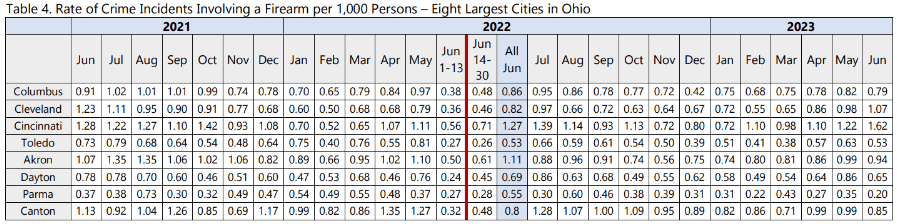
Figure 1 displays a line graph of crime incident rates involving a firearm per 1,000 persons, and Table 4 presents the rates in numeric form covering the months and years under study from June 2021-June 2023. Seasonal increases in crime rates in the spring-summer months appear both before and after the PCL went into effect for most cities. We continue to observe this seasonality influence most markedly in 2023 in the late spring and summer for Cincinnati and Cleveland. Cincinnati and Canton also showed increases in October and September 2022, respectively, and both cities witnessed another rise in crimes involving guns in December 2021 and April 2022. Rates in all cities, except for Akron and Parma, increased after the PCL goes into effect for about six weeks and then fell back into similar trends, if not decreased, that were observed pre-PCL. Table 5 presents the raw numbers, rates, and percent change pre- and post-PCL for the eight cities separately and combined.
We calculated percent change on crime rates involving firearms, as seen in Table 5, for the 12.5 months prior to the PCL and 12.5 months post. Only two cities experienced a slight increase in crime rates involving firearms; these were Cincinnati at 5% and Dayton at 6%. The remaining cities’ crime rates, as displayed in Table 5, declined with Parma, Akron, and Toledo having the highest percentage change in rates, 22%, 18%, 18%, respectively after the PCL went into effect.
| City | Pre-PCL | Pre-Rates | Post-PCL | Post-Rates | Percent Change |
| Columbus | 9,770 | 10.79 | 8,638 | 9.55 | -12 |
| Cleveland | 3,781 | 10.16 | 3,575 | 9.58 | -6 |
| Cincinnati | 3,991 | 12.91 | 4,196 | 13.56 | 5 |
| Toledo | 2,179 | 8.04 | 1,783 | 6.58 | -18 |
| Akron | 2,446 | 12.85 | 2,007 | 10.55 | -18 |
| Dayton | 1,043 | 7.57 | 1,111 | 8.04 | 6 |
| Parma | 468 | 5.76 | 365 | 4.50 | -22 |
| Canton | 898 | 12.67 | 848 | 11.98 | -5 |
| Total | 24,576 | 10.51 | 22,523 | 9.63 | -8 |
Per City Figures
The figures that follow display the total crime counts for each city under study. We present the raw numbers rather than rates in these line graphs to capture the detail that is sometimes obscured when comparing rates across units of analysis. Since the PCL went into effect mid-June, we provide a red indicator line denoting this and the values on pre and post. A trendline is also included to depict changes in gun crime over time. As stated previously, for most cities, we see the typical seasonal increases in crimes that tend to occur across the country in spring and summer months. Bullet point observations follow each city’s figure.
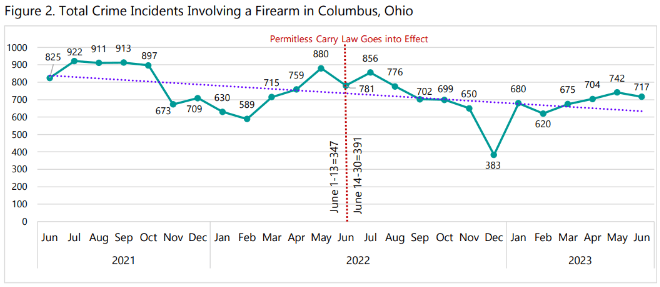
- The trend line for crimes involving firearms in Columbus tended to remain steady despite a sizable decrease by over 40% from November 2022 to December 2022, almost 6 months post-PCL. A similar decline did not occur in the same months in 2021.
- Seasonality effects are also evident in the Columbus crime counts involving firearms.
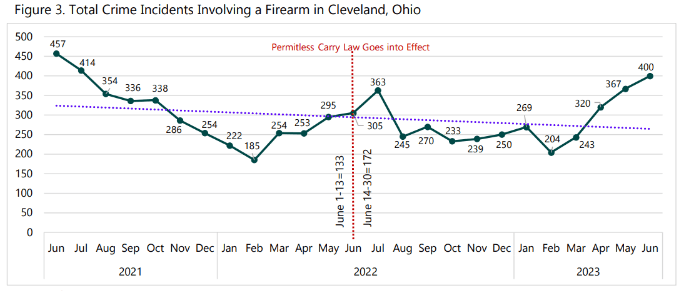
- After June 2021, where crimes involving Cleveland peaked at 457, crimes steadily decreased until February 2022, when after a low of 185, the trend line began to rise until July 2022, after the PCL goes into effect.
- Steady numbers of crimes occurred the rest of 2022 with 2023 starting out relatively the same as the previous year during January and February. Crime counts had a marked increase beginning in March 2023, only to end June 2023 at 400 crimes involving firearms.
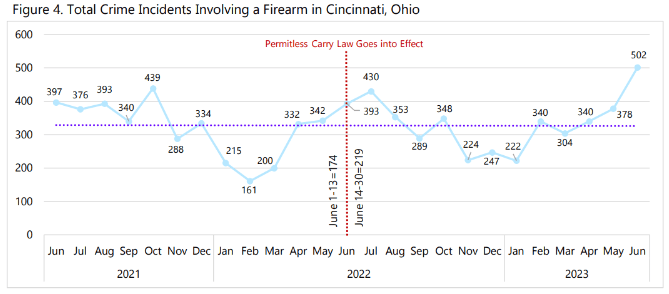
- Cincinnati’s number of crime incidents involving a firearm over the study period slightly to moderately increased after the PCL law goes into effect.
- Crimes dropped later in the summer months and remained relatively steady until late spring, early summer when the total crimes involving a firearm increased to a high of 5022, which was the largest number of gun-involved offenses in the past two years.
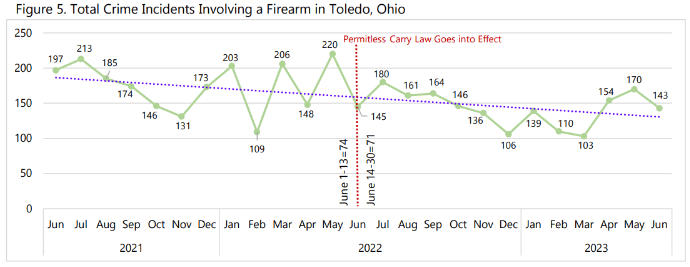
- Toledo’s number of crimes involving firearms declined slightly after the PCL went into effect other than the initial rise from June to July 2022.
- Toledo’s highest number of crimes involving weapons occurred in May 2022 at 220 just before the PCL went into effect.
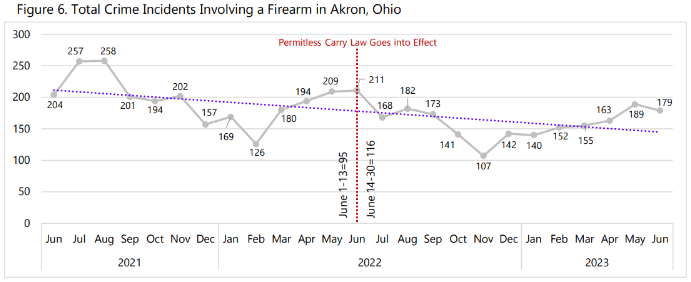
- Aside from a few outliers for crimes involving a firearm, the numbers, while higher pre-PCL, were relatively stable, especially post-PCL across the months under study for Akron.
- July and August 2021 were two months where crimes involving firearms were at their peak. At no other point did Akron see such high numbers.
- Substantive declines in February 2022 and November 2022 were observed.
- Akron is one of the two cities (Parma, the other) under study where there was a decrease in crimes within several weeks post-PCL and then rose slightly in August 2022.
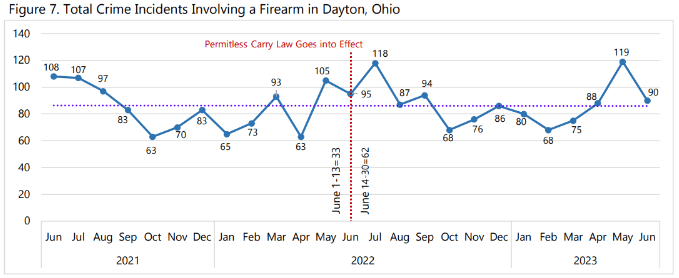
- Dayton’s pattern of crime incidents involving a firearm showed a somewhat moderate rise pre- to post-PCL and then dropped to similar numbers of these crimes observed in the months preceding the PCL until May of 2023, where there were similar numbers of offenses.
- May 2023 to June 2023, almost one-year post-PCL we observed a decrease that was similar to what occurred the year prior for July to August.
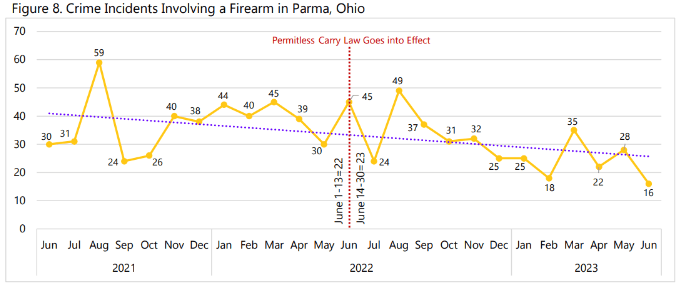
- Parma is the second of the two cities (i.e., Akron and Parma) that witnessed a decline in crimes within the month to six weeks following the mid-June date of when the PCL went into effect.
- A steep rise in crimes occurred from July 2022 to August 2022, only to fall back into pre-PCL patterns, as far as climb and fall, though there were fewer monthly occurrences after PCL.
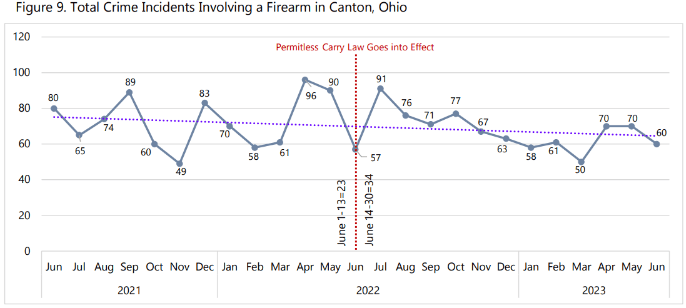
- Canton’s pre-PCL fluctuated with varying increases and decreases over the months under study.
- Post-PCL, after an increase of nearly 60% from June to July in 2022, the numbers of crimes involving firearms continued to steadily decline from August 2022-June 2023 except for an increase in April and May of 2023.
Mann-Kendall Test for Trend and T-Test Analyses
To determine if there were any consistently increasing or decreasing trends in the data, we ran the Mann-Kendall Trend Test (MK). To test for any significant differences pre- and post-PCL, we ran Independent Samples t-test. Given that the PCL went into effect in mid-June, to perform these statistical tests we divided the crimes involving firearms data for each month into biweekly figures, which differs from the rest of the report where we captured data monthly. Results are noted in Table 6. Interestingly, MK statistics indicated a significant decreasing trend in crime incidents in Akron, Columbus, Toledo, and across all cities combined from June 2021 to June 2023. The unit of Sen’s Slope (S) indicates the magnitude of the trend per month across the entire period where a negative sign means the trend is decreasing and a positive S value means the trend is increasing. Thus, across the entire period there was a decrease in crime incidents from June 2021 to June 2023 when measured bi-weekly. The cities driving this decreasing trend were Akron, Columbus, and Toledo.
For the independent t-tests, we coded pre-PCL as 0 and post-PCL as 1 and compared differences in incidents between the two. The results showed that there were significant variations in the average number of incidents in Columbus, Akron, Parma, and Toledo before and after implementation. Unlike the MK findings, there were no differences pre- and post-PCL enactment for all the cities combined. Generally, then, crime incidents involving a firearm were decreasing across the timespan under study. There may have been a difference in crimes following the law taking effect in Columbus, Toledo, Parma, and Akron, or, more likely, these findings are more consistent with the broad decreasing trend in crimes from June 2021 to June 2023.
Mann-Kendall Results
| City | tau | p-value | Sen's Slope |
| Columbus | -0.231 | 0.02 | -2 |
| Cleveland | -0.19 | 0.056 | -0.778 |
| Cincinnati | -0.047 | 0.642 | -0.279 |
| Toledo | -0.263 | 0.018 | -0.566 |
| Akron | -0.289 | 0.004 | -0.775 |
| Dayton | -0.041 | 0.692 | -0.055 |
| Parma | -0.187 | 0.064 | -0.125 |
| Canton | -0.075 | 0.458 | -0.078 |
| All Cities Combined | -0.209 | 0.035 | -4.5 |
Independent Samples t-test Results
| City | t-value | df | p-value |
| Columbus | 2.007 | 48 | 0.05 |
| Cleveland | 0.645 | 48 | 0.522 |
| Cincinnati | -0.482 | 48 | 0.632 |
| Toledo | 2.613 | 40.3 | 0.013 |
| Akron | 2.87 | 48 | 0.006 |
| Dayton | -0.801 | 48 | 0.427 |
| Parma | 2.42 | 48 | 0.019 |
| Canton | 0.709 | 48 | 0.481 |
| All Cities Combined | 1.396 | 48 | 0.169 |
Impact of Permitless Carry on Law Enforcement
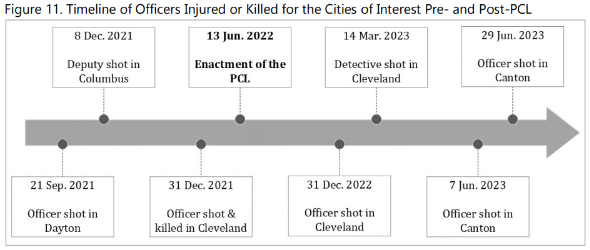
As discussed in the literature review earlier in this report, studies have found that less restrictive firearm laws, such as permitless carry, are positively correlated with higher numbers of officer involved shootings, including fatal shootings. Figure 10 represents the number of officers injured or killed by a firearm during a crime incident. We broke down these data into months that aligned with this study’s dates. The second half of 2021 witnessed eight police officer injuries or deaths by a firearm in Ohio, three of which occurred in Ohio’s eight largest cities. In the months following the PCL, there were four such incidents with one from the studied cities. Post-PCL, there was an increase of one additional officer injured/killed in the last half of 2022 compared to the first half of 2023. In the first half of 2023, there were three injuries or deaths and in the entire year of 2022, there were five. Data for the remaining six months of 2023 will help capture whether these numbers are on par with earlier years or something else is occurring that may or may not be a result of the enactment of the PCL. Figure 11 denotes the date, city location, and officer position of those killed or injured in the cities of interest pre- and post-PCL.
ShotSpotter Technology
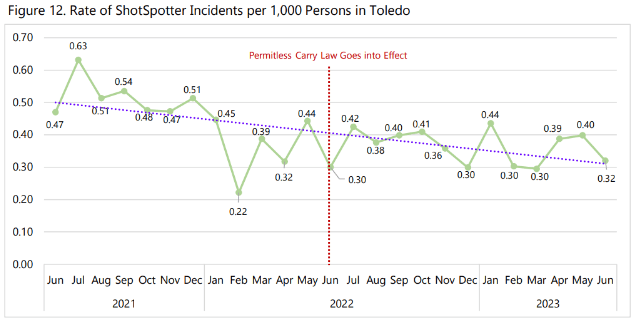
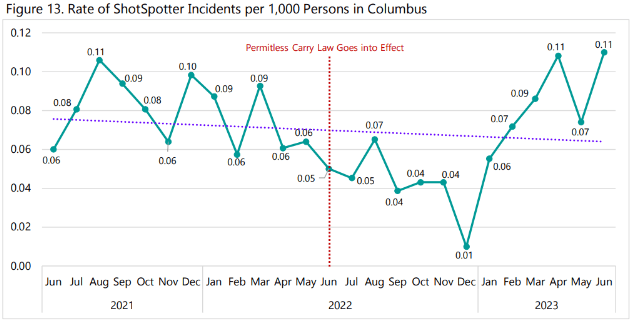
Observing data from the ShotSpotter Technology systems in Toledo and Columbus was another method we used to glean into the possible effects pre- and post-PCL since these systems provide information on guns fired in a particular area. The patterns observed, see figures 12 and 13 below, are not dissimilar to those we noted on crimes involving firearms data. Toledo’s rates were higher than Columbus’s for nearly any given month under study, yet the general trend follows along the same pattern for both cities pre- and post-PCL in that both cities witnessed a decrease post-PCL. Toledo’s rates decreased by 23.2% (pre-PCL raw numbers were 1,509 and post counts were 1,236) and Columbus saw a 20.6% drop-in rates (pre-PCL counts were 877 and post-PCL at 700) of shots detected after the PCL went into effect. A few other cities use gunfire detection systems, including ShotSpotter, but only Toledo and Columbus were able to provide us the data for the months under study. Refer to Table 2 for an overview of gunfire detection systems in each city.
Discussion and Conclusion
In sum, our observations of the trends pre- and post-PCL lead us to surmise that to date, the effects of the PCL are minimal on crime rates involving firearms, number of shots detected, and law enforcement officer injuries and deaths and generally show a decrease. To assess whether these decreases were significant, we conducted a trend analysis. Results indicated a significant decline in crime incidents involving a firearm for Akron, Columbus, and Toledo, and across all cities combined from June 2021-June 2023. When comparing the average number of crime incidents involving firearms in each city and then compared pre- and post-PCL, the results showed that four cities significantly differed before and after the enactment of the law. These were Columbus, Toledo, Akron, and Parma. We did not observe significant variations for any other city or when the cities’ values were combined and means tested.
Some limitations should be mentioned when considering the findings of this exploratory study. First, our study examined the impact of permitless carry on eight cities over a period of two years, 1-year pre and 1-year post-PCL. As a result, the generalizability of the findings should be considered. Future studies should analyze the impact of permitless carry, and other like laws, in other cities and states over a longer period of time to gain better insight on how more lenient firearm laws impact crime over time and in different areas. Moreover, our study examined the largest cities of Ohio, thus, the influence of permitless carry on smaller, more rural areas may not be represented in our findings.
Second, while we obtained multiple data sources to address validity concerns presented by other scholars (see Manski & Pepper, 2018), additional data should be included. Analyzed ShotSpotter data only included two cities, Toledo and Columbus, while multiple cities in our sample used this technology. Obtaining gunshot technology statistics for the other cities may provide a more accurate depiction of how the PCL may have had an impact on rates of ShotSpotter incidents, a tactic used by law enforcement to counteract gun violence. Further, while we had complete crime data for each city of interest, the Ohio Incident-Based Reporting System (OIBRS) was only able to provide us crime data for five of our cities of interest. As a result, crime data for the remaining cities were derived from alternative sources. This in turn, while accounted for to the best of our ability, may result in inconsistences between cities considering that each city may report their crime data differently than OIBRS.
Lastly, the impact of other factors such as seasonality on the observed findings should be considered. Szkola et al. (2021) argued that considering people’s routine activities is crucial to accurately examine the impact of crime. They suggested that, simply put, people’s routine activities change in different seasons. During holidays and warmer seasons, an increasing number of people are out. In turn, this leads to an increase in suitable targets and motivated offenders. The impact of routine activities and seasonality may have affected some of the trends observed in our exploratory study. Szkola et al. cautioned areas affected by this influence may result in ineffective police practices when responding to crime.
Brownlee, C. (2023, May 12). Permitless carry: These states allow gun owners to carry without a license. The Trace. https://www.thetrace.org/2023/05/permitless-carry-gun-laws-states-map/
Choi, K., Librett, M., & Collins, T. J. (2014). An empirical evaluation: Gunshot detection system and its effectiveness on police practices. Police Practice & Research, 15(1), 48-61. https://doi.org/10.1080/15614263.2013.800671
Crifasi, C. K., Merrill-Francis, M., McCourt, A., Vernick, J. S., Wintemute, G. J., & Webster, D. W. (2018). Association between firearm laws and homicide in urban counties. Journal of urban health, 95, 383-390.
Donohue, J. J., Aneja, A., & Weber, K. D. (2019). Right‐to‐carry laws and violent crime: A comprehensive assessment using panel data and a state‐level synthetic control analysis. Journal of Empirical Legal Studies, 16(2), 198-247.
Donohue, J. J., Cai, S. V., Bondy, M. V., & Cook, P. J. (2022). Why Does Right-to-Carry Cause Violent Crime to Increase? (No. w30190). National Bureau of Economic Research.
Doucette, M. L., Green, C., Necci Dineen, J., Shapiro, D., & Raissian, K. M. (2021). Impact of ShotSpotter technology on firearm homicides and arrests among large metropolitan counties: A longitudinal analysis, 1999-2016. Journal of urban health: bulletin of the New York Academy of Medicine, 98(5), 609–621. https://doi.org/10.1007/s11524-021-00515-4
Doucette, M. L., McCourt, A. D., Crifasi, C. K., & Webster, D. W. (2023). Impact of changes to concealed-carry weapons laws on fatal and nonfatal violent crime, 1980-2019. American Journal of Epidemiology, 192(3), 342-355. https://doi.org/10.1093/aje/kwac160
Doucette, M. L., Ward, J. A., McCourt, A. D., Webster, D., & Crifasi, C. K. (2022). Officer-involved shootings and concealed carry weapons permitting laws: Analysis of Gun Violence Archive data, 2014–2020. Journal of Urban Health, 99(3), 373–384. https://doi.org/10.1007/s11524-022-00627-5
Fridel, E. E. (2021). Comparing the impact of household gun ownership and concealed carry legislation on the frequency of mass shootings and firearms homicide. Justice quarterly, 38(5), 892-915.
Gius, M. (2019). Using the synthetic control method to determine the effects of concealed carry laws on state-level murder rates. International Review of Law and Economics, 57, 1-11. https://doi.org/10.1016/j.irle.2018.10.005
Hemenway, D., Azrael, D., Conner, A., & Miller, M. (2019). Variation in rates of fatal police shootings across US states: The role of firearm availability. Journal of Urban Health, 96(1), 63-73. https://doi.org/10.1007/s11524-018-0313-z
Kivisto, A. J., Ray, B., & Phalen, P. L. (2017). Firearm Legislation and Fatal Police Shootings in the United States. American journal of public health, 107(7), 1068–1075. https://doi.org/10.2105/AJPH.2017.303770
Manski, C. F., & Pepper, J. V. (2018). How do right-to-carry laws affect crime rates? Coping with ambiguity using bounded-variation assumptions. The Review of Economics and Statistics, 100(2), 232-244. https://doi.org/10.1162/REST_a_00689
Nagin, D. S. (2020). Firearm availability and fatal police shootings. The Annals of the American Academy of Political and Social Science, 687(1), 49-57. https://doi.org/10.1177/0002716219896259
Ohio Attorney General (June 2022). Ohio’s Concealed-Carry Laws and License Application. Retrieved August 3, 2023, from, https://www.ohioattorneygeneral.gov/Files/PublicationsFiles/Publications-for-Law-Enforcement/Concealed-Carry-Publications/Concealed-Carry-Laws-Manual-(PDF).aspx.
Ohio Attorney General (August 3, 2022). Criminal Justice Update: No Permit Needed. On the Job. Retrieved August 11, 2023 from
https://www.ohioattorneygeneral.gov/Media/Newsletters/Criminal-Justice-Update/August-2022/No-Permit Needed#:~:text=A%20new%20state%20law%20went,or%20undergoing%20a%20background%20check.
Page, J. (2022). Defensive Killing By Police: Analyzing Uncertain Threat Scenarios. Forthcoming, Journal of Ethics and Social Philosophy.
Ratcliffe, J. H., Lattanzio, M., Kikuchi, G., & Thomas, K. (2019). A partially randomized field experiment on the effect of an acoustic gunshot detection system on police incident reports. Journal of Experimental Criminology, 15(1), 67-76. https://doi.org/10.1007/s11292-018-9339-1
Siegel, M., Xuan, Z., Ross, C. S., Galea, S., Kalesan, B., Fleegler, E., & Goss, K. A. (2017). Easiness of legal access to concealed firearm permits and homicide rates in the United States. American journal of public health, 107(12), 1923-1929.
Skowronski, D., & Eith, V. (2022). SB 319: Chairman John Meadows Act. Georgia State University Law Review, 39(1). https://readingroom.law.gsu.edu/gsulr/vol39/iss1/4
Stansfield, R., Semenza, D., & Silver, I. (2023). The relationship between concealed carry licenses and firearm homicide in the US: a reciprocal county-level analysis. Journal of urban health, 1-9.
Szkola, J., Piza, E. L., & Drawve, G. (2021). Risk terrain modeling: Seasonality and predictive validity. Justice Quarterly, 38(2), 322-343.
Young, T. (2015). Concealed weapon proliferation and the impact on firearm-relation fatalities and injuries due to assault in Kentucky, 2005 – 2013. Theses and Dissertations—Public Health (M.P.H. & Dr.P.H.), 70
Updated: 04/21/2026 04:39PM