
Annual Report - Fiscal Year 2025
Executive Summary
The Ohio General’s Center for Justice Research (CJR) at Bowling Green State University goal is to inform criminal justice policy through science, the CJR funds original research that is designed to answer key questions about criminal justice, justice administration and justice policy in Ohio. The Center for Justice Research’s motto – “Science Informing Policy” – directly reflects
its purpose.
The Ohio Attorney General’s Center for Justice Research’s mission: At the Center for Justice
Research, we believe in the power of science to inform policy. Our mission is to promote data-driven, effective, and fair policy solutions to Ohio’s most pressing criminal issues. Collaborating with scientists and scholars across Ohio and the United States, we conduct innovative research and share our findings with criminal justice practitioners, academia, and the public. During this reporting period the mission and goals of the Center for Justice Research have been supported by:
- Enhanced analytical capacity by bringing on an additional graduate assistant in Data Science to continue the development of predictive modeling and mapping tools
- Brought an undergraduate research assistant to the team to improve the efficiency of data cleaning and literature search processes.
- Coordinated with agencies across Ohio, including the Toledo Police Department and the Ohio Incident-Based Reporting System housed in the Offices of Criminal Justice Services, as well as with agencies outside of Ohio, including Michigan Incident Crime Reporting, Michigan State Police, and Indiana State Police, to access and obtain data.
- Completed the Permit or Permitless Carry: A Longitudinal Study Comparing Ohio and Michigan Firearm Crime Incidents covering years June 2020-June 2024.
- Presented research on both the Residential Instability, Calls for Service, and Crime in Toledo, Ohio: A 10-Year Lookback study and the Permitless Carry and Crime Trends: A Tale of Two Rivals - Ohio vs. Michigan analyses at the Academy of Criminal Justice Sciences annual meeting in Denver, CO.
Memorandum of Understanding
The Center for Justice Research was established during the previous reporting period with an effective date of November 1, 2021, through a Memorandum of Understanding between Bowling Green State University and the Ohio Attorney General’s office.
Projects
Project 1: Residential Mobility and Crime in Ohio Project
During the previous fiscal year, two reports were submitted for the first CJR-funded project, examining the impact of residential instability on crime and calls for service across 92 census tracts in Toledo. The study found that residential instability significantly influenced crime and service call patterns both between and within tracts, offering insights for early crime prediction and community-police collaboration.
Based on the findings of the Toledo study, a replication analysis was conducted using data from the city of Dayton, Ohio. The purpose of this study was to assess if the 35 tracts within Dayton’s city limits exhibited similar patterns between residential instability and calls for service/crime incidents. Data used in this project included 2012-2019 calls for service and crime incident records from the Dayton Police Department. As in the Toledo study, residential instability was measured using vacancy information obtained from the Department of Housing and Urban Development, along with data on renter occupied housing and geographic mobility sourced from the U.S. Census Bureau and the American Community Survey (ACS) 5-Year Estimates. Additional demographic variables at the census tract level were also drawn from the Census Bureau and the ACS.
Due to the smaller sample size in Dayton – 35 census tracts as opposed to Toledo’s 92 a longitudinal (i.e., vector autoregressive) analysis could not be employed. The results of standard multivariate regression indicated that the total population of tracts was frequently a significant
predictor of both calls for service and crime incidents. In some cases, higher rates of female-headed households and lack of high school completion were also positively associated with calls for service and/or crime. The rate of vacant residences was significantly correlated with Part 1 property-related calls for service in 2014. However, no other residential instability variables were significantly associated with crime incidents and calls for service.
Overall, the findings for Dayton suggest that the smaller sample size may have limited the ability to detect the relationships observed in the Toledo study. Further examination of our regression model indicated that a minimum of 64 census tracts would be necessary to reliably detect these associations. Considering this information, the CJR team has initiated a new replication study using data from Cincinnati, whose 89 census tracts should provide an adequate sample size to evaluate whether the findings in Toledo are generalizable to other cities in Ohio.
For both Toledo and Dayton, predictive modeling was applied to the collected data. The Prophet model was used for its ability to detect patterns across time. In Toledo, the data were aggregated at the city level, as tract totals were too small for accurate predictions to be made. In Dayton, crimes counts were aggregated at the police beat level, which is larger than the census tract but smaller than the whole city. Graphs from 2010 to 2025 in Toledo and 2012 to 2019 in Dayton were created for six crime categories, revealing long-term trends as well as seasonal patterns which recurred over time. Visualizations were created to illustrate trends and future projections. These included both time series plots, which spanned the entire study period, and decomposition plots, which showed trends at weekly and monthly levels. Key findings in Toledo showed an inverse relationship between Part 1 and 2 personal crime categories and a steady decline in property crimes. The model showed abrupt changes in the patterns of public order and drug crimes around 2020, which exposed some limitations of predictive utility of the model. The Dayton models mirrored Toledo's crime trends, with negative correlations between Part 1 and 2 crime categories, as well as declining property crimes.
Future project efforts include replication studies in Cincinnati and Cleveland, continued predictive modeling and data mapping, and ongoing data collection to examine how residential instability and other community factors affect crime over time.
Project 2: Constitutional Carry
In a final report submitted during the previous fiscal year, the CJR examined the impact of Ohio’s permitless carry law (enacted June 13, 2022) on firearm-related crime across Ohio’s eight largest cities. The study found an overall decrease in such incidents—particularly in Akron, Columbus, and Toledo—though slight increases occurred in Cincinnati and Dayton. The law appeared to have no significant effect on firearm-related injuries or deaths among law enforcement.
During the current fiscal year, the CJR built on this work by conducting a comparison study of firearm-related incidents between Ohio and Michigan. Michigan was selected due to its geographical proximity to Ohio and its permit requirements for concealed carry of a firearm, which differs from Ohio’s (i.e., Michigan requires a concealed carry permit where Ohio does not). Data used in this comparison study included crime incidents involving a firearm in eight major Ohio cities – Akron, Canton, Cleveland, Cincinnati, Columbus, Dayton, Parma, and Toledo – and eight Michigan cities – Dearborn, Detroit, Flint, Grand Rapids, Kalamazoo, Lansing, Sterling Heights, and Warren. The analysis covered the period from June 2020-June 2024, utilizing data
from the Ohio Incident-Based Reporting System (OIBRS) and the Michigan Incident Crime Reporting (MICR) system.
Mann-Kendall trend tests and an independent samples t-tests were conducted to assess changes in firearm-related crime incidents in both states. In Ohio, the analyses were run twice: first using data from all eight cities between June 2020 and December 2023, and again from June 2020 to June 2024, excluding Columbus5. The Mann-Kendall trend test revealed declining trends in firearm-related incidents in each city and across all cities combined for both timeframes. In the initial analysis (i.e., June 2020-December 2023) that included Columbus, all cities displayed downward trends that were not statistically significant except Akron, Dayton, and Parma. When 2024 data were included for seven of the eight cities (all but Columbus), five of the cities exhibited significant declines. Akron and Dayton incidents decreased but were not statistically significant. In Michigan, the Mann-Kendall test also indicated significant downward trends in Detroit, Lansing, Dearborn, Kalamazoo, and the combined dataset. However, Sterling Heights experienced a statistically significant increase in firearm-related incidents over the study period.
The independent samples t-test for Ohio (June 2020–December 2023) showed significant variation in firearm-related crime rates across all cities and in each individual city, apart from Dayton. When the analysis was extended to include data through June 2024 (excluding Columbus), significant differences remained for all cities combined and each city independently except Akron and Dayton. For Michigan, the t-test results revealed significant variation in firearm-related incidents in Detroit, Sterling Heights, Lansing, Dearborn, Kalamazoo, and across all cities combined.
Future project efforts include extending the study’s timeframe, continuing data collection and analyses for the cities of interest, as well as adding additional cities to the study’s sample to evaluate how the PCL may influence crime incidents across various locations.
Center Personnel
Below is the organizational chart for the CJR. During this fiscal year, we added a new position to the team, which was an undergraduate assistant. In addition, we were able to recruit a graduate assistant from the Master’s program in Data Science to assist us with the mapping and predictive modeling elements to complement our research in visual form. The BGSU webpage hosting the CJR is updated with the current team members.
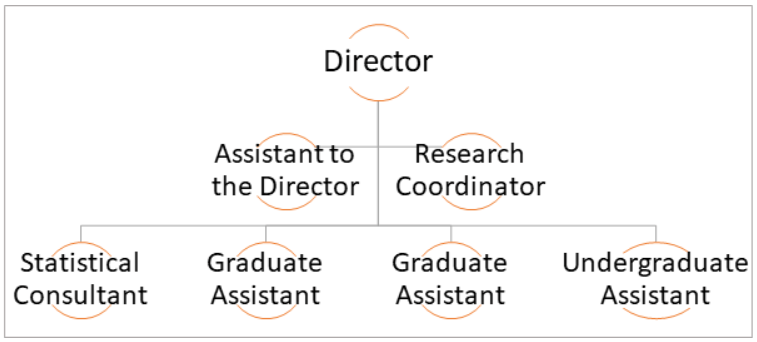
Organizational Chart for the Center for Justice Research
Center for Justice Research personnel consist of:
- Director, Dr. Melissa Burek
- Assistant to the Director, Nicole Pedraza
- Research Coordinator, Stephanie DeCroix
- Statistical Consultant, Dr. Eric Cooke
- Graduate Assistants: Jaryt Salvo (January 2024-present), Emily Massie (August 2024-May 2025)
- Undergraduate Assistant: Aiden Kelly (February 2025-present)
Presentations and Future Publications
ACJS Panel and Poster Presentations
During the reporting period of July 1, 2024- June 30, 2025, we presented a poster depicting findings from the Permitless Carry project (see Appendix A) at the Academy of Criminal Justice Sciences (ACJS) annual meeting in March in Denver, CO. In addition, during this conference members of the CJR team participated in a panel presentation titled Transforming Communities: The Influence of Residential Dynamics, Social Interventions, and Predictive Analysis on Crime Prevention, speaking about their work on the Residential Instability project. The slide decks of which can be found in Appendix A.
Future Publications
The CJR team would like to reach broader audiences, including the more traditional academic journal readers. Currently, a manuscript focusing on the predictive models on crime in Toledo is underway. The CJR hopes to have a completed manuscript to submit for publication by the end of this summer. In addition, we are putting together a manuscript on the comparative analysis of Ohio and Michigan for the Permitless Carry project. Other publication ideas include a second manuscript focusing on residential instability measures and calls for service as related to crime in Toledo and on findings from the replication studies using data from Dayton and Cincinnati.
Collaborations and Communications
During the July 1, 2024-June 30, 2025, reporting period, the CJR collaborated with a variety of criminal justice agencies and organizations across Ohio. Notable partnerships included the Toledo Police Department’s Intelligence and Special Investigations Bureau and the Ohio Incident-Based Reporting System. Through these collaborations, the CJR obtained essential data such as calls for service and crime incident data for Toledo and the numbers of crimes involving firearms in Ohio’s largest/larger cities.
Beyond Ohio, our collaborations with researchers at Northeastern University and the University of Central Florida resulted in organizing a panel presentation at the ACJS Annual Meeting in Denver, CO. This opportunity allowed the CJR team to share our research with a broader academic and practitioner audience. Through our correspondence with the state police agencies in Michigan, Indiana, Pennsylvania, and Illinois, the CJR was able to obtain data which made possible the comparison study of firearm incidents in Ohio and Michigan. Collaboration with these agencies allowed the CJR to gain insight into how they function and allowed the CJR to successfully complete the projects at hand.
Continued communication with Ohio-based agencies and organizations, as well as those outside our own state, is expected to enhance the scope and impact of future research efforts conducted by the CJR. Official CJR websites have been continuously updated during this reporting period, which provides information on the CJR’s mission, team members, press, and research activities.
Center for Justice Research Costs
Total expenditures to operate the Center for Justice Research for the reporting period July 1, 2024 to June 30, 2025 was $104,407.60. A breakdown of expenditures is below.
Dates: July 01, 2024, to June 30, 2025
Operation costs
Personnel and Fringes: $101,941.21
Travel: $2247.22
Supply: $219.17
Amount expended during reporting period: $104,407.60
Indirect Costs $9,577.29
Fiscal Year 2025 Summary: Costs
Total expenditures: $113,984.89
Updated: 04/21/2026 04:38PM