
Annual Report - Fiscal Year 2024
Executive Summary
The Ohio General’s Center for Justice Research (CJR) at Bowling Green State University goal is to inform criminal justice policy through science, the CJR funds original research that is designed to answer key questions about criminal justice, justice administration and justice policy in Ohio. The Center for Justice Research’s motto – “Science Informing Policy” – directly reflects its purpose.
The Ohio Attorney General’s Center for Justice Research’s mission: At the Center for Justice Research, we believe in the power of science to inform policy. Our mission is to promote datadriven, effective, and fair policy solutions to Ohio’s most pressing criminal issues. Collaborating with scientists and scholars across Ohio and the United States, we fund innovative research and share our findings with criminal justice practitioners, academia, and the public. During this reporting period the mission and goals of the Center for Justice Research have been supported by:
- Enhanced capacity and expertise by bringing on a statistical consultant and a PhD student in Data Science to assist in the development of predictive modeling and mapping tools.
- Coordinated with agencies across Ohio, including the Ohio Incident-Based Reporting System housed in the Office of Criminal Justice Services, Toledo, Dayton, and Columbus Police Departments, Montgomery County Sheriff’s Office to access and obtain data.
- Completed the Pre- and Post-Outcomes: Ohio’s Permitless Carry Law analyses.
- Submitted the Residential Instability, Calls for Service, and Crime in Toledo, Ohio: A 10-Year Lookback study.
Memorandum of Understanding
The Center for Justice Research was established during the previous reporting period with an effective date of November 1, 2021, through a Memorandum of Understanding between Bowling Green State University and the Ohio Attorney General’s office.
Projects Funded During Reporting Period
Activity 1: Bail Reform in Ohio (CJR-2022-001) Project
The first funded project for the CJR, accomplished by Drs. Dum, Nader, and Solomon at Kent State University, was completed December 2023 after a six-month, no-cost extension. The purpose of this mixed methods study was to draw policy-orientated conclusions about bail’s effect on public safety in Ohio, which was done so by exploring three priority areas.
Priority Area 1: Did the Supreme Court’s COVID-19 guidelines influence how county courts implemented pre-trial bond practices? Did these counties experience changes in crime during the pandemic and/or under these COVID-19 guidelines encouraging pre-trial release?
Findings: To explore priority area 1, incident-level court data and crime data from the Ohio Incident Based Reporting System (OIBRS) for Summit and Columbiana County were utilized. Findings indicated that Summit County experienced no significant changes in pre-trial practices. For Columbiana County, the use of pre-trial bonds in were increasing prior to COVID-19 and the issuance of the Supreme Court’s COVID-19 guidelines. However, since April 2020, the use of pre-trial bonds has decreased.
When examining at changes in crime, Summit County experienced an increase in crime prior to the pandemic and the issuance of the Supreme Court guidelines. Post pandemic, no changes in violent crimes were observed but non-violent offenses significantly decreased. Conversely, crime trends in Columbiana County were decreasing prior to the pandemic and during the immediate start of the pandemic. Since April 2020, there has been an overall increase in crime incidents in Columbiana County.
Priority Area 2: What are Ohio residents’ current opinions regarding bail reform legislation and how do case-specific factors, such as legal and extra-legal variables, influence support for recognizance release?
Findings: To gauge opinions on bail and pre-trial release preferences, a YouGov web-based survey was conducted with 1,000 Ohio residents. Survey results indicated that approximately 40% of respondents would support recognizance release oriented bail legislation consistent with Senate Bill 182/House Bill 315 (134th General Assembly). Generally, Ohioans indicated that they would support recognizance release bail reform, but worried it could result in an increase in crime and threaten public safety. Findings also indicated that legal and extra-legal variables, including the existence of a previous criminal record and case-specific details, shaped how supportive Ohioans were of recognizance release-oriented bail reform.
Priority Area 3: What are the effects of pretrial detainment on life course outcomes for Ohioans? Specifically, what areas of life are affected by pretrial detainment and how are these experienced?
Findings: Priority area 3 was explored by interviewing Ohioans who were arrested and detained until case disposition or who were released into the community until case disposition. Overall, it was concluded that individuals who were detained pretrial experienced markedly worse outcomes than those who were released. Pretrial detention was found to have negative effects on employment, mental and physical health, physical safety, social bonds, and legal defense.
Amount awarded, period of performance 04/25/2022-12/31/2023: $89,992.00
Activity 2: BGSU Sociology Department Project on Reentry and Employment in Ohio (CJR2022-002).
The second funded project by the CJR was completed in December 2023, after a six-month, no-cost extension, by Samantha Kopf and Leanne Confer. Using quantitative questionnaire surveys and qualitative interviews, the goal of this project was to provide insight on the characteristics and factors of employment that promoted successful reentry for previously incarcerated Ohioans. In total, 18 individuals completed the quantitative surveys, and four semi-structured qualitative interviews were conducted.
Survey findings revealed that only a small portion of the sample, roughly 22%, reported receiving programming while incarcerated. Of these individuals, only one reported that the programming they received while incarcerated prepared them for finding employment postrelease. While there was only a total of four individuals who completed the qualitative interview portion, some themes surfaced. Interviewees indicated that they had limited employment options and that transportation and geographic limitations influenced their ability to find employment post-release. Further, respondents reported that they had a difficult time navigating the job search process, and that they were not adequately prepared to find employment while they were incarcerated. Other identified barriers and concerns that contributed to challenges in finding post-release employment included workplace environment, homelessness, lack of mental health resources, and a lack of resources/structural supports (e.g., monetary funds, knowledge on how to find employment, and substance use treatment).
Amount awarded, period of performance 06/01/2022-12/31/2023: $25,000.00
Activity 3: Residential Mobility and Crime in Ohio (CJR-2023-001) Project.
Two final reports for the third funded project by the CJR per AG Yost’s request have been submitted. The first, specifically focusing on the residential instability and crime in Toledo, was submitted on January 29, 2024. A final report, which included calls for service data, was submitted on June 7, 2024. The purpose of this project was to assess if residential instability affects community calls for service and crime across 92 census tracts located within the city limits of Toledo, Ohio. Findings may be used to identify early predictive factors that contribute to crime, which may be informative in addressing community needs and in collaborating with police to employ practices the might buffer future crime. Data used in this project included 2010-2019 calls for service and crime incident data from the Toledo Police Department. To measure residential instability, the CJR collected quarterly aggregate data focusing on vacancy counts of residential addresses from the USPS Housing and Urban Development. Demographical data on the census tract level were collected from the Census Bureau and the American Community Survey (ACS) 5-Year Estimates.
Project findings revealed significant relationships between residential instability measures, and both calls for service and crime incident categories over the 10-year study period. At the between-tract level, an increase in the percentage of vacant addresses was consistently linked to higher calls for service and crime incidents. Within-tract analyses showed that an increase in renter-occupied housing units were linked to a slight rise in calls for Part 2 personal crimes, while an increase in vacancies resulted in a decrease in public order calls. Crime incidents within tracts revealed that incremental increases in residential instability measures significantly influenced certain crime types. For instance, increases in vacant addresses and renter-occupied housing units was associated with increased crime incidents, while higher percentages of people living in the same house as they were the previous year (i.e., the geographic stability measure) was correlated with fewer property crimes. Overall, the study concluded that residential instability variables have a significant influence on calls for service and crime incidents when comparing census tracts to one another and within the tracts themselves. Future project efforts include a replication study in Dayton, predictive modeling and data mapping, and ongoing data collection to examine how residential instability, and other community factors, affects crime overtime.
Period of performance 01/25/2023-06/07/2024
Activity 4: Constitutional Carry (CJR-2023-002)
The final report for the fourth funded project by the CJR, requested by AG Yost, was submitted on October 30, 2023. This project explored the relationship between permitless carry and crime incidents involving a firearm before and after the enactment of the permitless carry law (PCL) on June 13, 2022. Data used in this exploratory study included crime incidents involving a firearm in Akron, Canton, Cleveland, Cincinnati, Columbus, Dayton, Parma, and Toledo from June 2021 to June 2023. Additionally, it considered validated ShotSpotter incidents for Toledo and Columbus and the impact of the PCL on law enforcement in the cities of interest. Future project efforts include extending the study’s timeframe, continuing data collection and analyses for the cities of interest and adding additional Ohio cities to the study’s sample to evaluate how the PCL may influence on crime incidents across various locations.
Findings from this exploratory study indicated a decrease in crime incidents involving a firearm in Akron, Columbus, Toledo, and across all eight cities combined from June 2021 to June 2023. While crime rates decreased for most cities after the enactment of the PCL, rates of crime incidents involving a firearm slightly increased in Cincinnati and Dayton. Similarly, validated ShotSpotter data for Toledo and Columbus captured a significant decrease. Lastly, based on data collected from the Gun Violence Archive and the Officer Down Memorial Page, the enactment of the PCL did not appear to have any appreciable effect on law enforcement injured or killed by a firearm in the cities of interest.
Period of performance: 07/11/2023-10/30/2023
Center Personnel
Below is the organizational chart for the CJR. During this fiscal year, we added a new position to the team, which was a statistical consultant. In addition, we were able to recruit a graduate assistant from the PhD program in Data Science to assist us with the mapping and predictive modeling elements to complement our research in visual form. The BGSU webpage hosting the CJR is updated with the current team members.
Organizational Chart for the Center for Justice Research
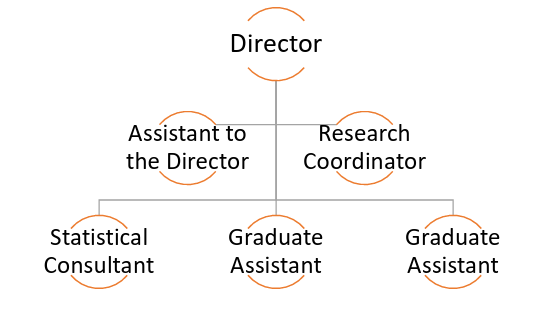
Center for Justice Research personnel consists of:
- Director, Dr. Melissa Burek
- Assistant to the Director, Nicole Pedraza
- Research Coordinator, Julia Bell
- Statistical Consultant, Dr. Eric Cooke
- Graduate Assistants
- Kayla Hauser (January 2024-May 2024)
- Jaryt Salvo (January 2024-present)
- Stephanie DeCroix (May 2024-present)
Publications and Presentations
ACJS Poster Presentation Graduate Assistant During the reporting period of July 1, 2023- June 30, 2024, the Center for Justice Research was not involved in any publications. Though, a poster depicting findings from the Constitutional Carry project, found in Appendix A, was presented at the Academy of Criminal Justice Sciences (ACJS) annual meeting in March in Chicago, IL.
Future Publications
The CJR team would like to reach broader audiences, including the more traditional academic journal readers. Currently, a manuscript focusing on residential instability and crime in Toledo is underway. The CJR hopes to have a completed manuscript to submit for publication by the end of this summer. Other publication ideas include a second manuscript focusing on residential instability measures and calls for service in Toledo and on findings from the constitutional carry exploratory study.
Marketing and Communications
During the July 1, 2023- June 30, 2024 reporting period, the CJR collaborated with a variety of criminal justice agencies and organizations across Ohio. These included the Toledo Police Department’s Intelligence and Special Investigations Bureau, the Dayton Police Department, the Columbus Police Department, the Montgomery County Sheriff’s Office, and the Ohio IncidentBased Reporting System. Through these collaborations, the CJR obtained essential data such as calls for service and crime incident data for Toledo and Dayton, ShotSpotter and gun detection data for Toledo and Columbus, and crime incident data involving firearms. Collaboration with these agencies allowed the CJR to gain insight into how they function and allowed for the CJR to successfully complete the projects at hand. Further, communication with Ohio agencies and organizations may benefit future research efforts conducted by the CJR. Official CJR websites have been continuously updated during this reporting period, which provides information on the CJR’s mission, team members, press, and research activities.
Center for Justice Research Websites:
- https://www.bgsu.edu/health-and-human-services/center-for-justice-research.html
- https://www.ohioattorneygeneral.gov/Law-Enforcement/Center-for-Justice-Research
Center for Justice Research Costs
Total expenditures for the Center for Justice Research for the reporting period July 1, 2023 to June 30, 2024 was $165,742.75. A breakdown of expenditures is included in the Appendix B. Both the Kent State University Bail Project and BGSU Sociology Program’s Reentry Project were approved for no-cost extensions to complete their projects. The remaining expenditures were paid out between July and September 2023. The CJR Review Team is no longer being utilized as we do not currently have any external funding opportunities available as we have been operating under a no-cost extension relying on the remaining funds from the original grant award in FY22.
Appendix B
Activities & Costs Annual Report: 2023-2024
Dates: July 01, 2023, to June 30, 2024
Activity 1: Bail Reform Project.
Amount Awarded, period of performance 07/01/2022-06/30/2023: $89,992.00
| Date | Expense | BGSU PO Number |
| 7/19/2023 | $164.54 | BG02401973 |
| 7/19/2023 | $1,645.38 | BG02401973 |
| 9/11/2023 | $1,979.54 | BG02405592 |
| 9/11/2023 | $19,795.38 | BG02405592 |
| 9/19/2023 | $164.54 | BG02406330 |
| 9/19/2023 | $1,654.38 | BG02406330 |
Amount expended during reporting period: $25,394.76
Activity 2: Reentry and Employment Project.
Amount Awarded, period of performance 07/01/2023- 07/21/2023: $ 2,136.11
Personnel: $1732.43
Fringes: $403.68
Amount expended during reporting period: $2,136.11
Activity 3: Operation costs
Personnel and Fringes: $135,670.32
Travel: $1117.16
Supply: $48.87
Amount expended during reporting period: $136,836.35
Indirect Costs: $12,549.71
Fiscal Year 2024 Summary: Costs
Total expenditures: $176,916.93
Updated: 04/21/2026 04:38PM