
Priority Area 2: Public Opinion on Bail Reform
Priority Area 2: Public Opinion on Bail Reform
Report Submitted: 2023
By: Christopher P. Dum, PhD, Elias Nader, PhD, and Starr Solomon, PhD
In 2019, sixty-one percent of Ohio jail inmates were awaiting trial (Doskocil, 2022). The Ohio Legislative Service Commission’s Fiscal Note on H.B. 315 (134th General Assembly) stated that the average cost of pre-trial incarceration was approximately $928,000 per day, or $339 million per year. In fiscal years 2024 and 2025, Ohio will direct $50 million from 2023 general revenue funds to local jails for construction and renovation projects (Golon, 2023). Given the state’s financial investment in pre-trial detention and the influence of public opinion on legislative policy (Pickett, 2019), it is useful to understand how taxpayers perceive criminal justice policies, such as pre-trial release, that may reduce operating costs.
Prior research suggests criminal justice opinions are “mushy” because public support for criminal justice policies appears to be contradictory (Cullen et al., 2000). In other words, the public holds simultaneously punitive and progressive views regarding criminal justice policy. For instance, Applegate and colleagues (1996) studied Cincinnati-area residents’ opinions regarding three strikes laws and found that an overwhelming majority of respondents supported three strikes laws. However, respondents were simultaneously willing to allow flexibility in the application of three strikes laws when the third offense was minor. Therefore, the public may support a range of punitive policies (e.g., incarceration, capital punishment, mandatory minimum sentences) while simultaneously displaying a willingness to substitute less punitive approaches if they know less punitive options are available (e.g., supporting life without parole sentences instead of capital punishment).
Knowledge about issues also matters when assessing criminal justice opinions. This is important as research suggests most Americans are somewhat misinformed about crime and punishment (Pickett, 2019). Criminal justice knowledge is especially limited among adults who rely on mass media (e.g., newspapers, magazines, television, and radio) to inform information about crime and justice (Pickett et al., 2015). Yet, providing accurate criminal justice information appears to influence public opinion, albeit in an inconsistent manner. Some studies find that providing accurate information about crime and punishment reduces punitive attitudes while other studies find that providing accurate information can harden punitive attitudes. For example, college students in criminal justice classes reported lower levels of death penalty support when they were provided accurate information about the death penalty, but these reductions did not persist over time (Bohm & Vogel, 2004). Additional research found that providing respondents information about incarceration, crime, and sentencing reduced punitiveness (Indermaur et al., 2012). However, another study found that providing victim impact evidence in death penalty eligible cases increased support for capital punishment (Paternoster & Deise, 2011). Further, the framing of racial disparities in the criminal justice system also influences punitiveness. When survey respondents were provided information that manipulated the racial composition of a prison such that the prison had a larger Black population, respondents were more supportive of punitive three strikes laws (Hetey & Eberhardt, 2014). These findings suggest that the type of knowledge matters and influences public opinion about criminal justice issues.
Opinions about criminal justice policy issues may also depend on whether the public is queried about general or specific attitudes (Pickett, 2019). The public tends to be more punitive when asked about general opinions regarding criminal justice policies and less punitive when specific opinions are measured (Applegate et al., 1996; Cullen et al., 2000). However, focusing on general versus specific attitudes may distract from macro-level factors that condition public opinion. Public opinions regarding criminal justice issues are complex—while there is some inconsistency in findings regarding public opinion, some macro-level factors consistently predict public opinion. Policy mood is macro-level variable that influences public opinion about a variety of topics, including criminal justice attitudes (Stimson et al., 1995; Pickett, 2019). Public policy mood refers to aggregate prevailing opinions on political issues and the “…public’s preferences for more or less government…” (Enns & Kellstedt, 2008, p. 433).
Policy mood is particularly relevant because it reflects the aggregation of complex individual opinions over time to reveal broad trends across a variety of political and social issues. To study policy moods, researchers use longitudinal data on global and specific attitudes collected over a period of time (e.g., Enns & Kellstedt, 2008; Ramirez, 2013). Two noteworthy studies on punitive sentiment revealed that aggregate punitive attitudes varied over time, but aggregate opinions of subgroups moved in a similar manner even though levels of punitiveness between subgroups varied (Anderson et al., 2017; Ramirez, 2013). Specifically, even though Republicans were more punitive than nonRepublicans, White individuals more punitive than Black individuals, and men more punitive than women, punitive sentiment changed over time in a similar manner between these groups— Republicans and non-Republicans, Black and White individuals, as well as men and women become more or less punitive at similar points in time (Anderson et al., 2017; Ramirez, 2013). Although levels of support between race, gender, or political subgroups varied, public opinion on punitiveness moved in a similar fashion because of the prevailing policy mood.
Public opinion is important because it can shape criminal justice policy. The ability of public opinion to affect public policy responses is called dynamic representation or dynamic responsiveness (Stimson et al., 1995). Public opinion can shape criminal justice policy by influencing politician support, electing officials, and by voting on criminal justice ballot issues (e.g., State Issue 1 in 2022) (Pickett, 2019). Research supports dynamic representation in the criminal justice policy realm. For example, in states where Supreme Court justices were elected, state Supreme Courts upheld capital punishment sentences when citizens in the state were supportive of the death penalty (Brace & Boyea, 2008). Importantly, this Supreme Court effect also holds at the federal level where justices are not elected—the U.S Supreme Court issues a higher proportion of liberal judgments in less salient (less public attention) cases when the policy mood becomes more liberal (Casillas et al., 2011). However, U.S Supreme Court decisions in salient cases tend to contrast the prevailing policy mood (Casillas et al., 2011). Public punitiveness is also associated with mass incarceration rates. When the public was more punitive, mass incarceration rates were higher (Enns, 2014). These studies suggest that public opinion can and does influence policy as well as criminal justice actors.
Current Study
In the current project we seek to examine individual-level public opinion on bail reform in Ohio. Macro-level research suggests that prevailing policy mood influences punitive attitudes. While there are differences between race, sex, and political subgroups, public opinion for those groups tends to move in the same direction over time. However, these findings do not indicate that individual demographic factors should be ignored in the realm of public opinion because these individual demographic factors provide information about where someone may fall on the punitive attitude spectrum. Instead, these findings suggest that aggregate level studies should supplement individual level research. Since this project was concerned with a specific criminal justice policy during an unprecedented pandemic, it makes sense to explore individual attitudes. Further, research suggests that the public has both general and specific opinions about crime policy and general opinions tend to be more punitive than specific opinions. Therefore, we examine Ohioans’ support for bail reform generally and specifically using an online survey experiment. Findings from our study provide insight to current punitive sentiments in Ohio regarding pre-trial release practices.
Data and Methods
Research Questions
Two research questions guided Priority Area 2 research.
- What are Ohio residents’ current opinions regarding bail reform legislation (i.e., 2020 Senate Bill 182 and 2020 House Bill 315)?
- How do case-specific factors (i.e., offender race, offender sex, offense type, offense history) influence support for recognizance release?
Sample
To answer our research questions, we collected data from a representative non-probability sample of 1,000 Ohioans using the YouGov Web Access Panel. The YouGov panel is an opt-in survey panel, composed of 1.8 million U.S residents who agreed to participate in YouGov’s web surveys. The YouGov panel includes 15,000-20,000 Ohio residents, making it an ideal platform to survey Ohioans about bail reform opinions. Additionally, YouGov has been used in recent criminological academic research (e.g., Pickett et al., 2023; Socia et al., 2021). YouGov panel members are recruited using a variety of methods to ensure panel diversity including web advertisements to join YouGov campaigns, web advertisements in public surveys, member referrals, random digit dialing telephone-to-web recruitment (i.e., YouGov completed telephone interviews and invited respondents to join the online panel), and organic recruitment (e.g., individuals join the panel after reading YouGov research). Participants are not paid to join the YouGov panel, rather they receive incentives using a points-based loyalty system to participate in surveys. Participants receive between 250 to 5,000 points to complete a survey and points are redeemed for small gifts (e.g., 30,000 points can be redeemed for a $25 gift card).
YouGov relies on a two-stage sample matching procedure to generate representative samples from non-randomly selected opt-in participant pools. YouGov selects the target population by drawing a stratified random sample using demographic characteristics (i.e., age, sex, race, education) from the most recent American Community Survey. This technique serves as a synthetic sampling frame because an actual sampling frame for online surveys does not exist. The frame is constructed using a politically representative frame of US adults—in this case, the American Community Survey, public voter file records, 2020 current population survey voting and registration supplements, the 2020 national election pool. A random sample is then drawn from this target population and then each member of the target sample is matched to YouGov’s pool of opt-in panelists using propensity score matching techniques. In our study, YouGov interviewed 1,067 Ohio residents who were then matched down to a sample of 1,000 to produce the final sample. Unweighted and weighted sample demographic characteristics are displayed in Table 1.
Sample Descriptive Statistics
| Unweighted | Weighted | Range | |
| Variable | % or M (SD) | % or M (SD) | |
| Race | --- | --- | 1-8 |
| NH White | 80.10% | 79.42% | --- |
| NH Black | 11.50% | 11.44% | --- |
| Hispanic/Latino | 4.80% | 5.02% | --- |
| NH Asian | 0.30% | 0.49% | --- |
| NH Indigenous Am. | 0.70% | 0.95% | --- |
| NH 2 or more races | 1.50% | 1.20% | --- |
| NH other | 0.90% | 0.93% | --- |
| NH Middle Eastern | 0.20% | 0.54% | --- |
| Gender | --- | --- | 0-1 |
| Male | 46.50% | 48.40% | --- |
| Female | 53.50% | 51.60% | --- |
| Age | 51.48 (16.69) | 49.22 (17.74) | 19-90 |
| Education | --- | --- | 1-6 |
| No High School | 4.70% | 6.97% | --- |
| Diploma or GED | 32.90% | 33.38% | --- |
| Some College | 19.60% | 20.46% | --- |
| Associate Degree | 9.80% | 9.59% | --- |
| Bachelor's Degree | 20.10% | 19.01% | --- |
| Post-graduate Degree | 12.90% | 10.61% | --- |
| Marital Status | --- | --- | 1-6 |
| Married | 45.00% | 40.09% | --- |
| Separated | 1.60% | 2.00% | --- |
| Divorced | 15.00% | 14.39% | --- |
| Widowed | 4.50% | 4.42% | --- |
| Never Married | 28.60% | 33.05% | --- |
| Domestic Partnership | 5.30% | 6.05% | --- |
| Employment Status | --- | --- | 1-9 |
| Full-time | 37.60% | 35.84% | --- |
| Part-time | 9.90% | 10.28% | --- |
| Laid Off | 0.30% | 0.37% | --- |
| Unemployed | 5.90% | 6.65% | --- |
| Retired | 25.40% | 23.49% | --- |
| Disabled | 8.60% | 8.99% | --- |
| Homemaker | 7.80% | 8.22% | --- |
| Student | 2.40% | 3.84% | --- |
| Other | 2.10% | 2.32% | --- |
| Political Ideology | --- | --- | 1-4 |
| Conservative | 33.20% | 32.05% | --- |
| Moderate | 30.80% | 32.00% | --- |
| Liberal | 27.20% | 25.80% | --- |
| Not Sure | 8.80% | 10.87% | --- |
Notes: Sample size (n) = 1,000. NH = Non-Hispanic/Latino.
Survey Experiment Design
YouGov distributed an online between-subjects survey experiment to our sample of Ohio residents. The survey had five distinct components: 1) pre-test bail opinion assessment, 2) random assignment to one experimental condition, 3) post-test assessment, 4) prior criminal justice system contacts and perceptions, 5) demographic information. YouGov randomly assigned participants to view one hypothetical vignette (i.e., a pre-trial scenario) describing a pre-trial detention scenario that varied the presentation of four case-specific factors.
Two of the case-specific factors manipulated in the vignette were demographic characteristics of the accused and two were offense characteristics. The two demographic factors were the accused’s race and gender, while the offense characteristics were offense type and offense history. Offense characteristics were manipulated by varying text descriptions of the accused’s arrest. Offense type was manipulated by stating whether the current offense was violent or non-violent. Offense history was manipulated by stating whether the current offense was a first or second offense.
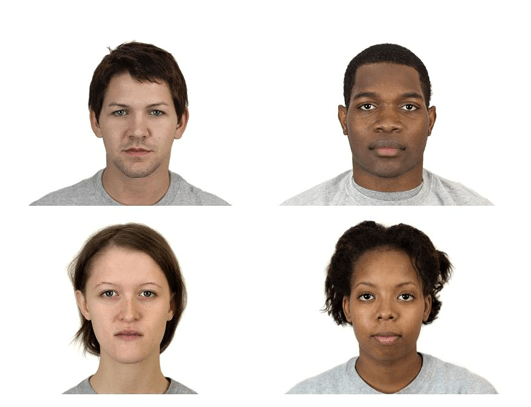
Race and gender were manipulated by varying the presentation of the accused’s race (Black or White) and gender (male or female) with images from the Chicago Face Database (CFD) 3.0 (Ma et al., 2015). The CFD 3.0 is a free repository of photographs of male and female individuals from various racial or ethnic backgrounds between the ages of 17-65. The CFD 3.0 consists of images of 597 unique individuals, of which we utilized a sample of Black male or female and White male or female models with neutral facial expressions. There are several advantages of using CFD images in experimental research. First, images are standardized and can be used for side-by-side comparisons. Second, the CFD provides norming data that allows researchers to select comparable images. Norming data includes physical attributes (e.g., face size) and subjective ratings of model faces or personality characteristics. Thus, we used seven subjective ratings to identify models within one standard deviation of the mean for all Black male/female and White male/female models to ensure models of different sexes and races were as comparable as possible. The characteristics included age, anger, attractive, threatening, trustworthy, dominant, and masculinity (male models only) or femininity (female models only). The models and experimental vignette can be viewed in Table 2.
Experimental Vignettes
Vignette Images
Vignette Text
Imagine the [man/woman] in this image was arrested for the [FIRST/SECOND TIME] for a [VIOLENT/NON-VIOLENT] crime in your Ohio county. Although this [man/woman] has not been convicted or found guilty of a crime related to [his/her] current arrest, [he/she] has been detained pre-trial in your county jail while [he/she] awaits [his/her] next court hearing.
The combination of the four survey manipulations resulted in sixteen unique experimental conditions. Respondents were randomly assigned to view one of the sixteen vignettes to reduce social desirability as well as survey ordering and anchoring effects. A priori power analyses using G*Power 3.1 determined that a minimum sample size of 732 would be required to detect medium sized main effects (f <.15) with 80% power and the .05 alpha level. The distribution of respondents per experimental condition can be viewed in Table 3.
Weighted Experimental Group Sample Sizes
| Experimental Group | n | % |
| 1. White/Male//First Offense/Non-Violent | 56 | 4.98% |
| 2. Black/Male/First Offense/Non-Violent | 57 | 5.67% |
| 3. White/Male/First Offense/Violent | 63 | 5.82% |
| 4. Black/Male/First Offense/Violent | 68 | 7.09% |
| 5. White/Male/Second Offense/Non-Violent | 59 | 5.94% |
| 6. Black/Male/Second Offense/Non-Violent | 66 | 6.64% |
| 7. White/Male/Second Offense/Violent | 62 | 6.23% |
| 8. Black/Male/Second Offense/Violent | 63 | 6.67% |
| 9. White/Female/First Offense/Non-Violent | 67 | 6.57% |
| 10. Black/ Female /First Offense/Non-Violent | 64 | 6.11% |
| 11. White/ Female /First Offense/Violent | 59 | 5.75% |
| 12. Black/ Female /First Offense/Violent | 65 | 7.17% |
| 13. White/ Female /Second Offense/Non-Violent | 61 | 6.14% |
| 14. Black/ Female /Second Offense/Non-Violent | 67 | 7.42% |
| 15. White/ Female /Second Offense/Violent | 64 | 6.46% |
| 16. Black/ Female /Second Offense/Violent | 59 | 5.37% |
Note: n = Sample size
Measures
Dependent Variables
Research Question 1: Analyses for research question one proceeded in two steps. First, we asked respondents to indicate release preferences (1 = no pre-trial release, 2 = secured bond, 3 = recognizance release or ROR) for 12 crimes listed in Table 4.
Weighted Pre-trial Release Preferences for Specific Crimes
| Crime | No Pre-Trial Release | Secured Bond | ROR |
| Murder | 75.57% | 19.85% | 4.57% |
| Robbery | 21.92% | 64.49% | 13.58% |
| Physical assault without weapon | 11.37% | 42.65% | 45.99% |
| Physical assault with weapon | 44.82% | 46.49% | 8.89% |
| Rape or sexual assault | 68.57% | 27.31% | 4.13% |
| Domestic violence | 37.46% | 48.09% | 14.46% |
| Marijuana-related drug crime | 6.58% | 20.64% | 72.78% |
| Crime related to other drugs | 15.51% | 53.05% | 31.44% |
| Alcohol or drug impaired driving | 14.46% | 50.45% | 35.08% |
| Stalking | 31.06% | 51.21% | 17.71% |
| Car Theft | 18.45% | 58.23% | 23.32% |
| Burglary | 24.47% | 59.18% | 16.35% |
Second, we assessed Ohio residents’ general views about bail reform legislation with five items that focused on recognizance release (ROR) opinions in multivariable regression analyses. Four of the five items were measured on a 1 – 7 Likert-type scale and are described in detail below: Higher scores on each variable indicated more support, fear, safety, or worry that crime would increase.
- General Covid ROR measured the extent to which respondents oppose or support ROR to reduce the spread of COVID-19 in Ohio jails (1 = strongly oppose, 7 = strongly support).
- General ROR measured the extent to which respondents oppose or support ROR to release persons charged, but not yet found guilty, with a crime from Ohio jails (1 = strongly oppose, 7 = strongly support).
- General Safety measured how unsafe or safe respondents would feel if ROR became the standard pre-trial release practice in Ohio (1 = extremely unsafe, 7 = extremely safe)
- General Crime Increase measured how worried respondents would be that ROR would increase crime (1 = not at all worried, 7 = extremely worried).
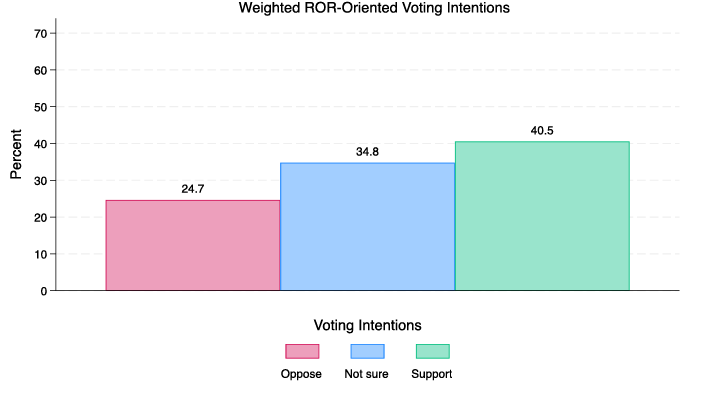
Higher scores on these four outcome variables indicated more support, safety, or worry that crime would increase. The fifth dependent variable, General Voting Intentions, was categorial and assessed whether respondents would vote to oppose or support ROR to release people charged, but not yet found guilty, of crimes from Ohio jails (1 = oppose legislation, 2 = not sure, 3 = support legislation). Descriptive Statistics for these dependent variables are displayed in Table 5.
| Unweighted | Weighted | Range | |
| Variable | % or M (SD) | % or M (SD) | |
| Independent Variables | |||
| Non-White | 19.90% | 20.57% | 0-1 |
| Female | 53.50% | 51.60% | 0-1 |
| Married | 50.30% | 46.14% | 0-1 |
| Work | 47.50% | 46.12% | 0-1 |
| Degree | 42.80% | 39.20% | 0-1 |
| Age | 51.48 (16.69) | 49.22 (17.74) | 19-90 |
| Conservative | 33.20% | 35.96% | 0-1 |
| Prior Arrest | 25.00% | 26.44% | 0-1 |
| Prior Victim | 44.40% | 42.98% | 0-1 |
| Court Procedural Justice (a = .84) | 3.18 (0.99) | 3.17 (1.00) | 1-5 |
| Courts use fair procedures | 3.17 (1.18) | 3.16 (1.18) | 1-5 |
| Courts makes decisions based on facts | 3.32 (1.17) | 3.32 (1.18) | 1-5 |
| People get the outcomes they deserve | 3.14 (1.10) | 3.14 (1.14) | 1-5 |
| I trust the decisions of criminal courts | 3.11 (1.12) | 3.08 (1.13) | 1-5 |
| Fear of crime (a = .93) | 2.80 (1.11) | 2.82 (1.12) | 1-5 |
| Steal money or property | 3.00 (1.24) | 2.99 (1.25) | 1-5 |
| Break into your house | 3.06 (1.26) | 3.05 (1.26) | 1-5 |
| Physical assault | 2.88 (1.26) | 2.90 (1.29) | 1-5 |
| Rob or mug | 2.85 (1.28) | 2.88 (1.29) | 1-5 |
| Rape or sexual assault | 2.43 (1.32) | 2.45 (1.34) | 1-5 |
| Murder | 2.60 (1.33) | 2.64 (1.35) | 1-5 |
| Black Offender | 50.90% | 52.13% | 0-1 |
| Female Offender | 50.60% | 50.99% | 0-1 |
| Violent Offender | 50.30% | 50.55% | 0-1 |
| Second Offense | 50.10% | 50.85% | 0-1 |
| Dependent Variables | |||
| General Covid ROR | 4.32 (2.03) | 4.31 (2.01) | 1-7 |
| General ROR | 4.49 (1.87) | 4.54 (1.88) | 1-7 |
| General Safety | 3.48 (1.66) | 3.47 (1.68) | 1-7 |
| General Crime Increase | 4.58 (1.78) | 4.59 (1.80) | 1-7 |
| General Voting Intentions | 2.15 (0.80) | 2.16 (0.79) | 1-3 |
| Oppose | 25.70% | 24.68% | --- |
| Not Sure | 33.90% | 34.78% | --- |
| Support | 40.40% | 40.54% | --- |
| Specific ROR | 4.15 (2.00) | 4.20 (1.99) | 1-7 |
| Specific Worry | 3.77 (1.76) | 3.77 (1.75) | 1-7 |
| Specific Safety | 4.15 (1.69) | 4.15 (1.69) | 1-7 |
| Specific Crime Increase | 3.59 (1.62) | 3.56 (1.62) | 1-7 |
| Specific Release Preferences | 2.27 (0.70) | 2.27 (0.69) | 1-3 |
| No Pre-trial Release | 14.70% | 14.12% | --- |
| Secured Bond | 43.20% | 44.40% | --- |
| Reconizance Release | 42.10% | 41.48% | --- |
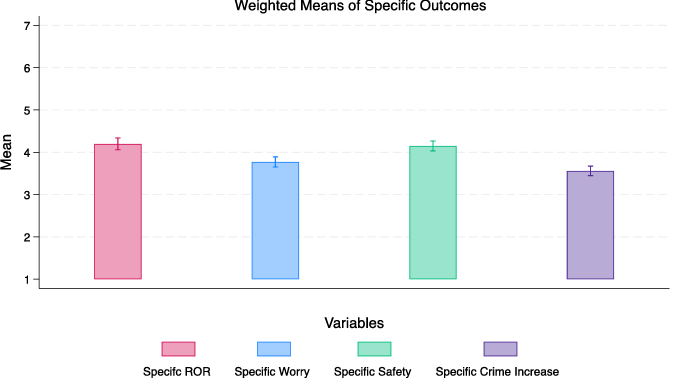
Research Question 2: We assessed how case-specific factors influenced Ohioans’ specific pre-trial release opinions using five items. Each of the five items served as a dependent variable in multivariable regression analyses. Four of the five items were measured on a 1 – 7 Likert-type scale and are described in detail below:
- Specific ROR measured the extent to which respondents oppose or support ROR for the person described in the vignette scenario (1 = strongly oppose, 7 = strongly support).
- Specific Worry measured how worried respondents would be if the person in the vignette scenario was granted ROR (1 = not at all worried, 7 = extremely worried).
- Specific Safety measured how unsafe or safe respondents would feel if the person in the vignette scenario was granted ROR (1 = extremely unsafe, 7 = extremely safe).
- Specific Crime Increase measured the perceived likelihood that crime would increase if the person in the vignette scenario was granted ROR (1 = extremely unlikely, 7 = extremely likely).
Higher scores on each variable indicated more support, worry, safety, or concerns that crime would increase. The fifth specific dependent variable, Specific Release Preferences, was categorical and assessed which pre-trial release option respondents would choose for the person in the vignette scenario (1 = no pre-trial release, 2 = secured bond, 3 = ROR). Descriptive Statistics for these dependent variables are also displayed in Table 5.
Independent Variables
Research Question 1: Several personal characteristics are associated with criminal justice opinions (Anderson et al., 2017; Ramirez, 2013). Thus, we assessed how these personal characteristics influenced the five dependent variables for the first research question to elucidate Ohio residents’ views on bail reform. Non-White indicated whether a respondent identified as White or Non-White (1 = Non-White, 0 = White). Female indicated respondents who selfidentified their sex as female (1 = female, 0 = male). Married indicated whether respondents in our sample were married or in a domestic partnership (1 = married or domestic partnership, 0 = divorced, separated, widowed, or never married). Work indicated whether respondents worked full or part-time jobs for income (1 = employed, 0 = temporarily laid off, unemployed, retired, permanently disabled, homemaker, student, or other non-full or part-time employment for income). Degree indicated whether respondents held at least an associate degree (1 = associate degree, bachelor’s degree, or post-graduate degree, 0 = no high school diploma, high school diploma or GED, or some college). Age indicated the respondent’s age in years. Conservative indicated whether a respondent self-identified as having conservative political views (1 = conservative, 0 = liberal or moderate). Prior arrest indicated whether respondents were arrested at least once in their lifetime (1 = prior arrest, 0 = no prior arrest). Prior victim indicated if respondents were the victim of a crime in their lifetime (1 = prior victimization, 0 = no prior victimization).
Apart from demographic variables, we also assessed views of criminal courts and fear of crime. Court Procedural Justice (∝ = .84) was a mean scale that took the average of four survey items measured on a 1 – 5 (1 = strongly disagree, 5 = strongly agree) Likert-type scale that assessed perceived fairness and trust in criminal court proceedings. The four items included: 1) Criminal courts use fair procedures when handling cases, 2) Courts make decisions based on facts, not personal opinions, 3) People with criminal cases get the outcomes they deserve in court, 4) I trust the decisions of criminal courts. The responses to each of the four courts items were averaged to create the court procedural justice measure and higher scores indicate courts were perceived as fair.
Finally, Fear of crime (∝ = .93) was a mean scale that took the average of six survey items measured on a 1 – 5 (1 = not at all afraid, 5 = extremely afraid) Likert-type scale that assessed respondents’ fear of being a victim of crime in the next five years. The six items included: 1) Steal money or property, 2) Break into house, 3) Physical assault, 4) Rob or Mug, 5) Rape or sexually assault, 6) Murder. The responses to each of the six fear of crime items were averaged to create the fear of crime measure and higher scores indicated greater fear of crime. Descriptive Statistics for these independent variables are displayed in Table 5.
Research Question 2: We examined how the four vignette scenario manipulations influenced each of the dependent variables for the second research question. Black indicated whether the person in the vignette scenario was Black or White (1 = Back, 0 = White). Female indicated whether the person in the vignette scenario was female or male (1 = female, 0 = male). Violent offense indicated whether the person in the vignette scenario committed a violent or nonviolent offense (1 = violent offense, 0 = non-violent offense). Second offense indicated whether the person in the vignette scenario was arrested for the first or second time for the offense (1 = second offense, 0 = first offense). Descriptive Statistics for these independent variables are displayed in Table 5.
Analytical Approach
All analyses were conducted in STATA 18 using a survey weight provided by YouGov. Analyses began by examining missing data patterns for each independent and dependent variable included in analyses. Three independent variables—conservative, prior arrest, and prior victimization—for the first research question were missing 8.80%, 2.00%, and 2.70% data, respectively. Thus, we used multiple imputation to account for the missing data patterns. One variable for the second research question—specific worry—was missing less than 1.00% data. However, due to the low number of missing cases we did not impute data for the second research question. We then summarized data to report descriptive trends for independent and dependent variables.
Next, we treated outcomes measured on the 7-point scale as continuous and used Ordinary Least Squares (OLS) regression in analyses. Importantly, the OLS regression results for research question two do not use control variables because the use of control variables in experimental analyses will bias treatment effect estimates. Finally, we used Multinomial Logistic regression and requested relative risk ratios (i.e., we measured the likelihood of selecting one response option relative to selecting another response option) for the two categorical outcomes. The Multinomial Logistic regression analyses compared the relative risk of being an undecided or oppositional voter relative to supporting ROR legislation as well as preferring no pre-trial release or secured bond relative to ROR release preferences. Relative risk ratios less than one indicate negative associations while relative risk ratios greater than one indicate positive associations. Results for regression models are presented separately for each research question.
Results
Descriptive Statistics
Table 1 highlights similarities between the unweighted and weighted sample descriptive statistics. We focus on weighted descriptive statistics because we use a survey weight in this analysis. The sample was 79.42% White, 51.60% female, and on average, 49 years old. Most respondents have high school diplomas (or GED equivalent) and at least some college education. The sample consisted of 40.09% married persons and indicated that 46.12% of respondents work full or part-time, while 23.49% are retired. Finally, 32.05% indicated conservative political ideologies, 32.00% had moderate political ideologies, 25.80% had liberal political ideologies, and 10.87% were unsure about their political ideology.
Reviewing weighted pre-trial release preference trends indicated that respondents preferred pre-trial detention for serious violent crimes such as murder and rape or sexual assault. Respondents preferred secured bond for robbery, domestic violence, non-marijuana-related drug crimes, alcohol or drug-impaired driving, stalking, car theft, and burglary. Respondents preferred recognizance release for physical assault without a weapon and marijuana-related drug crimes. In sum, respondents appeared to support secured bond more often than pre-trial detention and recognizance release. These results are displayed in Table 4.
Table 5 displays both unweighted and weighted percentages or averages and standard deviations for all variables included in regression analyses. Again, we focus on describing data trends with weighted data since we use weighted data in analyses. Approximately 26.44% of respondents indicated they had been arrested at least once in their lifetime and 42.98% of respondents indicated they had been the victim of a crime at least once in their lifetime. On average, respondents indicated middling views of court fairness and were somewhat unafraid of crime.
Weighted Means of General Outcomes
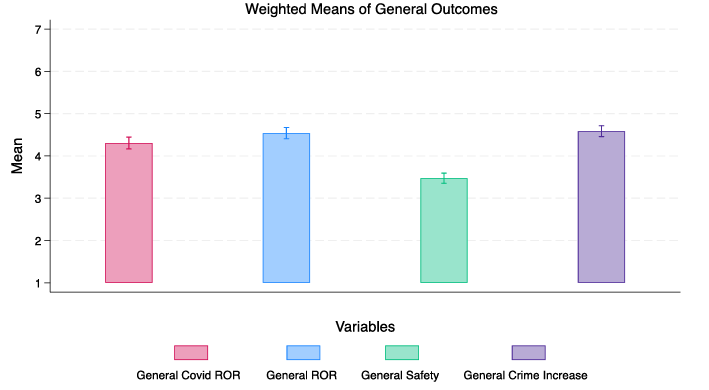
Descriptive findings indicated that respondents were somewhat supportive of using recognizance release during the height of the Covid-19 pandemic and using recognizance release in general. However, respondents indicated concerns for personal safety if the use of recognizance release became standard pre-trial practice in Ohio and were worried about recognizance release increasing crime in Ohio (see Figure 1). Further, 24.68% of respondents indicated they would vote to oppose ROR-oriented legislation while 34.78% were unsure and 40.54% were in support of such legislation (see Figure 2). In other words, among decided voters, the majority would vote to support ROR-oriented legislation.
Weighted ROR-Oriented Voting Intentions
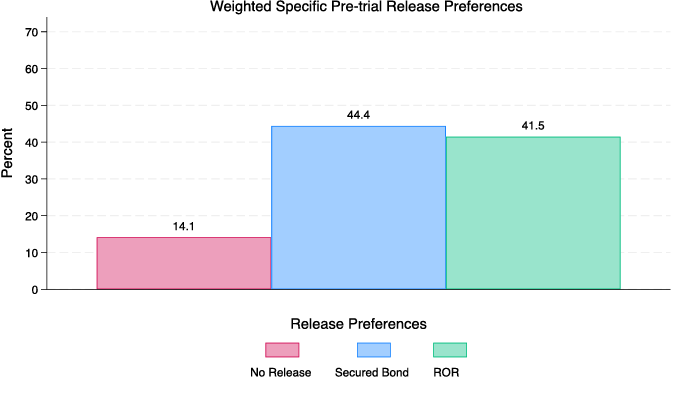
When examining trends for specific ROR opinions related to experimental scenarios, respondents support for ROR was similar to general recognizance release support findings. Again, respondents were somewhat supportive of using ROR for offenders in experimental scenarios. However, trends for specific worry, safety, and perceived crime increases diverged from general opinions. Specifically, respondents were, on average, less worried, felt safer, and were less likely to perceive crime increases when considering ROR for specific scenarios and offenders (see Figure 3). In sum, respondents appear to be more supportive of recognizance release when they have information about cases than when generally queried about bail reform opinions. Finally, respondents overwhelmingly preferred pre-trial release to pre-trial detention. For instance, 44.4% of respondents preferred secured bond and 41.5% preferred ROR (see Figure 4).
Weighted Means of Specific Outcomes
Weighted Specific Pre-trial Release Preferences
Research Question 1 Results
Outcome: General Covid ROR
All weighted OLS regression results for research question one are displayed in Table 6. Non-White Ohioans expressed higher levels of support for using ROR to reduce the spread of Covid-19 in jails than White Ohioans. However, older respondents and those with conservative political ideologies expressed lower levels of support for using ROR to reduce Covid-19 in jails relative to younger and liberal or moderate respondents. Lastly, perceived procedural fairness of Ohio courts was negatively associated with Covid-19 ROR support—beliefs that Ohio courts used fair procedures reduced support for Covid-19 ROR.
| General Covid ROR | General ROR | General Safety | General Crime Increase | |
| b (SE) | b (SE) | b (SE) | b (SE) | |
| Non-White | 0.378 (0.186) * | 0.231 (0.165) | -0.046 (0.154) | 0.014 (0.168) |
| Female | -0.015 (0.141) | 0.131 (0.136) | 0.127 (0.119) | -0.075 (0.119) |
| Married | -0.172 (0.139) | -0.065 (0.132) | -0.132 (0.119) | 0.001 (0.121) |
| Work | -0.116 (0.140) | -0.108 (0.135) | -0.024 (0.134) | 0.161 (0.122) |
| Degree | 0.029 (0.138) | -0.179 (0.133) | 0.049 (0.119) | -0.046 (0.120) |
| Age | -0.011 (0.004) * | -0.014 (0.004) ** | -0.011 (0.004) ** | 0.012 (0.004) ** |
| Conservative | -1.411 (0.152) ** | -1.118 (0.153) ** | -1.044 (0.118) ** | 1.068 (0.124) ** |
| Prior Arrest | 0.310 (0.165) | 0.301 (0.165) | 0.257 (0.139) | -0.162 (0.152) |
| Prior Victimization | 0.090 (0.135) | 0.083 (0.133) | 0.167 (0.116) | -0.392 (0.121) ** |
| Court Procedural Justice | -0.181 (0.072) * | -0.110 (0.071) | -0.195 (0.063) ** | 0.273 (0.064) ** |
| Fear of Crime | -0.108 (0.066) | -0.109 (0.064) | -0.335 (0.052) ** | 0.443 (0.056) ** |
| Intercept | 6.134 ** | 6.190 ** | 5.789 ** | 1.707 ** |
| N | 1,000 | 1,000 | 1,000 | 1,000 |
| Avg. F | 18.079 ** | 12.918 ** | 17.742 ** | 21.027 ** |
| Avg. Adjusted R2 | 0.179 | 0.137 | 0.184 | 0.206 |
Notes: ** p<.01, * p<.05; Unstandardize Coefficients; SE = Robust Standard Error; ROR = Recognizance Release; Avg. = Average.
Outcome: General ROR
Older respondents and those with conservative political ideologies expressed lower levels of general support for ROR than younger and liberal or moderate respondents.
Outcome: General Safety
Similar to results for the previous dependent variables, older respondents with conservative political ideologies reported they would feel less safe if ROR became standard pre- trial release practice in Ohio. Perceived court fairness and fear of crime also predicted lower feelings of safety.
Outcome: General Crime Increase
Findings gauging whether respondents believed crime would increase if ROR became standard practice in Ohio suggested older respondents and those with conservative political ideologies believed crime would increase if ROR became standard practice in Ohio. Further, respondents who perceived courts as fair and feared crime also believed the use of ROR would increase crime.
RQ 1: Weighted Multinomial Logistic Regression Results
| Oppose vs. Support ROR | Not Sure vs. Support ROR | |
| Relative Risk Ratio (SE) | Relative Risk Ratio (SE) | |
| Non-White | 0.432 (0.138) ** | 0.951 (0.213) |
| Female | 0.660 (0.133) * | 1.084 (0.206) |
| Married | 1.099 (0.229) | 0.727 (0.132) |
| Work | 1.080 (0.225) | 0.754 (0.151) |
| Degree | 1.300 (0.275) | 1.011 (0.191) |
| Age | 1.022 (0.007) ** | 1.011 (0.006) |
| Conservative | 4.557 (0.973) ** | 2.108 (0.454) ** |
| Prior Arrest | 0.826 (0.219) | 0.606 (0.133) * |
| Prior Victimization | 0.955 (0.204) | 0.900 (0.172) |
| Court Procedural Justice | 1.238 (0.136) | 1.015 (0.092) |
| Fear of Crime | 1.153 (0.115) | 0.977 (0.078) |
| Intercept | 0.048 ** | 0.643 |
| N | 1,000 | |
| Avg. x2 | 136.025 | |
| Avg. Pseudo R2 | 0.084 |
Outcome: General Voting Intentions
Table 7 displays weighted results from the multinomial logistic regression model for research question one. The relative odds of voting to oppose ROR-oriented legislation versus voting to support ROR legislation were lower for Non-White and female respondents than White and male respondents. Additionally, the relative odds of voting to oppose ROR-oriented legislation versus voting to support ROR legislation were larger for older and conversative respondents than younger and liberal or moderate respondents. In other words, Ohioans who were Non-White, female, younger, and did not hold conservative political ideologies were less likely to vote to oppose ROR legislation while White, male, older, and conservative respondents were more likely to vote to oppose ROR legislation.
The relative odds of voting not sure on ROR-oriented legislation versus voting to support ROR legislation were higher for respondents with conservative political ideologies and lower for respondents with a prior arrest. In other words, respondents with conservative political ideologies were more likely to vote not sure on ROR legislation and respondents with a prior arrest were less likely to vote not sure on ROR legislation.
Research Question 2 Results
Outcome: Specific ROR
All weighted OLS regression results for research question two are displayed in Table 8. Respondents who viewed vignettes with female offenders relative to male offenders were more likely to support ROR for the person in the vignette. However, respondents who viewed vignettes with violent or second-time offenders were less likely to support ROR for the person in the vignette. In other words, respondents supported ROR release for non-violent and first offenses.
Outcome: Specific Worry
Respondents who viewed vignettes with violent or second offenses were more likely to be worried if the person in the vignette was granted ROR than respondents who viewed vignettes with non-violent or first-time offenders.
Outcome: Specific Safety
Relative to non-violent and first offenses, respondents reported lower levels of perceived safety for vignettes with violent offenders and second offenses.
RQ 2: Weighted OLS Regression Results
| Specific ROR | Specific Worry | Specific Safety | Specific Crime Increase | |
| b (SE) | b (SE) | b (SE) | b (SE) | |
| Black Offender | 0.175 (0.133) | -0.072 (0.116) | 0.046 (0.114) | -0.098 (0.115) |
| Female Offender | 0.284 (0.133) * | -0.139 (0.117) | 0.141 (0.115) | -0.084 (0.116) |
| Violent Offender | -1.495 (0.133) ** | 1.095 (0.117) ** | -1.075 (0.114) ** | 0.364 (0.115) ** |
| Second Offender | -0.642 (0.133) ** | 0.468 (0.117) ** | -0.355 (0.113) ** | 0.320 (0.115) ** |
| Intercept | 5.045 ** | 3.088 ** | 4.778 ** | 3.306 ** |
| F | 37.378 ** | 28.388 ** | 27.566 ** | 5.223 ** |
| N | 1,000 | 999 | 1,000 | 1,000 |
| Adjusted R2 | 0.168 | 0.113 | 0.109 | 0.019 |
Note: ** p<.01, * p<.05; Unstandardized Coefficients; SE = Standard Error; ROR = Recognizance Release
Outcome: Specific Crime Increase
Respondents were more likely to perceive crime would increase for violent or second offenses relative to respondents who viewed vignettes with non-violent and first offenses.
Outcome: Specific Release
Preferences The weighted multinomial logistic regression results for research question two are displayed in Table 9. Respondents who viewed vignettes with female offenders had a lower relative risk of selecting no release versus ROR than respondents who viewed male offenders in vignettes. In other words, the odds of selecting no release for female offenders were lower than for male offenders. Additionally, the odds of selecting no release relative to ROR were higher for respondents who viewed vignettes with violent or second-time offenders.
Similarly, the odds of choosing secured bond versus ROR were lower for respondents who viewed vignettes with female offenders relative to male offenders. The odds of selecting secured bond relative to ROR were higher for violent and second-time offenders. In sum, respondents preferred no release and secured bond relative to ROR for male offenders as well as for violent and second offenses.
RQ 2: Weighted Multinomial Logistic Regression Results
| No Release vs. ROR | Secured Bond vs. ROR | |
| Relative Risk Ratio (SE) | Relative Risk Ratio (SE) | |
| Black Offender | 0.846 (0.193) | 0.961 (0.161) |
| Female Offender | 0.499 (0.114) ** | 0.715 (0.119) * |
| Violent Offender | 11.902 (3.173) ** | 3.545 (0.606) ** |
| Second Offender | 2.633 (0.618) ** | 1.710 (0.289) ** |
| Intercept | 0.074 ** | 0.572 ** |
| N | 1,000 | |
| X2 | 113.080 | |
| Pseudo R2 | 0.091 |
Summary & Policy Recommendations
In Priority Area 2, we examined general and specific attitudes toward recognizance release among a sample of Ohio residents. Six key findings emerged from this priority area:
- The results suggested Ohioans were generally supportive of some type of pre-trial release, either secured bond or recognizance release, for a variety of crime types (see Table 4, Table 5, and Figure 4).
- Approximately 25% of respondents indicated they would vote to oppose recognizance release-oriented legislative policy while approximately 40% of respondents indicated they would vote to support recognizance release-oriented legislative policy (see Table 5 and Figure 2).
- Approximately 86% of respondents indicated they supported some type of pre-trial release (44.4% supported secured bond; 41.5% support recognizance release) when queried about a specific offending scenario (See Table 5 and Figure 4).
- When gauging general ROR opinions, respondents believed they would be less safe and more worried about crime increasing if ROR became standard practice in Ohio. However, respondents reported higher levels of safety and less worry about crime increasing if ROR was granted in specific scenarios (see Table 5, Figure 1, and Figure 3).
- Race, age, and political ideology were consistently associated with general ROR opinions. Non-White Ohioans were more supportive of using recognizance release during Covid-19, generally to release persons charged but not yet convicted of crimes from Ohio jails, and were less likely to indicate they would vote to oppose recognizance release. However, Ohioans who were older and held conservative political ideologies were less likely to support using recognizance release during Covid-19, generally to release persons charged but not yet convicted of crimes from Ohio jails, and were more likely to indicate they would vote to oppose recognizance release.
- Legally relevant case variables drove specific attitudes about recognize release. Ohioans were less likely to support recognizance release in cases involving violent or repeat offenses.
While this study was limited because we were unable to examine aggregate long-term trends in Ohioan support for punitive policies, or even trends related to bail policy, we were still able to identify correlates associated with bail policy opposition or support. Thus, we provide four data-driven policy recommendations from Priority Area 2. First, since Ohioans are generally supportive of pre-trial release, we recommend using pre-trial release, and specifically recognizance release, for first-time and non-violent offenders. Second, any attempt to gauge public opinion, including ballot issues, on criminal justice attitudes must include questions with general and specific wording to best assess support or opposition for criminal justice policies. Third, Ohioans must be provided data and facts on aggregate trends on legally relevant casespecific variables to best assess opposition or support for bail reform and other criminal justice policy legislation. Fourth, state-level longitudinal research should be conducted to best understand trends in bail criminal justice policy opposition or support in Ohio.
Anderson, A. L., Lytle, R., & Schwadel, P. (2017). Age, period, and cohort effects on death penalty attitudes in the United States, 1974–2014. Criminology, 55(4), 833-868.
Applegate, B. K., Cullen, F. T., Turner, M. G., & Sundt, J. L. (1996). Assessing public support for three-strikes-and-you’re-out laws: Global versus specific attitudes. Crime and Delinquency, 42(4), 517-534.
Bohm, R. M., & Vogel, B. L. (2004). More than ten years after: The long-term stability of informed death penalty opinions. Journal of Criminal Justice, 32(4), 307-327.
Brace, P., & Boyea, B. D. (2008). State public opinion, the death penalty, and the practice of electing judges. American Journal of Political Science, 52(2), 360-372.
Casillas, C. J., Enns, P. K., & Wohlfarth, P. C. (2011). How public opinion constrains the US Supreme Court. American Journal of Political Science, 55(1), 74-88.
Cullen, F. T., Fisher, B. S., & Applegate, B. K. (2000). Public opinion about punishment and corrections. Crime and Justice, 27, 1-79.
Doskocil, J. (2022). Fiscal note and local impact statement, H.B. 315 (134th Generally Assembly). Retrieved from: https://www.legislature.ohio.gov/download?key=19095&format=pdf
Enns, P. K. (2014). The public's increasing punitiveness and its influence on mass incarceration in the United States. American Journal of Political Science, 58(4), 857-872.
Enns, P. K., & Kellstedt, P. M. (2008). Policy mood and political sophistication: Why everybody moves mood. British Journal of Political Science, 38(3), 433-454.
Gerber, E.R. (1999). The populist paradox: interest group influence and the promise of direct legislation. Princeton, NJ: Princeton University Press.
Golon, J. E (2023). Redbook: LBO analysis and executive budget proposal, Department of rehabilitation and correction. Retrieved from: https://www.lsc.ohio.gov/assets/legislation/135/hb33/in/files/hb33-drc-redbook-asintroduced-135th-general-assembly.pdf
Hetey, R. C., & Eberhardt, J. L. (2014). Racial disparities in incarceration increase acceptance of punitive policies. Psychological science, 25(10), 1949-1954.
Indermaur, D., Roberts, L., Spiranovic, C., Mackenzie, G., & Gelb, K. (2012). A matter of judgement: The effect of information and deliberation on public attitudes to punishment. Punishment & Society, 14(2), 147-165.
Ma, D. S., Correll, J., & Wittenbrink, B. (2015). The Chicago face database: A free stimulus set of faces and norming data. Behavior research methods, 47, 1122-1135.
Paternoster, R., & Deise, J. (2011). A heavy thumb on the scale: The effect of victim impact evidence on capital decision making. Criminology, 49(1), 129-161.
Pickett, J. T. (2019). Public opinion and criminal justice policy: Theory and research. Annual Review of Criminology, 2(1), 405-428.
Pickett, J. T., Mancini, C., Mears, D. P., & Gertz, M. (2015). Public (mis)understanding of crime policy: the effects of criminal justice experience and media reliance. Criminal Justice Policy Review, 26(5), 500-522.
Pickett, J. T., Graham, A., Nix, J., Cullen, F. T. (2023). Officer diversity may reduce Black Americans’ fear of the police. Criminology, Advance Online Publication. https://doi.org/10.1111/1745-9125.12360
Ramirez, M. D. (2013). Punitive sentiment. Criminology, 51(2), 329-364.
Socia, K. M., Rydberg, J., & Dum, C. P. (2021). Punitive attitudes toward individuals convicted of sex offenses: A vignette study. Justice quarterly, 38(6), 1262-1289.
Stimson, J. A., MacKuen, M. B., & Erikson, R. S. (1995). Dynamic representation. American political science review, 89(3), 543-565.
Updated: 04/21/2026 04:38PM