
Crude Birth and General Fertility Rates in the U.S.: Geographic Variation, 1982-2024
Family Profile No. 2, 2026
Author: Krista K. Westrick-Payne
In recent years, fertility trends in the United States have received increased public and scholarly attention. In response, the National Center for Family & Marriage Research (NCFMR) announces the addition of a new dataset—County-, State-, and National-level Birth Counts and Fertility Rates, 1982-2024—to the Marriage, Divorce, & Birth Data Compass, which provides contextual data on marriage, divorce, and fertility across multiple geographic levels and time periods. The newly archived birth dataset includes annual counts of resident live births and computed crude birth rates [(Number of live births / Total population) X 1000] and general fertility rates [(Number of live births / Number of females aged 15-44) X 1000] from 1982 through 2024. Birth counts were drawn from U.S. Census Bureau county-level Population Estimates Program (PEP) components-of-change files, and population denominators were drawn from intercensal and postcensal PEP estimates by age and sex. Additional documentation and access to the dataset are available on the Data Compass website.
National Trends in Births and Fertility Rates
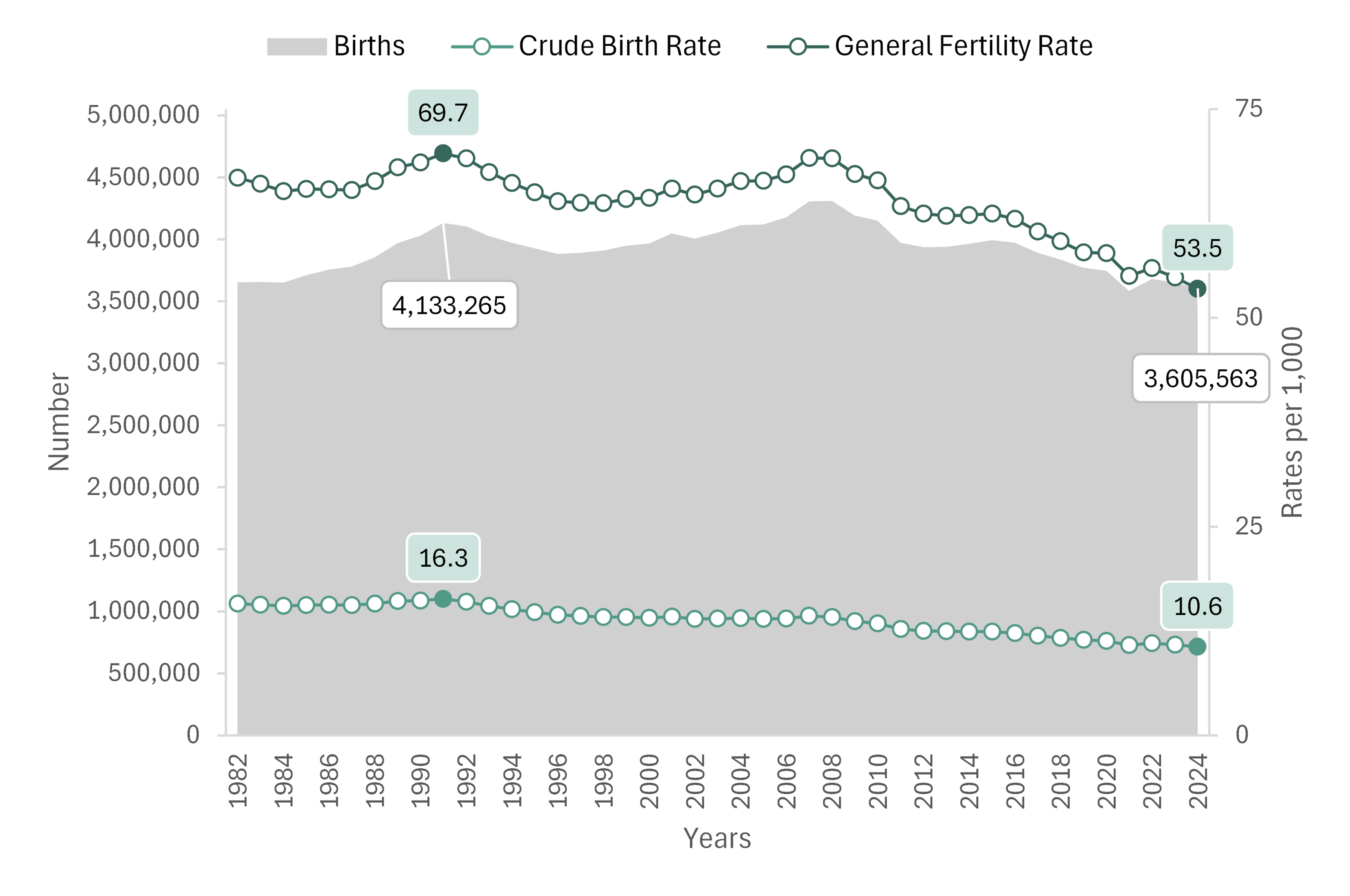
- National fertility rates peaked in the early 1990s, with both the crude birth rate and general fertility rate reaching their highest levels in 1991.
- Rates again rose in the mid-2000s, immediately preceding the Great Recession, before entering a prolonged decline.
- By 2024, both rates reached their lowest levels observed during the period.
- The number of births peaked in 2008 and declined sharply during the COVID-19 pandemic, with 2021 marking the lowest number of births on record; births in 2023 and 2024 also ranked among the lowest observed since 1981.
Figure 1. National Trends in the Number of Births, Crude Birth Rates, and General Fertility Rate, United States, 1982-2024
State-level Trends in the General Fertility Rate
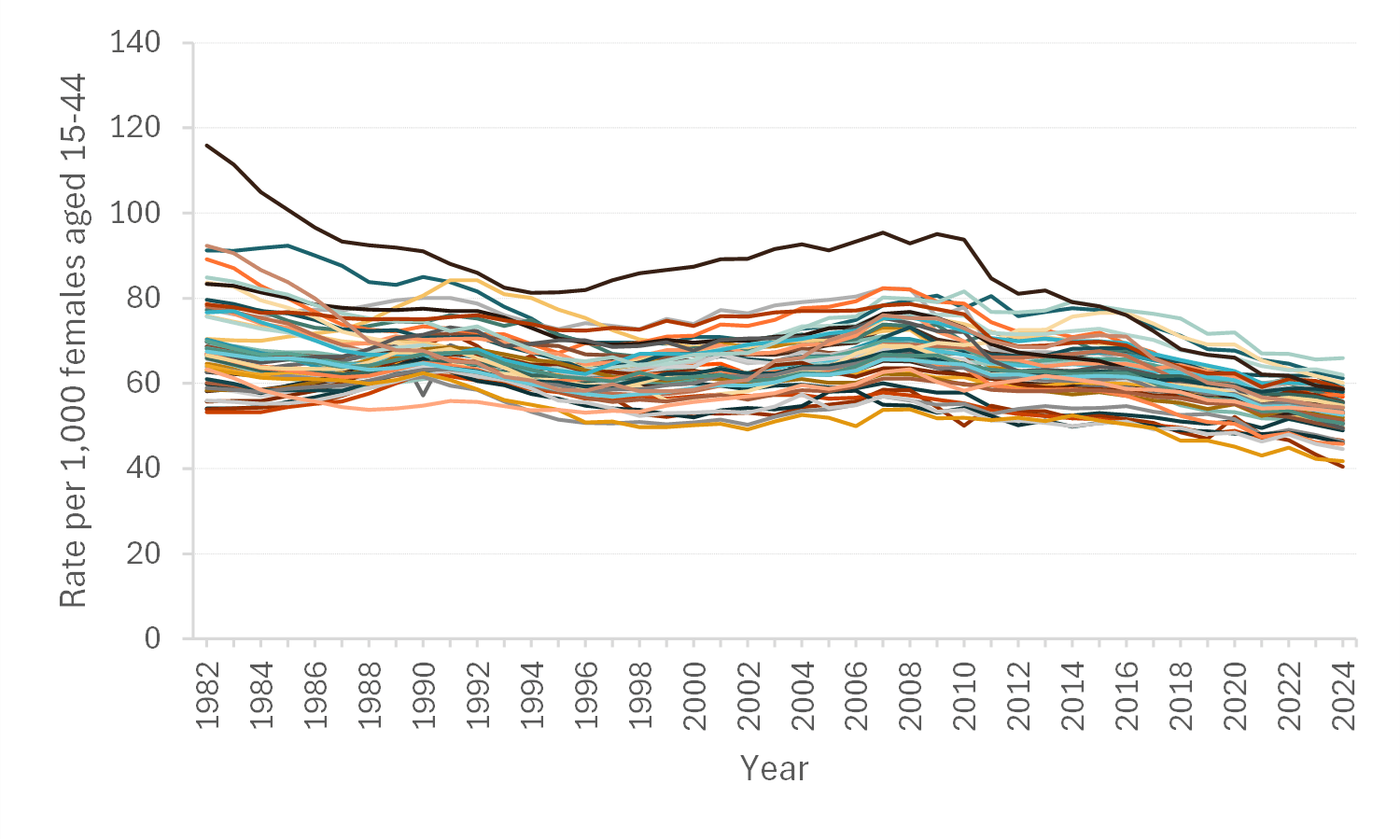
- Despite differences in level, states follow a largely shared trajectory in the general fertility rate over time, with increases in the mid-2000s followed by sustained declines in the 2010s and the early 2020s.
- Variation in the general fertility rate across states narrows over time, with state values becoming more tightly clustered in the later years of the period.
Figure 2. State-level Trends in the General Fertility Rate, United States, 1982-2024
State-level Variation in General Fertility Rate Quartiles Over Time
Figure 3. State-level General Fertility Rate Quartiles, United States, 1982-2024
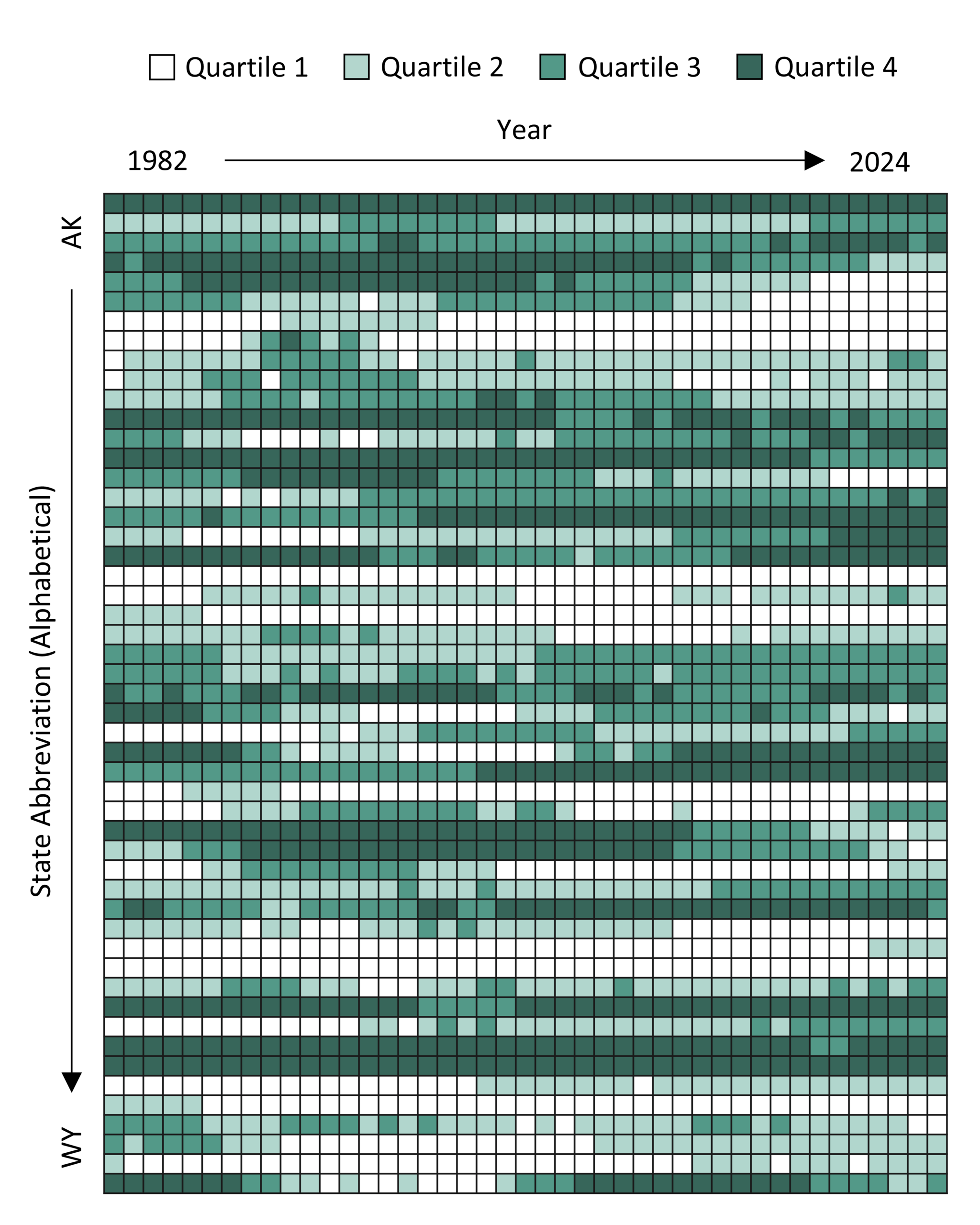
Figure 3 displays state-level general fertility rate quartiles from 1982 to 2024, with states ordered alphabetically by row and years shown sequentially by column, illustrating states' relative fertility positions over time.
- States vary substantially in the stability of their fertility quartile membership over time. Many states remained in the same fertility quartile for extended periods, indicating stable relative positions within the annual national distribution, while others moved more frequently across quartile boundaries.
- Four states remained in the same quartile throughout the period. Utah and Alaska consistently occupied the fourth quartile, while Massachusetts and Rhode Island consistently occupied the first quartile.
- Other states experienced frequent quartile transitions. Mississippi and Wyoming exhibited 15 or more quartile changes, although the pattern of movement differed: Mississippi moved between the top two quartiles, whereas Wyoming occupied all four quartiles over time.
- In total, eleven states occupied all four quartiles between 1982 and 2024[1] highlighting substantial variation in relative fertility ranking for a subset of states.
[1] The eleven states that occupied all four fertility quartiles during the period are California, the District of Columbia, Iowa, Illinois, Indiana, Kentucky, Montana, North Dakota, New Mexico, Nevada, and Wyoming.
County-level Spatial Variation in General Fertility Rate Quartiles
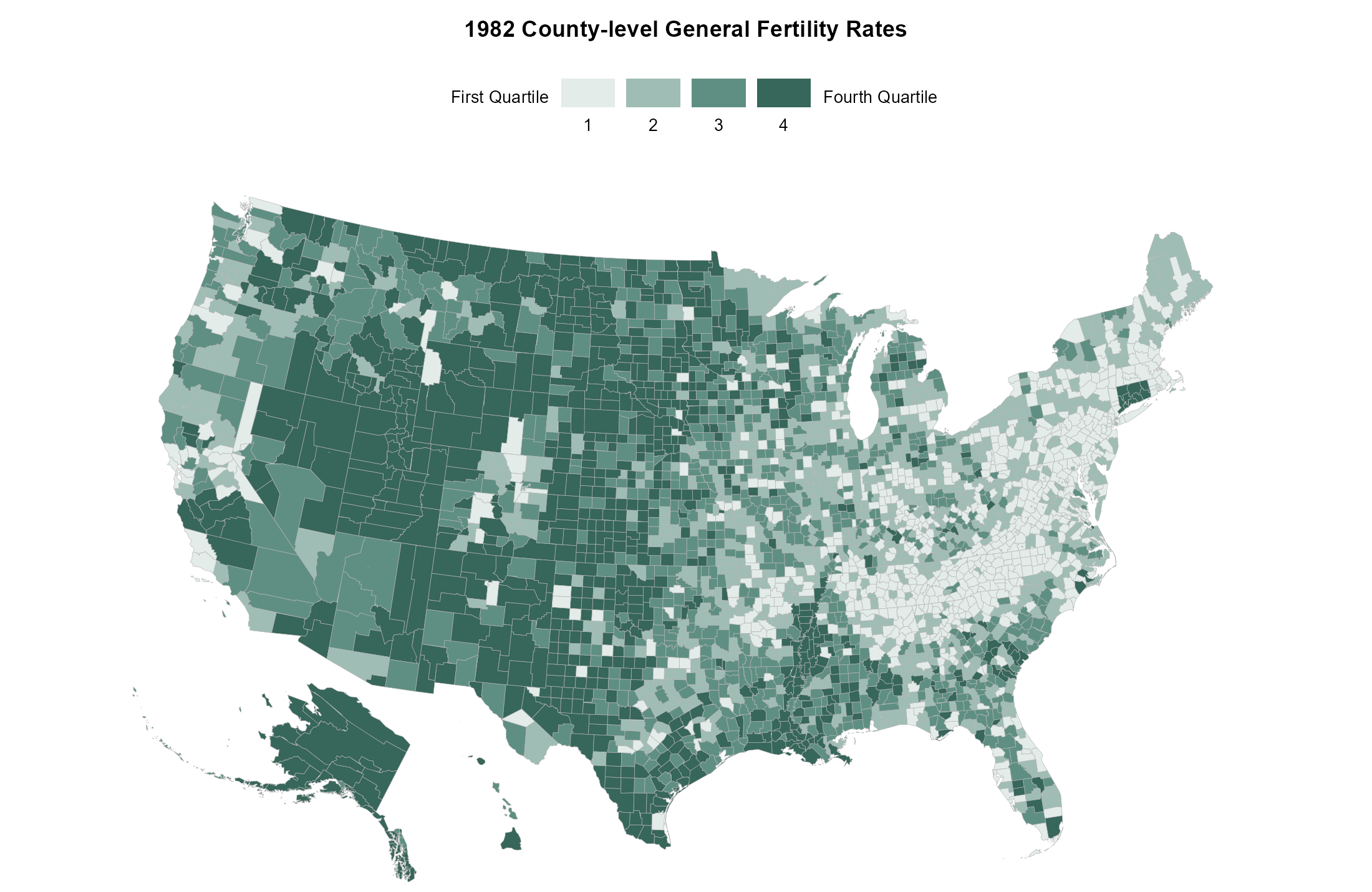
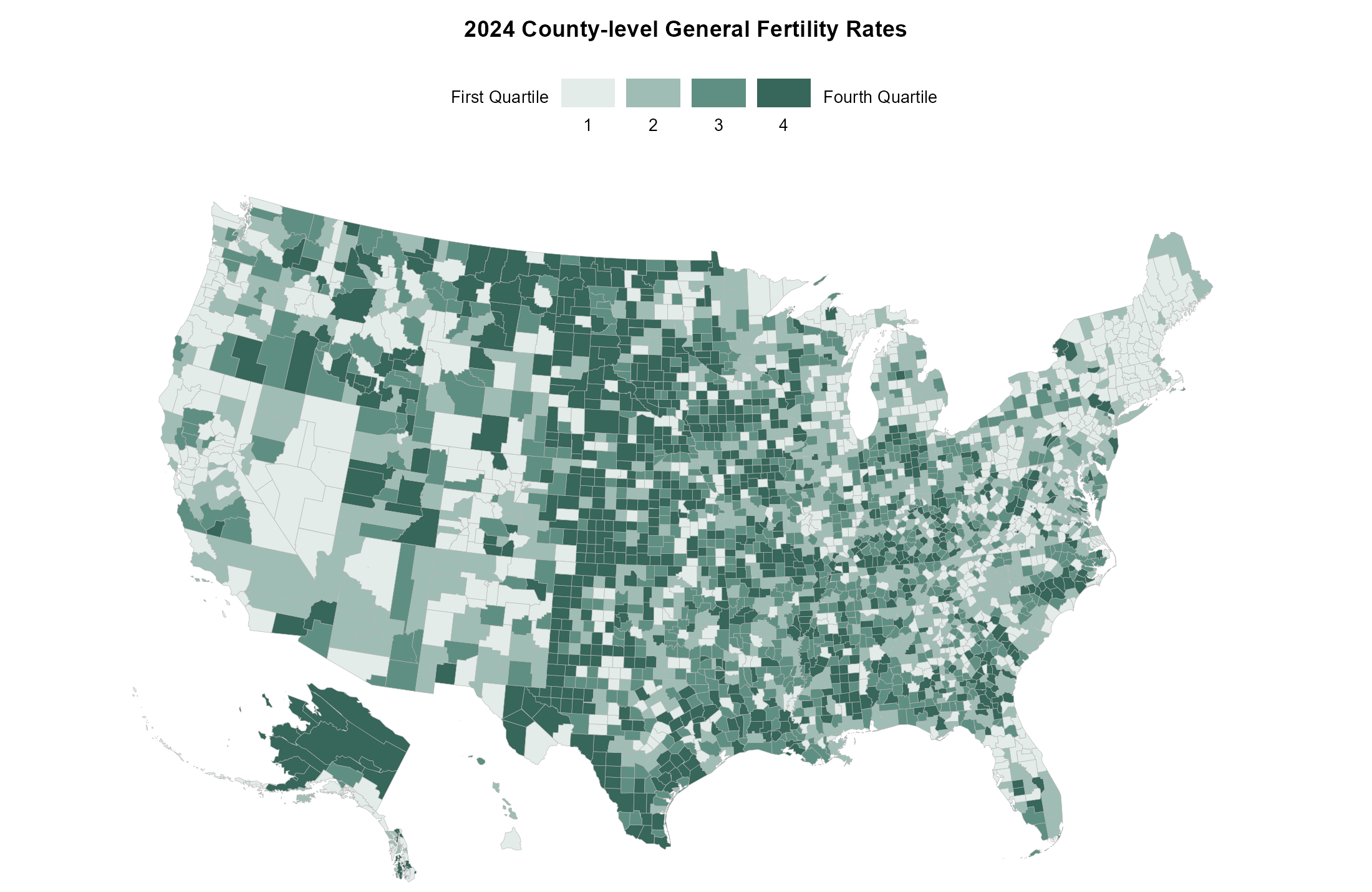
Figure 4 displays county-level general fertility rate quartiles in 1982 and 2024, with counties classified into quartiles based on the national distribution of county rates in each respective year.
- County-level fertility rates showed substantial spatial variation in both 1982 and 2024, indicating considerable geographic heterogeneity at the county level.
- The geographic patterning of higher-fertility counties differed between 1982 and 2024. In 1982, counties in higher fertility quartiles were more heavily clustered across much of the western United States, forming large contiguous areas of relatively high fertility. By 2024, higher-quartile counties appeared more diffusely distributed, with clustering extending across parts of the central United States.
- Within-state variation remained evident in both years but became more pronounced over time. In 1982, 32 states had counties represented in all four fertility quartiles; by 2024, this number had risen to 41 states.
- Taken together with Figure 2, these figures indicate that while state-level fertility rates converged over time, within-state variation increased, with counties increasingly spanning a wide range of relative fertility positions.
Figure 4. County-Level General Fertility Rate Quartiles, United States, 1982 and 2024
Source: NCFMR analysis of NCFMR County-, State-, and National-Level Birth Counts and Fertility Rates, 1982–2024

Data Sources:
National Center for Family & Marriage Research (2026). County-, state-, and national-level birth counts and fertility rates, United States, 1982–2024 (Version 1.0) [Dataset]. Marriage, Divorce, & Birth Data Compass. Bowling Green State University. Retrieved from https://www.bgsu.edu/ncfmr/resources/data/original-data/county-level-birth-data-1982-2024
Suggested Citation:
Westrick-Payne, K. K. (2026). The crude birth and general fertility rate: Geographic variation, 1981-2024. Family Profiles, FP-26-02. Bowling Green, OH: National Center for Family & Marriage Research. https://doi.org/10.25035/ncfmr/fp-26-02
Updated: 07/08/2026 07:39PM