
Refined Marriage Rate Trends by Age Groups, 2010 & 2024
Family Profile No. 3, 2026
Authors: Wendy D. Manning & Krista K. Westrick–Payne
Since 2010, the refined marriage rate in the U.S. has remained relatively stable (Westrick-Payne, 2025). Over the same period, cohabitation rates have remained high, reflecting a broader trend among younger adults to postpone marriage and enter first marriages at later ages (Manning & Loo, 2024; Westrick-Payne, 2026). Rather than distinguishing between first and remarriages, this profile focuses on all marriages. Using the latest data from the American Community Survey, we examine the refined marriage rate among males and females and focus on select age groups: 18-29, 30-39, 40-49, 50-59 and 60-69 year olds. This Family Profile extends our report Charting Marriage & Divorce in the U.S.: The Refined Marriage Rate, 2008–2024 by examining recent trends by age group and sex (Westrick–Payne, 2025). The age specific refined marriage rates are computed by dividing the number of marriages to an age group in the last year by the number of unmarried individuals belonging to that age group.
Trends in the Refined Marriage Rate for Males and Females
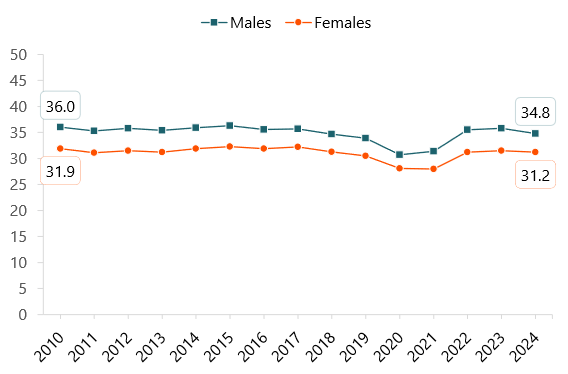
- Since 2010, the refined marriage rate has remained relatively stable for both females and males, with a dip in 2020 and 2021 followed by a rebound. Among females, the rate decreased from 31.9 marriages per 1,000 unmarried women in 2010 to 31.2 in 2024, while among males the rate declined from 36.1 to 34.8 marriages per 1,000 unmarried men over the same period.
- The estimated number of individuals marrying increased from about 2.11 million in 2010 to 2.39 million in 2024 among females and from about 2.14 million in 2010 to 2.44 million among males.
Figure 1. Refined Marriage Rates for Males and Females, 2010-2024
Note. Refined marriage rates are calculated as the number of marriages per 1,000 unmarried individuals aged 15 and older. Estimates may reflect minor changes over time in ACS editing procedures and questionnaire response categories, which may affect the measurement of recent marriage.
Refined Marriage Rate by Age for Males and Females
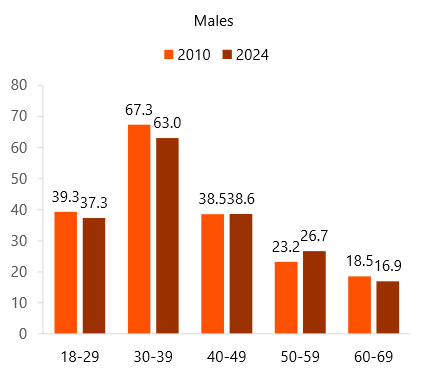
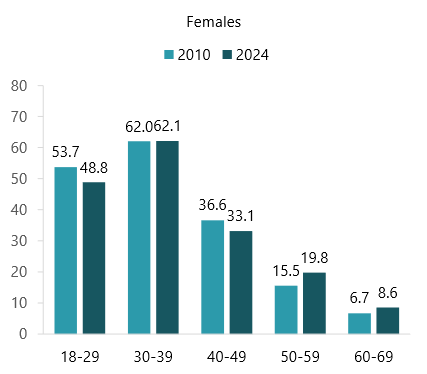
The overall age pattern remained largely consistent over time for both males and females. Marriage rates peaked among those aged 30–39, and then declined at older ages. In the youngest age group, the marriage rates for females were higher than for males, at ages 30-49 the marriage rates were similar for males and females, and at older ages, the rates diverged, with males aged 50 and older marrying at higher rates than females.
- The largest change in marriage rates occurred among females aged 18–29. Their marriage rate declined from 53.7 in 2010 to 48.8 in 2024. Despite the change in the marriage rate, the number of marriages among females in this age group was similar in both years (1.11 million in 2010 and 1.10 million in 2024), and represent about half of all marriages to females (53% in 2010 and 46% in 2024) (not shown).
- The highest marriage rates occurred among those aged 30–39. In 2024, the rate was 62.1 marriages per 1,000 unmarried females and 63.0 per 1,000 unmarried males. Between 2010 and 2024, marriage rates for this age group declined slightly for males and remained relatively stable for females.
- The only age groups to experience increases in marriage rates from 2010 to 2024 were older Americans, with increases among males and females ages 50-59 and among females ages 60-69.
- Marriage rates were lowest among those aged 60–69, in 2024 there were 8.6 marriages per 1,000 unmarried females and 16.9 per 1,000 unmarried males.
Figure 2. Marriage Rates for Males and Females 18 and Older by Age, 2010 & 2024
Source: NCFMR Analysis of American Community Survey, 1-year estimates, 2010 & 2024 (IPUMS-USA).
Note. Refined marriage rates are calculated as the number of marriages per 1,000 unmarried individuals aged 15 and older. Estimates may reflect minor changes over time in ACS editing procedures and questionnaire response categories, which may affect the measurement of recent marriage.

Data Sources:
Ruggles, S., Flood, S., Sobek, M., Backman, D., Cooper, G., Rivera Drew, J. A., Richards, S., Rodgers, R., Schroeder, J., & Williams, K. C. W. (2025). IPUMS USA: Version 16.0 [Dataset]. Minneapolis, MN: IPUMS. https://doi.org/10.18128/D010.V16.0
References:
Manning W. D. & Loo, J. (2024). A decade of change in cohabitation across age groups: 2012 & 2022. Family Profiles, FP-24-03. Bowling Green, OH: National Center for Family & Marriage Research. https://doi.org/10.25035/ncfmr/fp-24-03
Westrick-Payne, K. K. (2025). Charting marriage & divorce in the U.S.: The refined marriage rate, 2008-2024. Bowling Green, OH: National Center for Family & Marriage Research. https://www.bgsu.edu/content/dam/BGSU/college-of-arts-and-sciences/NCFMR/documents/RBT/chart-mar-div-2024-mar-ud-2025-09-19-kkp.pdf
Westrick-Payne, K. K. (2026). Median age at first marriage: Geographic variation, 2024. Family Profiles, FP-26-01. Bowling Green, OH: National Center for Family & Marriage Research. https://doi.org/10.25035/ncfmr/fp-26-01
Suggested Citation:
Manning, W. D. & Westrick-Payne, K. K. (2026). Refined marriage rate trends by age groups, 2010 & 2024. Family Profiles, FP-26-03. Bowling Green, OH: National Center for Family & Marriage Research. https://doi.org/10.25035/ncfmr/fp-26-03
Updated: 07/08/2026 07:39PM