
Aviation Studies Accreditation Data
 | BOWLING GREEN STATE UNIVERSITY
Bowling Green, Ohio |
| College of Engineering and Innovation | |
| School of Aviation – Aviation Studies Program | |
| OCTOBER 2025 | STUDENT ACHIEVEMENT DATA |
AABI Criterion 3.2.4 Public Information. Each AABI-accredited aviation program MUST provide reliable information to the public on student success in the program, at least annually. The following Student Achievement Data MUST appear in easily accessible locations including public program websites:
- The Program Educational Goals of each accredited program, as publicly published, and how these Program Educational Goals are assessed by the program.
- Student retention and graduation rates, including the number of degrees produced each year, the percentage of students enrolled one year after starting the program, and the percentage of bachelor’s students graduating within 6 years.
- The employment rate and types of employment (aviation, aviation-related or other positions) of fulltime graduates within 1 year of graduation.
- Other STUDENT ACHIEVEMENT DATA, as determined by the program.
BGSU Aviation Studies Program consists of two concentration areas. They are Aviation Management and Operations (AMO) and Flight Technology and Operations (FTO). The Program Educational Goals and employment information for these two concentrations are presented below.
AMO Program Educational Goals*
- Program Educational Goal 1: Create competent, skillful aviation professionals and leaders who can solve managerial and operational problems within the aviation industry
- Program Educational Goal 2: Develop a solid foundation of aviation management, operational risk management, organizational behavior, and safety professionalism in the aviation industry.
- Program Educational Goal 3: Impart professional, business, and ethical responsibility in the global aviation environment.
FTO Program Educational Goals*
- Program Educational Goal 1: Create competent, skillful professional pilots and flight department leaders who can solve flight operations problems within the aviation industry.
- Program Educational Goal 2: Develop crew resource management, operational risk management, and safety professionalism skills in students for their careers in the aviation industry.
- Program Educational Goal 3: Impart professional, business, and ethical responsibility in the global aviation environment.
Responsibility
On the first and third Tuesday of each month during the academic year, the leadership and faculty of the Aviation Studies (AVS) program conduct a meeting called the AVS and ABBI Assessments meeting. This meeting is facilitated by the Aviation Program Director (APD) and is attended by the Aviation Program Coordinator, all Aviation full-time and adjunct faculty, the leadership of the Bowling Green Flight Center (BGFC), and two student academic advisors. In this meeting, the faculty and staff work together on determining all course mapping and assessments in accordance with AABI General and Core requirements. At the conclusion of each semester, the Director and faculty members collect data for each applicable course and complete the course assessments forms to measure the results. Action Items are assigned to individual members for completion and meeting minutes are created to document shortcomings and make changes as appropriate. In addition, the Director shall remain apprised of the latest AABI requirements. Program changes are then presented to our Aviation Industry Advisory Board for their feedback.
Each Aviation faculty member is responsible for assessing their individual courses to ensure that course objectives are being met and that course outcomes evaluate the stated course objectives. The program faculty and leadership are involved in the assessment process throughout the semester in the scheduled faculty/program meetings that occur twice per month.
Timeline
The Aviation program has a Master Plan for program assessment, where we have selected specified courses that are evaluated in a three-year cycle. Each year, select courses are evaluated every Fall and Spring semester. These course assessments are used as evidence to evaluate the program level outcomes for both Flight Training and Operations (FTO) and Aviation Management and Operations (AMO).
In addition to individual course assessments, other evidence such as alumni/graduate surveys, Airman Knowledge Test scores, final course grades, student GPAs, FAA practical test results, team projects, class attendance, research papers, writing assignments and oral presentation assignments are used to provide evidence of achievement of program outcomes. These items are evaluated to assess program outcomes achievement. AVS leadership and faculty selected 90% as an overall standard of successful achievement, based on student performance of selected course criteria (exams, projects, etc.) used to assess outcomes.
Continuous Improvement
The continuous improvement process for the Aviation Studies program involves assessing the degree of attainment of the student outcomes: evaluating the assessment results; identifying improvement needs and opportunities; and implementing the indicated program improvements. Coordination and leadership for this process is assigned to the Aviation Studies Curriculum and Assessment committee. Reports and recommended action by this committee are reviewed and must be approved by the entire faculty.
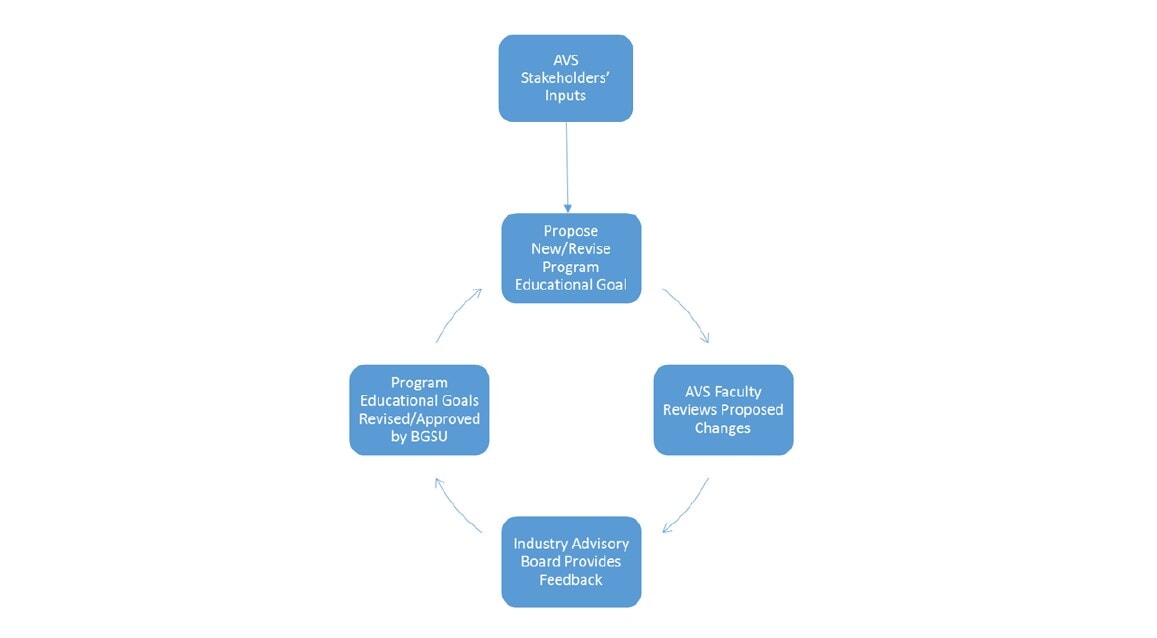
For instance, if an assessed course area does not meet the 90% achievement standard, the AVS faculty and leadership meet to determine appropriate changes to be made in each course to ensure continuous improvement. The faculty member responsible for the course will develop specific action items to improve outcomes. The next time the course is taught, or a program-level review is conducted, the results of actions are evaluated, follow-up with the implementation of action items, and close the loop. Figure 1 explains the revision process of AVS program educational goals.
Institution-wide Assessment Culture
BGSU has an institutional assessment plan focusing on continuous improvement; whereas the Student Achievement Assessment Committee (SAAC) is a university level assessment committee that monitors program assessment plans that support the accreditation and program review process. SAAC is a comprehensive committee composed of A-Deans and faculty from all colleges, assessment staff, and Student Affairs staff. All departments complete an assessment plan and report for their program learning outcomes aligning with their accreditation or program review cycle. The SAAC assessment plans/reports contain the program learning outcomes, information about the approval and communication of the students’ learning outcomes, and a multi-year learning outcome assessment plan, with corresponding rational and schedule. Each department submits either a SAAC short-form or a SAAC long-form annually depending upon their reporting cycle. The purpose of the short-form assessment report is to identify and describe the programmatic Learning Outcomes (LO) that were assessed this academic year and how the results are being applied to improve programs. The goal of the long-form assessment report is to describe the assessments completed during past academic years and how the results are being applied to improve programs. The assessment reports are reviewed by SAAC with a rubric to evaluate the LOs assessed, methods and procedures, expectations for student achievement, results and conclusions, and actions taken. The SAAC reports and feedback are then used by program faculty for strategic planning, the submission of future SAAC reports, and accreditation or program review. The main goal of assessment or “assurance of learning” is to improve the effectiveness of BGSU academic and co-curricular programming.
To support the assessment plan process, the program learning outcomes are embedded within the Canvas learning management system. With the program learning outcomes embedded within Canvas, faculty can document learning outcomes data, and the program can track their student learning. Faculty can monitor how students are doing on each outcome though this process to make pedagogical, course, and programmatic improvements and the department can review the data holistically to inform programmatic decisions. As part of SAAC assessment, each program must go through a yearly assessment cycle. Short-form assessment and Long-form assessment are done in alternate years. AVS program assesses student learning outcomes every year using a short form or a long form as part of the SAAC requirement.
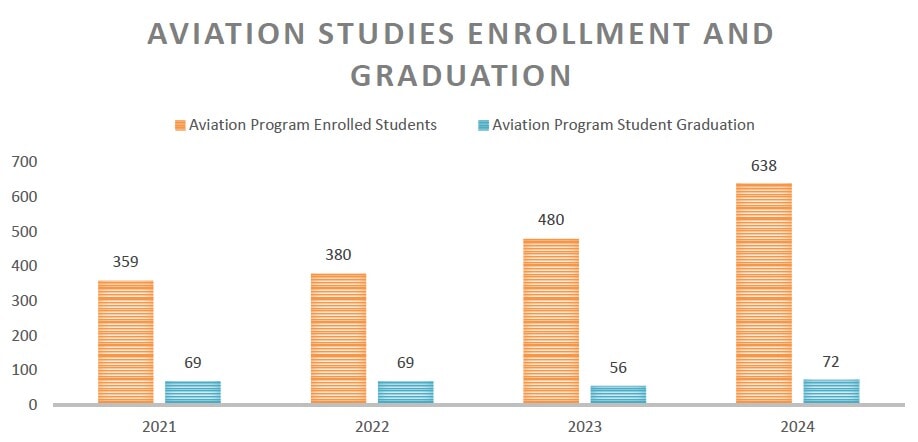
Aviation Studies Enrollment and Graduation Data
| Fall 2025 | Fall 2024 | Fall 2023 | Fall 2022 | Fall 2021 | |
| FTO Admitted | 193* | 799 | 623 | 389 | 285 |
| AMO Admitted | 728* | 75 | 75 | 50 | 43 |
| Aviation Studies 4-year graduation headcount | |||
|---|---|---|---|
| AMO | FTO | TOTAL | |
| Fall 2021 | 9 | 18 | 27 |
| Spring 2022 | 14 | 14 | 58 |
| Summer 2022 | 4 | 19 | 23 |
| Fall 2022 | 2 | 16 | 18 |
| Spring 2023 | 7 | 21 | 28 |
| Summer 2023 | 1 | 7 | 8 |
| Fall 2023 | 3 | 18 | 21 |
| Spring 2024 | 10 | 20 | 30 |
| Summer 2024 | 5 | 14 | 19 |
| Fall 2024 | 3 | 10 | 13 |
| Spring 2025 | 6 | 23 | 29 |
| TOTAL | 64 | 180 | 244 |
Rates and Types of Employment of Graduates
Over the past four academic years (2021-22, 2022-23, 2023-24, 2024-25) the program has produced 244 Aviation Studies graduates. See Table 1 for the rates and type of employment of Aviation graduates. Of note, only 110 AVS graduates responded with their employment information in our graduate survey. This response rate is very similar to the overall response rate of BGSU graduates.
Table 1
| Rates and Type of Employment | |
| Position | Number |
| Military | 12 |
| Airline pilot | 7 |
| Flight Instructor | 39 |
| Aviation Operations | 22 |
| Airline Operations | 8 |
| FBO Manager | 3 |
| Non-aviation field/other | 7 |
| Graduate Education | 5 |
| Further Flight Training | 13 |
| Air Traffic Control | 1 |
Graduates of the Aviation Management and Operations (AMO) and Flight Technology and Operations (FTO) specializations at BGSU have found employment in many various aspects in the aviation industry. Our graduates have found employment with the following employer’s.
- Bowling Green Flight Center
- NetJets
- FlexJet
- Textron Aviation
- Houston Hobby Airport
- Findlay Airport
- Tampa International Airport
- Premier Aviation
- Toledo Port Authority
- ERA Aviation
- Signature Flight Support
- LSG Group
- Republic Airways
- Allegiant Airlines
- Jet Blue
- Express Jet
- Flight Safety International
- United Parcel Service (UPS)
- Southwest Airlines
- PSA Airlines
- GoJet Airlines
- Envoy
- Spirit Airlines
- Guardian Jet
- Endeavor Air
- Federal Aviation Administration
- American Airlines
- United Airlines
- SkyWest Airlines
- Frontier Airlines
- FedEx Express
- Delta
- United States Air Force
- Department of the Navy
- United States Army
- United States Marine Corps
- United States Coast Guard
- Owens Corning
- Marathon Petroleum
- Horizon Airlines
- Toledo Jet Center
- Grand Aire
- National Flight Services
Updated: 10/23/2025 01:43PM