
Faculty Scholar Series
Faculty Scholar Series
October 7, 2026
Bryan Recital Hall, 8 pm
Program
Katherine Meizel, ethnomusicology
Title: A New Resource on Disability and Accessibility in the Voice Studio
Abstract:
Since originating as a discipline in the 19th century, modern voice pedagogy has maintained its foundational grounding in medical and scientific research. Because of these roots and the institutional ableism that excludes many disabled singers from pre-professional study and professional work, there is almost no relevant literature examining voice pedagogy from the perspectives of disability advocacy and disability studies. But these frameworks, focusing on the lived experiences of those with disabilities—who are the experts—are essential for all studio voice teachers as they work toward the removal of access barriers in vocal music. To address this lacuna, and with the financial support of Open Educational Resources, my colleagues and I have created an accessible, multimedia open access educational resource that will be available in Fall 2026. This collection centers writing and videos from disabled singers and voice instructors, as well as related research from other contributors, all sharing experiences and suggestions toward making the singing world more accessible.
-----------------------------------------------
Per Broman, music theory
Title: AI as a Pedagogical Provocation: Generating “Good” and “Bad” Analytical Examples Through Rule-Based Composition
Abstract:
The surge of user‑friendly generative‑AI tools has entered the music‑theory classroom, shaking up how we teach and assess (though the impact is not as dramatic as in subjects like literature or computer science). The problem is not new: a new gadget lets students finish familiar assignments faster and with less effort. What worries me more than cheating or outright automation is how AI flips the notion of “getting the right answer.” When an exercise is primarily designed to test whether a student can follow a checklist and hand in a technically correct result, AI simply highlights an existing weakness—the task may be measuring obedience more than musical judgment.
In this paper I ask what happens if we stop treating AI as a rival that spits out the “correct” solution and instead view it as a provocateur that throws ideas at us. A system that pretends to have interpretive authority is risky because it can hallucinate or mistake a label for insight. By contrast, a system that generates example material provides concrete artifacts that students can examine, critique, and learn from.
For this project I combine rule‑based composition with AI‑assisted coding to produce short, symbolic musical snippets grounded in explicit theoretical frameworks. My pilot case is Paul Hindemith’s exercise‑driven pedagogy from The Craft of Musical Composition. I focus on the workbook’s rules for one‑voice melodic writing and two‑voice counterpoint: range limits, closure, directional changes, repetition, sequences, skips, and the placement of the climax. The resulting material shows that following the right procedure does not guarantee understanding, exposing both the strengths and limits of the rules and demonstrating that a classroom task ends too soon when the answer is technically correct. It also enables richer pedagogy: students not only apply the methods, but also question them, identify and understand errors, and create examples that sound musically convincing.
BIOGRAPHIES
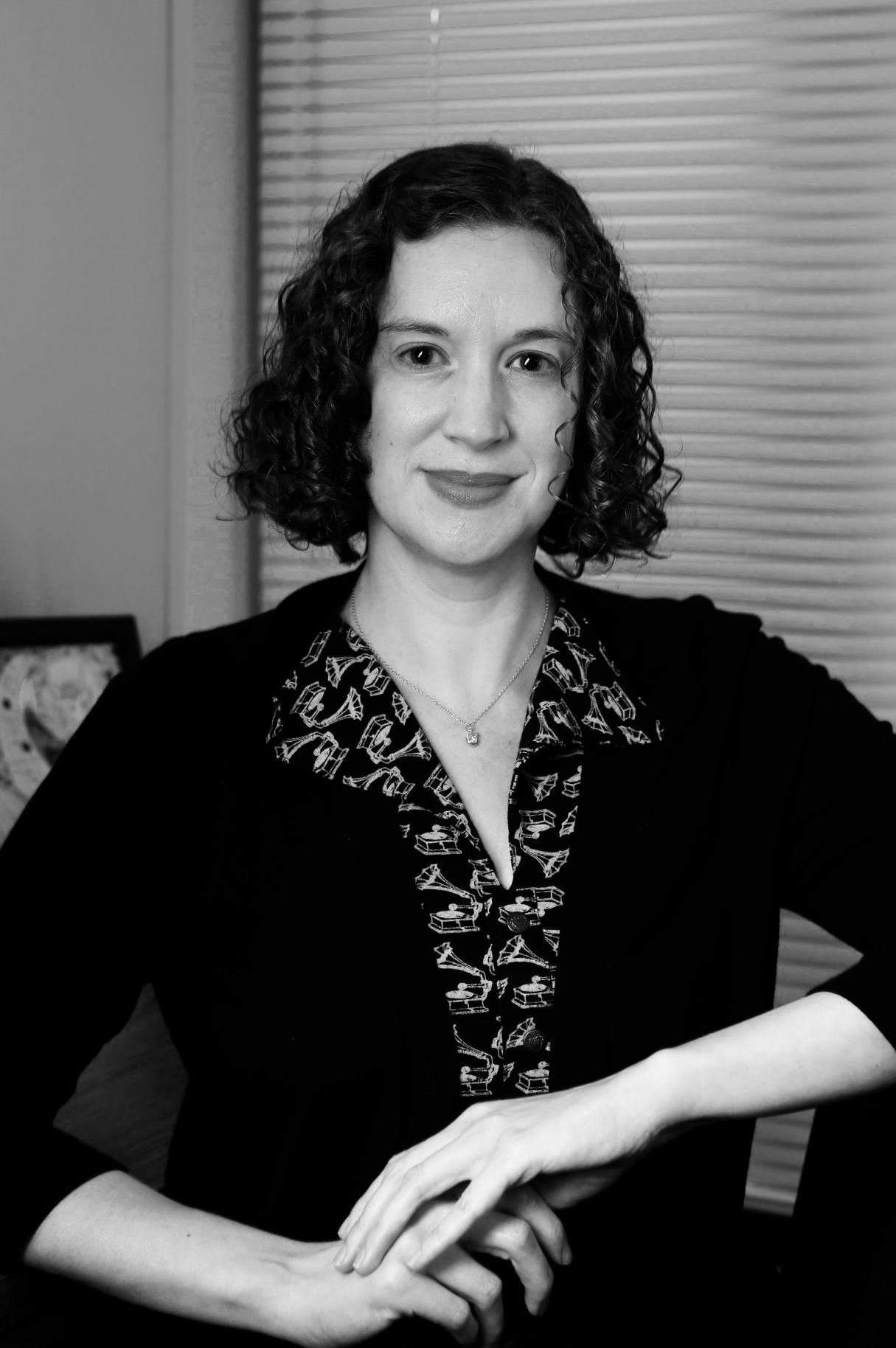
Katherine Meizel earned her Ph.D. in ethnomusicology at the University of California, Santa Barbara, and also holds D.M.A., M.M., and bachelor’s degrees in vocal performance. Her research has focused on voices and vocalities, and topics including popular music and media, religion, identity, and disability studies. Her book Multivocality: Singing on the Borders of Identity was published in 2020 by Oxford University Press. She was co-editor of the Oxford Handbook of Voice Studies (2019), and her first book, Idolized: Music, Media, and Identity in American Idol, was published by Indiana University Press in early 2011. Other academic publications have appeared in Popular Music and Society, The Grove Dictionary of American Music, MUSICultures, The Voice and Speech Review, the Journal for the Scientific Study of Religion, eHumanista, and multiple edited collections. She has had an additional focus on public scholarship, and co-produced the album Raise Your Voice: The Sound of Student Protest with Little Village Foundation in 2018, to showcase the music of high school and college students during protests against gun violence. She has also written for outlets such as NPR. com, TheConversation.com, and about American Idol for Slate.com from 2007 to 2011. At BGSU, Dr. Meizel teaches undergraduate courses in world musics, musics of the Americas, global pop, and music theory for musical theater, and graduate seminars in ethnomusicology research methods, critical voice studies, and music and disability studies. She also leads an Old Time String Band ensemble.

Professor of Music Theory, Per F. Broman holds degrees in violin, musicology, and music theory from Ingesund College of Music, The Royal College of Music in Stockholm, McGill University in Montreal, and a Ph.D. from the University of Gothenburg. He has presented papers at conferences of the American Musicological Society, the American Society for Aesthetics, Canadian University Music Society, College Music Society, International Association for the Study of Popular Music (U.S.), International Musicological Society, Music and the Moving Image, Royal Musical Association, Society for Music Theory, the Nordic Musicological Congress, The 9th European Music Analysis Conference, and the Swedish Musicological Society. Broman is the author of Back to the Future: Towards an Aesthetic Theory of Bengt Hambraeus (University of Gothenburg, 1999), the chapter “New Music of Sweden” for New Music of the Nordic Countries (Pendragon Press, 2002), the monographs Sven-David Sandström (Atlantis, 2012) and Karin Rehnqvist (Gidlunds, 2018) is the co-editor of What Kind of Theory Is Music Theory? (Stockholm University Press, 2008) and Crosscurrents and Counterpoints: Offerings in Honor of Bengt Hambræus at 70 (University of Gothenburg, 1998). He has contributed articles to a number of Swedish periodicals, journals, and newspapers, as well as Journal of Music Theory Pedagogy, Perspectives of New Music, New Grove Dictionary of Music and Musicians, Journal of Popular Music Studies, College Music Symposium, Woody Allen and Philosophy (Open Court, 2004) and The Ultimate South Park and Philosophy (Blackwell, 2013), along with numerous liner notes for the BIS and Deutsche Grammophon labels and was the founding editor of the internet journal STM-Online. Prior to BGSU, he served on the faculties of the Swedish Conservatory (Jakobstad, Finland), the University College of Music Education (Stockholm), Örebro University, Luleå University of Technology (Sweden), and Butler University in Indianapolis. He also serves as a National Association of Schools of Music (NASM) accreditation visitor. Most recently, he finished a chapter on Ingmar Bergman for the volume Ingmar Bergman: A Enduring Legacy, one article on Woody Allen for BACH: Journal of the Riemenschneider Bach Institute, the second edition of his Sven-David Sandström biography, and a chapter for The Last of Us and Philosophy.
Updated: 09/30/2026 08:27PM