
Student Teaching Semester
Introduction
The Capstone experience for the aspiring teacher is student teaching. Student teaching for most programs will be scheduled for the semester immediately following the methods block semester. In most cases, pre-service teachers will have the same placement for student teaching as they had for the methods experience; however, some program areas may make assignments based on their requirements. This section of the Professional Year Handbook provides basic guidelines for the student teaching experience.
Student Teaching Objectives
Ohio Standards for the Teaching Profession
- Students: Teachers understand student learning and development and respect the diversity of the students they teach.
- Content: Teachers know and understand the content area for which they have instructional responsibility.
- Assessment: Teachers understand and use varied assessments to inform instruction, evaluate, and ensure student learning.
- Instruction: Teachers plan and deliver effective instruction that advances the learning of each individual student.
- Learning Environment: Teachers create learning environments that promote high levels of learning and achievement for all students.
- Collaboration & Communication: Teachers collaborate and communicate with students, parents, other educators, administrators and the community to support student learning.
- Professional Responsibility & Growth: Teachers assume responsibility for professional growth, performance and involvement as an individual and as a member of a learning community.
Student Teaching Objectives
The plan for student teaching is based on the belief that the understandings, attitudes, and skills that are desired for the teacher candidate can be developed most effectively when there is opportunity for the teacher candidate to feel a part of a Community of Inclusion Collaboration and Respect.
College of Education and Human Development Conceptual Framework
EDHD’s faculty and staff engaged in conversations about the ideas and principles that we share across our various roles and fields of studies. We asked, “What does, or should, the EDHD Experience mean?" In responding to that question, we developed the EDHD Conceptual Framework:
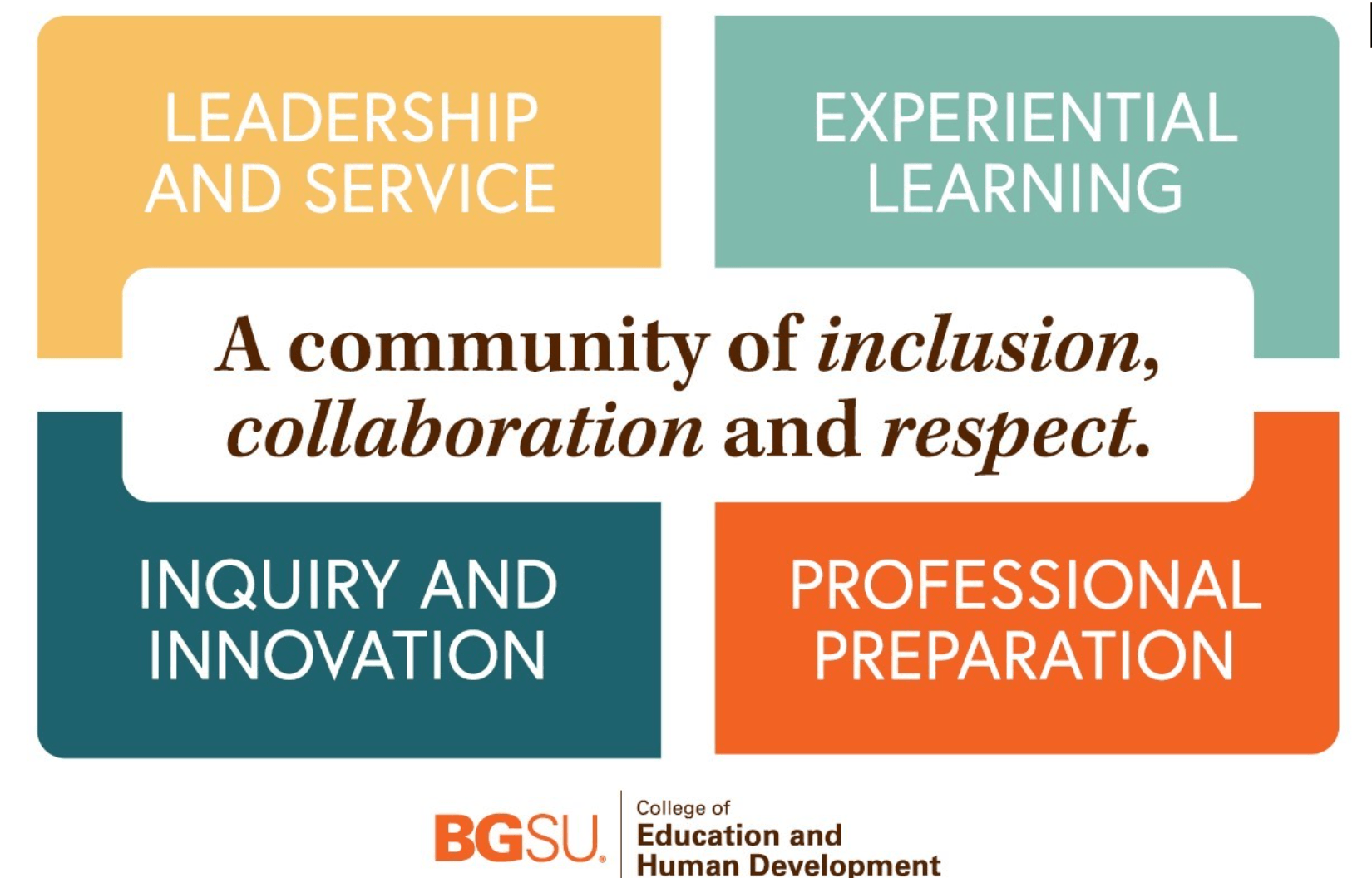
A Community of Inclusion, Collaboration, and Respect
Learn across differences by promoting equitable and inclusive practices
Leadership and Service
Develop capacities to lead and serve professions and communities
Integrative and Experiential Learning
Engage through practice and reflection
Inquiry and Innovation
Integrate theory and practice to generate knowledge and promote public good
Professional Preparation
Commit to meaningful personal and professional lives
While all of the principles are important, nothing else is possible if we are not part of a community of inclusion, collaboration, and respect. Consequently, we ask everyone who works in the College to commit to doing something that contributes to our community. As Helen Keller once said, “Alone we can do so little; together we can do so much.”
Student Teaching Internship
The student teaching internship portion of the professional year is an exciting and challenging capstone to the undergraduate major in one of our teacher education programs. There are several common expectations for all of our programs and these expectations are made clear here. There may also be program specific expectations that will be shared by program coordinators.
Attendance Policy:
The School of Inclusive Teacher Education faculty and staff expect you to be prepared and present daily during your professional year, and our accrediting body expects that we monitor that to ensure adequate time in a supervised internship. Plan to be at your placement every day that your Classroom Mentor Teacher is required to report to work.
During the 8-week methods semester, students will be expected to make up missed days during finals week. During the 15-week student teaching semester, students will be expected to make up any days beyond 3 that are missed, regardless of the reason. In both methods and student teaching semesters, you will be notified by the field office if you have reached your 3rd absence.
We recognize that weather can be uncertain in our area. To assist you in planning for missed days due to weather, you will be notified no later than the 8th week of the semester if there are any days you will need to make up during finals week due to weather. This is VERY rare.
Next, to assist in supporting your professional development, you may apply in advance via email, to your Classroom Mentor Teacher, University Mentor AND Program Coordinator to attend 1 day of Professional Development (attend a PD, conference, job interview, or other professional activity). This does not include the allowable absence for the Teacher Job Fair.
Additionally, the TC may serve in a "substitute teacher" role only under the very specific guidelines provided HERE. These guidelines are in place to ensure consistent supervision and feedback for your continuous growth as an educator. You will record those days in your attendance log as SUB.
For your Professional Year, log your attendance and view observations, etc here: edhd.bgsu.edu/m
Dates of Attendance/Spring Break:
For the Internship semester, teacher candidates (TC) will follow the school district calendar. This means that all vacation days the school is closed, the TC will not be in attendance. This policy also includes spring break. TC will take only the days designated by the school district for spring break. Students will not follow the BGSU spring break or other vacation day calendar INSIDE the semester of their student teaching.
Required Lesson Plans:
It is the expectation of the College of Education and Human Development faculty and staff that you will be prepared with an approved lesson every day that you teach. Each program has an approved lesson plan format that must be fully completed and approved by the Cooperating Mentor Teacher (CMT) and/or the University Mentor (UM). The approved templates can be found in the EGADS portal, accessible by UM’s and CMT’s. It is up to the CMT and UM to determine the due dates for these lesson plans to be submitted each week for review.
After the second observation of the student teaching semester, if it is determined by the CMT and UM that a strength of the teacher candidate is in planning, approval may be given to the TC to use the modified lesson plan template. This template still requires essential planning structures, but reduces the amount of detail for each of the requirements. This template is shared by ALL teacher education programs.
Updated: 11/05/2026 03:47PM